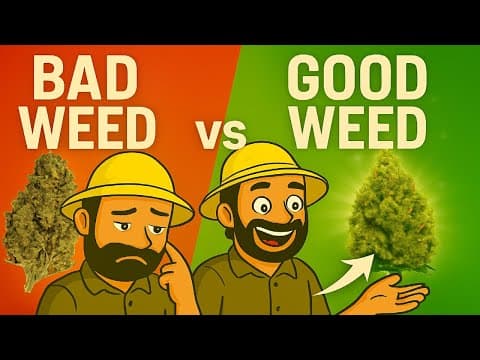
[0:00]Hello, enthusiasts! Welcome back to the channel. Today, we're tackling one of the most important questions in the cannabis world. How do you tell the difference between bad weed and good weed? If you've been partaking long enough, you've probably run into both. Sometimes you open a jar and your senses explode with frosty aromatic buds that scream quality. Other times, you're staring at something that looks like it came out of a lawn mower bag. The difference is huge, and it affects not only your enjoyment, but also your health. So in this video, we're breaking down the four biggest signs that separate good cannabis from the mediocre stuff - the look, the smell, the feel, and the smoke. By the end, you'll have a simple checklist that makes spotting quality second nature. And trust me, once you know these signs, you'll never get fooled again. Chapter One: The Look The very first thing you notice about weed is how it looks. Good cannabis should almost glow. Bright greens, deep purples, fiery orange pistils, and most importantly, have a shimmering frost of trichomes that sparkle under the light. Those trichomes aren't just decoration. They're tiny resin factories that house the plant's cannabinoids and terpenes, which are the compounds that give weed its power and personality. A dense coating of trichomes usually means the grower harvested at the right time and preserved the resin through drying and curing. The bud structure itself also matters. Well-grown cannabis forms tight, compact flowers that show it received proper light, airflow, and nutrients. Bad weed, on the other hand, gives itself away immediately. Dull, brownish or yellow buds are often old, oxidized, or stored poorly. If you see gray or white fuzz, that's mold, a complete no-go. Airy or leafy buds can mean the plant was stressed or underfed during flowering. And if you find seeds or lots of stems, that's a clear downgrade in quality. Even if you didn't know anything else about weed, just looking closely will tell you a lot. If a bud looks lifeless, it almost always smokes lifeless. If it looks vibrant and frosty, chances are you're in for a good time. Chapter Two: The Smell Cannabis is one of the most aromatic plants on earth, and its smell is one of the strongest indicators of quality. Crack open a jar of good weed and the aroma should rush out to greet you, bold and unmistakable. Maybe it's citrusy like lemon peel, sharp like fresh pine, gassy like diesel fuel, or sweet like ripe berries. These scents come from terpenes, which are the volatile oils that not only smell incredible but also shape the effects of each strain. A strong, distinct smell usually means those terpenes were preserved through careful growing and curing. Bad weed tells a completely different story. If your bud smells like hay, grass clippings, or wet cardboard, it wasn't cured properly. The terpenes either evaporated too quickly or were never developed in the first place. Sometimes old weed just loses its aroma over time, leaving behind a bland, stale scent. Even worse, if you detect a sharp ammonia-like smell, it often means the buds were jarred while still wet, leading to bacteria or mold. The smell test is one of the easiest tools for judging cannabis because your nose rarely lies. If it excites you, chances are it's going to smoke well. If it doesn't trigger any reaction, or worse, makes you want to pull away, you're probably holding bad weed. Now that we've covered some background on today's topic, we just wanted to take a moment to thank the sponsor of today's video, the Exhale Homegrown CO2 Company. They offer one of the most practical and reliable ways to introduce natural carbon dioxide into your grow. For over 20 years, Exhale has taken the science of fungal respiration and turned it into a clean, controlled and highly effective solution for indoor gardening. Each bag is thoughtfully designed to meet the needs of real-world growers from small home tents to fully sealed commercial rooms. It's a true plug-and-play system.
[4:16]Just hang the bag above your canopy and the fun guy inside get to work, producing a steady stream of CO2. This is possible because inside each bag is a proprietary substrate that serves as the fungi's food source along with a patented non-fruiting mycelium strain developed specifically for steady, reliable respiration. What really sets Exhale apart is that they were the first to bring the CO2 bag concept to market. While plenty of imitators have followed, none match Exhale's consistency or quality. That's why every product carries the original CO2 bag seal. So when you see that label, you know you're getting proven performance. And here's something special for our October monthly giveaway. Exhale will be providing one cannabis guy channel member with a free Exhale CO2 bag. This model delivers a steady 1300 PPM of CO2 for up to 6 months and is rated for grow spaces up to 4x4 feet or 120 cubic feet. For more information about Exhale and their products, go to the video summary and visit their website at exhaleco2bags.com. While you're there, check out our promo codes from Exhale. It's a great way to save if you're ready to give it a try. Now, let's get back to today's topic. Chapter Three: The Feel Now, let's talk about touch, because how a bud feels in your hand tells another side of the story. Good weed has a perfect balance of stickiness and structure. When you squeeze it, it should have some give, but it shouldn't collapse or feel spongy. The resin from trichomes should leave a little tackiness on your fingers, almost like nature's glue. Break a nug apart and the stem should snap clean with a crisp sound. That snap is a sign the flower was dried and cured properly. On the flip side, bad weed fails this test instantly. If it feels crumbly and turns to dust the moment you touch it, it's too old or was over-dried. If it feels damp and mushy, it was under-dried or stored in too much humidity—conditions that can easily lead to mold. Airy or hollow feeling buds are another red flag, usually caused by poor light or lack of nutrients during flowering. You want cannabis that feels alive, sticky enough to coat your fingers, firm enough to hold shape, but not so brittle that it disintegrates. A quick squeeze can tell you just as much as a good sniff, and when both look and feel are off, you know you've got bad weed on your hands. And that's a wrap on today's episode. Whether you're dialing in your setup or just getting your hands in the soil for the first time. Remember, this is a journey, and every small improvement adds up to bigger and better results. If you found this video helpful, go ahead and hit that like button, subscribe to the channel, and make sure to drop a comment below. I'd love to hear your story and what techniques have worked best for you. Your insights help fuel this community and shape future videos. And if you want to dive even deeper, consider becoming a Cannabis Guy channel member. You'll unlock access to monthly giveaways, exclusive content, loyalty badges, member-only discount codes, and much, much more. It's a great way to support the channel, stay informed, and grow right alongside an amazing group of cultivators. Thanks for tuning in to this educational video, and as always, keep being awesome and stay curious, my friends.


