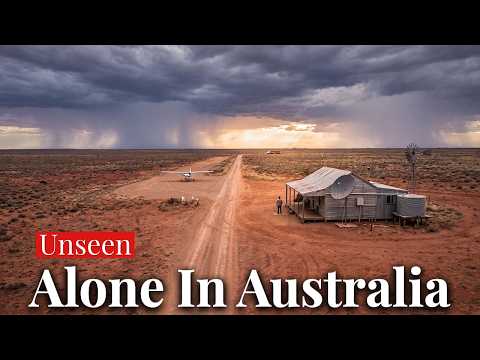
[0:00]Imagine waking up to absolute silence. No traffic, no neighbors, no sirens cutting through the night. The nearest town is 400 km away across red dirt roads that disappear during the wet season. Your closest neighbor lives 3 hours down a track that floods 6 months of the year. The internet drops out for days. Mobile phones are useless paperweights. This is home for thousands of Australians who have chosen isolation over civilization. Australia is the sixth largest country on earth, but most of its 26 million people cling to the coastline in just five major cities. That leaves an interior roughly the size of Western Europe almost completely empty. The back is not just remote. It is one of the most hostile environments on the planet where summer temperatures regularly exceed 50°C where the nearest hospital can be a 6-hour flight away, and where a broken water pump can mean the difference between survival and catastrophe. Today, we meet 10 families who have made the impossible choice to live where most people would not last a week. From cattle stations larger than small countries to mining camps where the only company is dust and flies. These families have built lives in places that challenge every assumption about what human beings need to survive. Number one, the Henderson family runs Anna Creek station in South Australia, the largest cattle station on earth. At 34,000 square km, Anna Creek is bigger than Belgium. The property sprawls across the arid landscape north of the Flinders Ranges where summer heat turns the ground into a furnace and winter nights drop below freezing. The Hendersons manage 17,000 head of cattle across country so vast. They use helicopters and light aircraft just to check fence lines. Their homestead sits alone in an ocean of red dirt and spinifex grass. The nearest town of William Creek, 100 km to the south with a permanent population of four people. Sarah Henderson grew up on Anna Creek. Her father was head stockman before the family took over management of the property. She married a helicopter pilot who now flies low over endless paddocks, searching for strays and checking water points that can be 60 km apart. Their three children attend School of the Air, taking lessons via satellite internet from teachers based in Port Augusta, 500 km away. Survival here means thinking months ahead. Food deliveries arrive by road train every six weeks, massive trucks hauling supplies across dirt roads that can vanish overnight when rare rains turn the desert into a temporary inland sea. The Hendersons keep three chest freezers stocked with meat, vegetables and bread. Medical emergencies mean calling the Royal Flying Doctor Service, waiting for a plane that might take two hours to arrive at their dirt air strip. Water is everything. The station relies on underground bores that pull ancient water from the Great Artesian Basin. When a bore fails, it can cost $100,000 to drill a new one, and cattle start dying within days. The Hendersons have lost entire mobs during drought, finding carcasses clustered around dried troughs. But Sarah will tell you she would not trade this life for anything. Her children know the night sky without light pollution and understand the value of self-reliance in ways city kids never will. Number two, the Cartwright family operates a gold mine outside Laverton in Western Australia, 500 km northeast of Kalgoorlie. Laverton itself is a town of 600 people at the end of a sealed road. The Cartwrights live another 120 km beyond Laverton on a dirt track that requires a four-wheel drive and 5 hours of careful driving. Their mine is a small operation, two excavators, a processing plant and a camp of portable buildings arranged around a central generator that runs 24 hours a day. David Cartwright spent 20 years working for big mining companies before deciding to stake his own claim. He bought secondhand equipment, took out a loan against his house in Perth, and moved his wife Michelle and two teenage sons to a camp with no running water and no phone reception. The mine operates on a simple principle. David and his crew dig ore from an open pit, crush it, run it through a processing plant that separates gold from worthless rock. On a good week, they might recover 20 ounces of gold worth $40,000. On a bad week, the ore yields nothing, and they keep digging, gambling every day that the next load will pay off. Michelle manages the books, orders supplies and home schools the boys using correspondence materials sent from Perth. She has learned to repair diesel engines, splice electrical cables and treat injuries that would send most people to an emergency room. Water comes from a bore that tastes slightly metallic. Showers are limited to 3 minutes. Food comes from Laverton on monthly supply runs, $1200 worth of groceries loaded into a trailer. But David will tell you the mine has given his family something priceless. His sons know the value of hard work, the satisfaction of building something with their own hands. They have watched the Milky Way arc across a sky so dark, you can see the galactic core with the naked eye. And when the mine finally pays off, they will have proven that it is still possible to make a fortune with nothing but determination and dirt. Number three, the McKenzie family lives on a pastoral lease in the Northern Territory, managing cattle across 8,000 square kilometers of Savannah grassland south of Catherine. Their homestead is a collection of tin-roofed buildings surrounded by mango trees and bougainvillea, sitting on a slight rise above the floodplain that turns into an inland sea during the wet season. The nearest sealed road is 80 km away. The nearest town, Catherine is 150 km to the north. Tom McKenzie is fourth generation Territorian. His great grandfather took up the lease in 1923, running cattle on country that had never seen a fence. Tom married a nurse from Darwin who now serves as the unofficial medical officer for the station's Aboriginal workers and their families who live in a small community 20 km from the main house. The wet season defines life here. From November to March, the monsoon dumps over a meter of rain, turning dry creek beds into raging rivers and cutting the property off from the outside world for weeks at a time. The road to Catherine disappears underwater. Supply trucks cannot get through. The McKenzie stock up in October, filling shipping containers with food, fuel and spare parts. During the dry season, Tom and his stockmen must have cattle using helicopters, motorbikes and horses. They push mobs of 500 head towards the yards and truck them to Darwin for export to Indonesia and Vietnam. It is brutal work in brutal heat, 12-hour days in temperatures that hit 45°C. The McKenzie children grow up wild and free. They learn to ride horses before they learn to read. Swim in water holes filled with freshwater crocodiles and navigate country using landmarks that look identical to untrained eyes. They attend school of the air until high school, then board in Catherine during term time, coming home during holidays. Number four, the Patterson family operates a roadhouse at the junction of two dirt roads in Central Queensland, 300 km west of Longreach. The roadhouse is the only structure for 100 km in any direction. A low building with fuel pumps out front, a small shop inside and living quarters out back. The Patterson served passing truck drivers, grey nomads towing caravans and the occasional lost tourist who took a wrong turn. Julie Patterson and her husband Mark bought the roadhouse 15 years ago after Mark's mining career ended with a back injury. They saw an opportunity to own their own business in a place where competition was non-existent. The nearest roadhouse is 160 km to the east. Their two children were young when they moved, and Julie home-schooled them using materials sent from Brisbane. The roadhouse operates 7 days a week, 365 days a year. Mark and Julie take turns pumping fuel, cooking meals in the small kitchen, and sleeping in shifts during busy periods when road trains roll through all night, hauling cattle to the coast. They sell diesel, unleaded petrol, cold drinks and basic groceries at prices that reflect the cost of trucking supplies 300 km from Longreach. A loaf of bread costs $8. Every item on the shelves traveled hours to get here. Water comes from a bore. Power comes from a diesel generator that runs 24 hours a day, burning through 500 L of fuel a week. The Patterson keep 3 months of food in storage, but the roadhouse has given them a life they love. They have met travelers from every corner of Australia, helped stranded motorists and listened to stories from truck drivers who spend their lives on the road. Number five, the Chen family runs a research station in the Tanami Desert, 500 km northwest of Alice Springs. The station is a collection of solar-powered buildings, studying desert ecology and tracking wildlife populations in one of the most remote regions of Australia. Doctor Lisa Chen is a climate scientist who spent years working in universities before taking a position that required her to live in the field for 6 months at a time. Her partner Wei maintains the station's equipment and manages the satellite communications. The Tanami Desert is a landscape of red sand dunes, sparse vegetation and extreme temperature swings. Summer days can hit 50°C. Winter nights drop to freezing. The nearest town is Uwendumu, 150 km to the southeast with a population of 800. Supplies arrive every six weeks on a truck from Alice Springs, bringing food, fuel and scientific equipment. Water comes from rainwater tanks and a bore that taps into underground aquifers. Every drop is precious. Showers last 2 minutes. Medical care is virtually non-existent. Lisa has treated snake bites and heat stroke using nothing but online medical consultations and supplies from the station's medical kit. The isolation keeps most scientists away, but Lisa and Wei find it liberating. They work long days collecting data and documenting changes in the desert ecosystem that are invisible to satellites. Their evenings are spent analyzing data via satellite internet. They watch the sunset, paint the sand dunes in shades of red and gold and marvel at meteor showers that streak across the sky untouched by light pollution. Number six, the Williams family lives on Thursday Island in the Torres Strait, the northernmost inhabited point of Australia. The island has a population of 2500, but the Williams family runs a pearl farm on a smaller island 20 km offshore, reachable only by boat. They live in a house built on stilts above the tidal zone, surrounded by water that shifts from turquoise to deep blue. Marcus Williams grew up on Thursday Island, the son of a fisherman who worked the waters of the Torres Straight for 40 years. Marcus started the Pearl Farm in his 20s, learning the delicate art of seeding oysters and managing them through years of growth. His wife Alana came from Cairns, drawn to the island by a teaching position. They have three children who attend the small school on Thursday Island, making the boat trip across open water every morning. Life on the Pearl Farm revolves around the tides and the seasons. The oysters grow in suspended nets beneath the water's surface, requiring constant monitoring and cleaning. Marcus dives daily checking each oyster, scraping away algae watching for signs of stress. A single cyclone can destroy years of work, ripping the nets from their moorings and scattering oysters across the ocean floor. The Williams family has lost everything twice to storms and rebuilt both times. Food comes from the sea and from monthly supply runs to Thursday Island. They eat fish almost every day, supplemented by rice and vegetables from their garden. Fresh water comes from rain tanks, power from solar panels. The isolation is complete, but never lonely. They swim in water so clear, you can see 30 m to the bottom. They watch sea turtles nest on beaches that have no footprints but their own. Number seven, the Nguyen family operates a market garden in Coober Pedy, the Opel mining town in South Australia. Coober Pedy is famous for underground living. Summer temperatures regularly exceed 50°C, so residents live in dugouts carved into hillsides. The Injuyans grow vegetables in a greenhouse built half underground, using hydroponic systems that recycle water with 90% efficiency. Tom and Julian arrived in Coober Pedy 30 years ago as a refugee from Vietnam. He worked in the Opal mines for a decade before realizing the real money was in food. Fresh vegetables in Coober Pedy sell for triple what they cost in Adelaide, 900 km to the south. Tom built his greenhouse using salvage materials and trial and error, learning hydroponic farming from books. Water is the challenge. Coober Pedy gets less than 200 mm of rain a year. The Nigoyans capture every drop of run-off from their greenhouse roof, store it in tanks, and recycle it through their hydroponic systems. They supplement with town water, trucked in from a borefield 60 km away. Tom has calculated that each tomato he grows consumes roughly $5 worth of water but sells for eight. The underground greenhouse is a marvel of engineering. Tom has rigged LED grow lights powered by solar panels, created a cooling system using evaporative pads and built growing beds from recycled plastic piping. The investment took years to perfect. Tomatoes, lettuce, cucumbers and herbs flourish in climate controlled conditions. While outside the temperature hits 50° and the landscape looks like Mars. Number eight, the O'Brien family runs a cattle station on Cape York Peninsula, the remote northern tip of Queensland. The property covers 6,000 square kilometers of tropical Savannah and monsoon forests. The homestead is accessible only by light aircraft during the wet season, when roads become rivers, and the property is cut off from civilization for up to 5 months. The O'Briens run 15,000 head of cattle using helicopters, horses and local Aboriginal guides. Patrick O'Brien inherited the property from his father who bought it in the 1960s when Cape York was considered too remote for commercial cattle operations. His wife Rebecca is a veterinarian who traded a comfortable practice in Brisbane for a life where she delivers calves in monsoon rain and treats snake bites with makeshift antivenom. The wet season transforms the landscape into a green paradise, fills the water holes and grows the grass that feeds the cattle. But it also brings isolation, floods and cyclones. Rivers break their banks, roads become impassible quagmires. The O'Briens stock up in October, filling shipping containers with 6 months worth of food, fuel and medical supplies. Their three children attend boarding school in Cairns during term time, flying home during holidays. The kids spend their breaks helping muster cattle, swimming in water holes and exploring country that few Australians will ever see. Rebecca will tell you the isolation is the hardest part. There are months when the only adults she sees are Patrick and the station stockman. There is no phone reception, no internet beyond a satellite connection that drops out during storms. But she has watched the sun rise over rainforests older than human civilization and delivered foals under stars so bright, they cast shadows. Number nine, the Jackson family lives at Giles Weather Station in Western Australia, 700 km west of Alice Springs in the Gibson Desert. Giles exists for one purpose, collecting meteorological data from one of the most remote locations in Australia. The settlement has a permanent population of four, the Jackson family. Andrew Jackson maintains the weather instruments and transmits data via satellite to the Bureau of Meteorology in Melbourne. His wife Emma teaches their two children and serves as the station's medical officer and mechanic. The Gibson Desert is a sea of red sand dunes stretching to the horizon in every direction. The nearest town is Warburton, 300 km to the west with a population of 400. Alice Springs is a 12-hour drive on dirt roads. Supplies arrive every 3 months on a truck from Alice Springs, bringing food, fuel and equipment. The Jackson's plan every meal 3 months in advance. Fresh food is a rare luxury. They eat a lot of canned vegetables, powdered milk and frozen meat. Water comes from a bore that produces slightly alkaline water. Every faucet has a filter. Showers are rationed to 5 minutes. Medical care is non-existent. Emma has a comprehensive first aid kit and satellite phone access to remote medical consultations. She has treated scorpion stings, heat exhaustion, and an infected tooth using online instructions. But the Jackson's love Giles. Their children are growing up, learning resilience and self-reliance. They have explored sand dunes that shift with every wind, found Aboriginal rock art sites that have never been documented, and watched desert storms approach from 50 km away. Number 10, the Fraser family runs a crayfish fishing operation in the Southern Ocean, working from King Island between Tasmania and the mainland. King Island is accessible only by light aircraft or a freight ship that runs once a week from Melbourne. The Frasers live in a small cottage on the island's west coast and spend weeks at a time at sea in a fishing boat, working waters so rough and cold that survival suits are mandatory equipment. James Fraser grew up fishing the Southern Ocean with his father. He bought his own boat at 25 and has spent 30 years pulling crayfishing pots from water that can turn deadly in minutes. His wife Helen manages the shore operation, coordinating with buyers on the mainland and maintaining equipment. The Southern Ocean is one of the most dangerous working environments on Earth. Storms form with little warning. Waves can reach 15 m. Water temperature hovers around 10°C, cold enough to kill an unprotected person in minutes. James has lost friends to the ocean, boats that went down with all hands during winter storms. He checks weather forecasts obsessively and never takes unnecessary risks. The work is brutal. James and his crew spend 3 weeks at a time at sea, pulling pots that weigh 200 kg when full, working in freezing spray and howling wind. The crayfish export to China and Japan. A good season can earn $200,000. A bad season barely covers costs. Helen will tell you the hardest part is waiting. When James is at sea, she monitors weather forecasts and listens to marine radio. She has spent sleepless nights during storms, watching the ocean, but she has seen her sons grow into confident young men who know the ocean's moods. And when James comes home after three weeks, salt-crusted and exhausted with a hold full of crayfish, she remembers why she married a fisherman and why King Island is home. These 10 families have chosen isolation, and it has shaped them in ways that comfort never could. They have learned that resilience is built through hardship, that community matters most when you are far from everyone, and that the things we think we need are often just things we have grown accustomed to wanting. They live in places where nature is indifferent to human survival, where mistakes have consequences, and where every day requires a level of self-reliance that most Australians will never experience. They have proven it is still possible to live on your own terms, but they also live in places of extraordinary beauty and freedom. They have seen landscapes that appear on no postcards, experienced silences that city dwellers cannot imagine, and raise children who understand that the world is bigger and stranger than any screen can show. Which family's story resonated most with you? Could you survive in such complete isolation? Subscribe to this channel for more documentaries, exploring the hidden corners of Australia. Thank you for watching.
10 Families Living in the Most Isolated Places in Australia — And How They Survive
Loving Wallaby
23m 44s3,343 words~17 min read
Auto-Generated
Watch on YouTube
Share
MORE TRANSCRIPTS