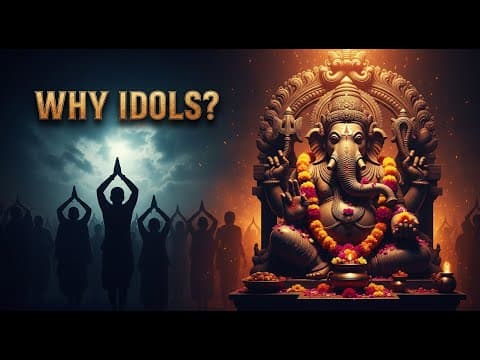
[0:00]For thousands of years, Hinduism has produced enlightened sages, philosophers, yogis, and scientists of consciousness. It is the world's oldest living spiritual tradition, the only major religion that survived from the ancient world.
[0:14]Yet today, many people in the West, and even some in India dismiss it with one single phrase, idol worship, or worse, they call its deities demonic.
[0:24]But how did we go from a civilization of seekers, meditators, and philosophers to being labeled as primitive idol worshipers? Where did this misunderstanding begin? Why does it continue? And what does Hinduism actually say about Murtis, the so-called idols?
[0:39]This is the true story of how symbolism became misunderstood, how depth became dismissed, and how an entire civilization's spiritual science was reduced to a stereotype. Welcome to Hinduism Unveiled.
[0:52]When Western travelers first entered India during the medieval and colonial periods, they carried one assumption: there is only one true God, and he can never have form.
[1:03]Anything outside this framework was automatically labeled pagan, demonic, or misguided. Christian missionaries had only one lens through which they viewed the world.
[1:12]So when they entered a Hindu temple and saw people offering flowers and prayers to a statue, they interpreted it literally. Ah, the Hindus are worshiping stone. Idol worship.
[1:25]But here is the important truth. Hindus don't worship the stone; they worship through the stone. Just like a Christian doesn't worship the paper the Bible is printed on, and a Muslim doesn't worship the black ink of the Quran, a Hindu does not worship the physical Murti.
[1:40]The Murti is a doorway, not the destination. To understand Murti Puja, we need to understand the evolution of human consciousness. Human civilization didn't begin with abstract philosophy.
[1:54]It began with images, symbols, patterns, and forms. Even today, the human mind learns visually. Symbols bypass logic and speak straight to the deeper layers of awareness.
[2:02]This is why every culture in history used sacred images. The Egyptians had statues of Horus and Isis. The Greeks had Zeus, Athena, Apollo. The early Christians used icons of Jesus and Mary.
[2:15]Buddhists still worship Buddha statues today. Even Islam, despite its rules, reveres the Kabba, a sacred stone structure. The truth is simple: humans never escaped symbols.
[2:27]They evolved through them. Hinduism understood this thousands of years ago. Unlike Western assumptions, a Hindu Murti is not just an artistic sculpture.
[2:36]It is a spiritual technology. A properly consecrated Murti undergoes a ritual called Prana Pratishtha, where the deity's energy is invited into the form. This is not superstition.
[2:45]It is a yogic science based on geometry, sound, vibration, mantra form, resonance, spatial energy fields. When chanting, devotion and intention converge, the Murti becomes a receiver.
[3:02]Just as a radio receives signals invisible to the eye, the stone is not God. It is a medium through which the infinite can be experienced. This is why a temple feels alive.
[3:11]Why even non-Hindus feel an unexplainable energy in front of Nataraja, Durga, or Krishna? The experience is real. The Murti is the access point.
[3:20]For ancient Indians, the goal was never worship in the Western sense. The goal was always experience: to become the Buddha, to become Shiva, to realize the self, Atman.
[3:32]But as the Abrahamic worldview spread globally, anything that wasn't book-based monotheism was labeled primitive, and Hinduism suffered the most because it is the only major religion that openly embraces multiple paths, multiple forms, multiple expressions of the divine.
[3:47]The West interpreted this diversity as chaos. But in reality, it is freedom of seeking something no other tradition protects so fiercely.
[3:56]Our viewer said it perfectly: as human mind is getting narrow and radical, they are denying the two most important aspects of life: time and evolution.
[4:07]Hinduism is the only tradition that openly says humanity evolves, consciousness evolves. Our ways of reaching the divine also evolve.
[4:17]In the earliest times, people connected through fire, nature, the sun. Later, as societies grew, rituals evolved, temples emerged, and symbolic representation became necessary.
[4:29]A Murti is not a decline; it is an evolution of spiritual methodology. Just like writing evolved from cave drawings, just like language evolved from sound, just like a child learns through pictures before letters, the image is the bridge.
[4:46]Once you cross it, the divine beyond the image becomes visible. So why do Hindus use Murtis? One, because God is infinite, but the human mind needs form. A form is a focus point.
[4:54]Two, because symbolism is the oldest human language. Three, because consciousness can be invoked into matter.
[5:02]Four, because Hinduism is the only major religion that allows God to be both with form and formless. This is why a Hindu can meditate on Nirguna Brahman, the formless absolute, or Saguna Brahman, the same divine expressed as Shiva, Vishnu, Durga.
[5:25]Both paths are valid. Both lead to the same truth. This is the sophistication that outsiders never understood. This is the uncomfortable part of the conversation.
[5:30]But it must be said, historically, Abrahamic religions labeled every non-Abrahamic practice as pagan, idol worship, witchcraft, demonic. This was not theology; it was political strategy.
[5:43]When you reduce other cultures, you justify converting them. Hinduism was never demonic. What was demonized was misunderstanding.
[5:53]A civilization that produced yoga, Ayurveda, astronomy, zero, grammar, meditation, philosophy, enlightenment cannot be reduced to primitive idol worship. That is an intellectual crime.
[6:07]Hinduism never asks you to believe; it asks you to experience. A Murti is one of many tools, not a requirement, not a dogma. The ultimate goal is not worshipping outside, but awakening inside.
[6:20]As the Upanishads say, the self alone is the God within. This is why Hinduism survived while all other ancient religions died. It evolves, it adapts, and above all, it empowers the seeker.
[6:35]So, how did Hinduism move from the world's greatest community of seekers to being misunderstood as idol worshipers? The answer is simple: through misinterpretation, through lack of context, through losing the language of symbols.
[6:50]We must restore this clarity not to convert anyone, but to elevate human understanding. When people realize that Murtis are not idols, but mirrors, doorways, and technologies of consciousness, ignorance dissolves, and acceptance rises.
[7:08]If you enjoyed this journey into the truth behind Hindu symbolism, don't forget to subscribe, leave a like, and share your thoughts in the comments below. What topic should we decode next?
[7:18]This very video was requested by a viewer, so you could be the one to suggest our next video. Thank you for supporting Hinduism Unveiled. Together, we will keep illuminating the world one truth at a time. Jai Shri Ram. Jai Shri Krishna.


