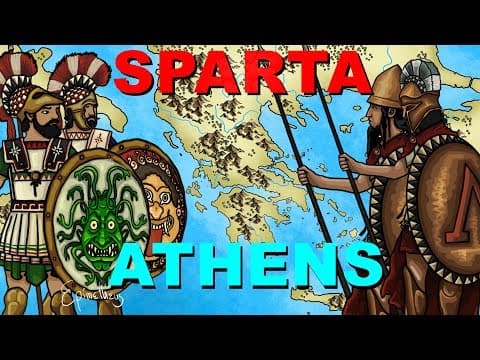
[0:05]The war between Athens, leader of the Delian League of allied city states and colonies, against Sparta, leader of the Peloponnesian League, pitted a powerful navy against one of the most dominant infantry forces in history.
[0:18]Proceeding this conflict, Athens had defeated a Persian invasion force at the Battle of Marathon.
[0:24]A decade later, a much larger Persian invasion force suffered major setbacks and defeats at Thermopylae, where 300 Spartans famously fought to the last man.
[0:35]Then at Salamis, the Persians were dealt a major naval defeat against the Athenian Navy, and finally at Platea, the Persian army was defeated on land before downsizing and eventually abandoning the campaign.
[0:50]For the next half century, both states followed an anti-Persian policy and supported any anti-Persian activities in the Eastern Mediterranean, allowing for an intermittent peace to exist between Athens and Sparta.
[1:03]In order to fight the Persians at sea, the Athenians formed the Delian League.
[1:08]By exercising more and more control over the members of the League, Athens converted this coalition into an empire, exacting tribute from its members.
[1:17]From the money extracted from her client states, Athens built herself into a city that was the envy of the Hellenistic world, and a fleet of 300 triple-banked galleys.
[1:27]Each of these triremes was manned by a crew of 170 professional oarsmen.
[1:33]The city-state of Corinth had been the dominant maritime power prior to the Persian wars, and as Athens's power grew, her Navy outnumbered Corinth's fleet three to one, and began to incite rebellion in her colonies and encroach on its trade routes.
[1:47]In a series of small conflicts lasting 15 years, known as the First Peloponnesian War, Sparta opposed Athens and defeated the Athenian army in one non-decisive engagement, while Athens continued to expand her naval power.
[2:00]One significant development during this period was the rebuilding of Athens's walls on a grand scale, with a long causeway connecting Athens with the port city of Piraeus, allowing Athens to be fully supplied by sea, even if an invading army would destroy the surrounding countryside and farmland.
[2:19]This hostile period ended with the so-called Thirty Years' Peace between the two city-states that would last for less than half of its intended duration.
[2:28]Despite this peace, hostility between Athens and Corinth continued, and in 431 BC, Corinth successfully convinced Sparta and the Peloponnesian League to declare war on Athens, with the goal of ending the burgeoning Athenian Empire.
[2:41]The first phase of the Second Peloponnesian War, commonly referred to as simply the Peloponnesian War, is known as the Archidamian War, where Sparta pursued a policy of pillaging the countryside around Athens in an attempt to provoke a pitched battle.
[2:57]The Athenians had anticipated the Spartan strategy and had organized a continuous flow of grain shipments from Egypt and colonies on the Aegean and Black Sea coasts.
[3:04]The Athenian strategy was to blockade the Peloponnesian Peninsula from any trade and supplies, while opportunistically raiding Sparta's allies.
[3:14]While initially the Athenians seemed to be maintaining the upper hand in this asymmetric war of attrition that had been carefully planned for years by the Athenian statesman Pericles, the population from the surrounding countryside poured in behind the safety of the Athenian walls in the early stages of the war.
[3:32]This had been taken into account beforehand, and wealthy Athens had more than enough food flowing into the crowded city to feed everyone.
[3:40]What had not been taken into account was tainted grain shipments carrying plague, which rapidly spread through the overcrowded city.
[3:48]Initially, the city was resilient, inspired by the charismatic rhetoric of Pericles.
[3:53]An estimated one in four Athenians succumbed to the plague, including Pericles and his sons, before it had run its course.
[4:00]At the height, mercenaries refused to fight for Athens, and even the Spartans ceased to campaign near Athens for fear of catching the plague.
[4:08]Ironically, the masterfully planned Athenian blockade of the Peloponnese had protected Sparta and its allies from receiving any of the plague-tainted grain.
[4:16]The Athenian survivors adopted a much more aggressive strategy, greatly increasing the raids and building fortified outposts along the Peloponnesian coast.
[4:25]The helots, Spartan slaves that out-numbered them ten to one, were encouraged to run away to these outposts, which put pressure on Sparta to defend the home front.
[4:34]This phase of the war ended with the 50-year Peace of Nicias, which never really went into full effect, with both belligerents raiding each other through proxies from the onset and eventually directly.
[4:44]In 415 BC, the Athenians devised a plan they believed would bestow upon themselves an overwhelming advantage.
[4:51]The conquest of the fabulously wealthy city-state of Syracuse on the island of Sicily, who along with Athens and Carthage controlled the lion's share of Mediterranean trade.
[5:01]Led by the young charismatic Athenian statesman Alcibiades, the expedition ended in disaster, with Athens losing over 10,000 hoplites and two-thirds of her navy.
[5:14]Ships could be rebuilt, but the 30,000 professional oarsmen could not be replaced.
[5:20]This was followed by further disasters. Sparta freed 20,000 Athenian slaves in the city's silver mines.
[5:25]Athens then raised the tribute from her vassals, which caused widespread revolt in Ionia, for which this final stage of the war is named.
[5:33]The Athenian general Alcibiades, fearing retribution for his failure, switched sides and fought for Sparta, who began to receive vast sums of money from the Persian Empire, who viewed the Athenian Empire as a greater threat.
[5:46]With this, Sparta built up its fleet and combined with its Corinthian allies, decisively defeated the Athenian Navy at Aegospotami.
[5:55]Athens, now effectively without a navy, was besieged by Sparta and promptly surrendered.
[6:01]Spartan hegemony over the Greek world would be short-lived. Its most precious resource, Spartan warriors, had become far too low to maintain an empire.
[6:08]And after a series of smaller wars in the aftermath of the Peloponnesian War, Philip of Macedon, the father of Alexander the Great, was able to conquer the decimated Greek city-states.


