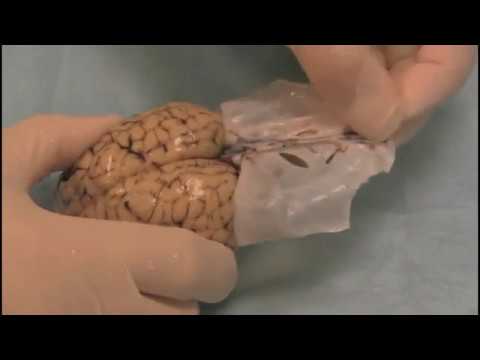
[0:03]Hi, I'm Olivia. You can't see me, but I'll be doing the voice over. First of all, we're going to take a look at the outside of the brain. This is the rostral end where the nose is, and this is the caudal end where the spinal cord is. The first thing that we can see is that the brain is covered all over by a very thick protective membrane. So the first thing we're going to do is to get rid of the membrane so that we can get a closer look at the brain structures. The membrane is much more tightly attached to the underside of the brain. So we're going to start off by removing it from the top. Take our sharp scissors, and keeping the point up, we cut the brain around the top surface, like this.
[1:02]across here and back here.
[1:20]We didn't film taking all of the covering off because it took quite a while. You should take time to do it properly. In particular, make sure you get the coverings out down here, like this.
[1:57]For right now, we're going to leave the coverings on the underside of the brain because they're difficult to remove. We'll get to them later.
[2:11]Okay. Before we throw the coverings in the trash, let's take a look at them. This brain has been fixed, but you can see even so that they're really tough. You can also see some blood vessels attached to the inside of the coverings. But now, let's put them aside and look at the brain. Rostral end, caudal end, spinal cord. You can see that the brain is divided into two hemispheres, and we can see the blood vessels on the surface. They're black. We look at the surface of each hemisphere, and we can see numerous hills and valleys. The hills are called gyri, and the valleys or fissures between them are called sulci. There's still a membrane covering on the brain, which is why we can't probe down deeply into the sulci. The front of the brain is called the cortex, and the two hemispheres of the cortex are separated by the longitudinal fissure. You can see that I'm teasing that apart. The two hemispheres are connected in the middle by a band of neurons that pass from one side to the other. We'll take a closer look at them later.
[3:55]Behind the cortex is the cerebellum.
[4:03]The cerebellum is not divided into two hemispheres like the cortex. It has two hemispheres, but it also has a middle area we call the vermis. The cerebellum sits on top of the brainstem, and then coming from the brainstem is the spinal cord. I spent some time cleaning up the base of the brain, getting rid of the covering, so we can get a better look at it. In particular, I trimmed off this bit to reveal the optic nerve more closely. Now we can clearly see how it comes in from the right eye and the left eye, crosses at the optic chiasm, and then moves over into the brain itself.
[4:50]You can see the optic nerve moving under here. If we look closely, we can also see little nerves sticking out of the brainstem. Some of them have been cut. These are nerves which supply the muscles and the sensory organs of the of the head and transmit information into and out of the brain. Let's do our sagittal cut. The first thing I'm going to do is to turn the brain over and decide where I'm going to cut. I want to go precisely down the middle here and also down the middle of this central region of the cerebellum called the vermis. I'm going to place the knife in position and then cut. It's important to cut cleanly in one stroke if possible. So I'm pressing down firmly, and now I've reached the pulling back. Very nice. We can see now see the brain open like a book and get some idea of the inside. Rostral, caudal, spinal cord, brainstem, cortex, and then subcortical structures. We can see the cortex very clearly, and now we can start to see the sulci, the fissures, and the gyri quite clearly. Here, we see this space, it's called the lateral ventricle.
[6:58]And here on this side, you can see it more clearly. Above the lateral ventricle is that band of neurons that we saw down the fissure previously. This band of neurons that connects one side of the brain to the other. Moving back, we can see the cerebellum, and you can see how it's name the tree of life arose. It looks just like a tree, and like the cortex, it also has folds and fissures between the folds. Another name for the cerebellum is the little brain, and it's responsible for a great deal of unconscious learning that's carried out to control movement. Cortex, corpus callosum, lateral ventricle, cerebellum, brainstem, spinal cord. The brainstem has three parts. The medulla, the pons, and the midbrain. Here we have the thalamus, which is a very important the thalamus and here we have the hypothalamus. Now I'm going to detach the subcortical structures from the cortex.
[9:01]First thing I'm going to do is to detach the cerebellum. You can see how the cerebellum is connected to the was connected to the brainstem at the region of the pons. We can move back just tease out. You can tease the cortex apart from the cerebellum, from the brainstem, from the subcortical structures.
[9:44]And you can see these radiating, these radiations coming from the cortex to and from the thalamus. These are called the cerebral peduncles because they bring all the information from the cortex into the thalamus. You can see how all the neurons are coming from the cortex to the subcortical structures that we've removed. Now we're left with the spinal cord, the brainstem, medulla, pons, and also the thalamus.
[10:44]And we can see very clearly the different areas of the thalamus and neurons that run through the thalamus into the cortex and out from the cortex. Underneath the thalamus, we have the hypothalamus. Hypo means underneath. We can take a cut coronally from the top of the cortex down, again, quick to reveal the structure of the cortex. Now we can see the gyri and the sulci much more clearly. The gray matter of the cortex is on the outside, and the white matter, which are the neurons running to and from the cortex, is on the inside. Likewise, in the cerebellum, you can also see the folds and fissures of the cerebellum. Again, the gray matter or the neurons are on the outside, and the white matter, which are the axons going to and from the cerebellum, is on the inside.
![Thumbnail for [Arabic] Learn Command Line #04 - Directories And Files Part 2 by Elzero Web School](/_next/image?url=https%3A%2F%2Fimg.youtube.com%2Fvi%2FI90afN1SgTA%2Fhqdefault.jpg&w=3840&q=75)