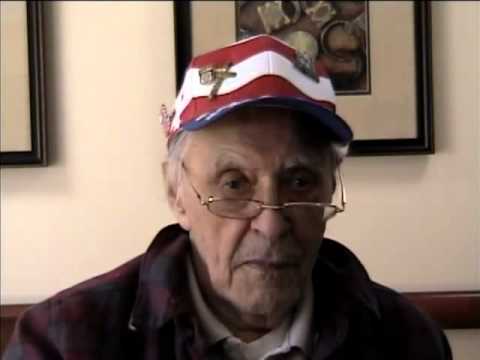
[0:03]He is the second person on the left on the lower rank. We will be starting the interview in a few moments.
[0:18]This is September 14, 2014, at 1:00 in the afternoon in Coni, New York. Ken and June Hunter are interviewing Alfred Manzi, who served in the United States Army, beginning in 1939 until 1945. Please tell us when and where were you born? I was born Yeah, what date were you born? April, April the 7th, I think it was that when I was born. This is September 14, 2014, at 1:00 in the afternoon in Coni, New York. Ken and June Hunter are interviewing Alfred Manzi, who served in the United States Army, beginning in 1939 until 1945. Please tell us when and where were you born? I was born Yeah, what date were you born? April, April the 7th, I think it was that when I was born. And it was the year 1921. Yeah. And where were you born?
[1:03]Well, somewhere in Connecticut. Oh, well. From what I gather. Your son says it was Albany, New York. No, I wasn't born in Albany. I was raised there. Okay, well that's good. That's all right. Now, you went through grade school before you went into the service. And were you drafted or did you enlist? No, no, I wasn't drafted. I'll tell you how it happened. because I worked at the news papers. And I'd go up Madison Avenue all the way up to Wall Street, Wall Street, and I walk over and the theater was there. And I'd get in front of the theater, but I got that job kind of in the military ice cream parlor next door to this movie house. So I needed they kept teasing me to get in the army and and I had to get out here, get lost. I could, you know, but they find coax me to join the army. It's the National Guard. It's not army, but it's part of the army, excuse me. It's the Guard, National Guard.
[2:20]And so then uh, you went down and you enlisted in Albany. Yeah, I went down there and they got got a job in the guard. And did you uh, then I understand you went down to Fort Dix after that? What did you do at Fort Dix? What did you do in Fort Dix? Was that where your basic training was held? I don't know to be honest with you.
[2:48]Do you remember anything about basic training? Oh, basic training was the same over, you know, they'd take you out in the field and walk you and run you and do everything they can. They used to walk us 50 miles just for one day and they'd for you had a hard time to get back. They always had a Jeep right behind us to bring us back. And uh, that was good. And then uh you had to drink in part of it. And you were with people that drink and you're only 16, 17 years old, you don't know what to drink. But you do drink after a while. When you say drink, you must mean beer and other stuff like that. Yeah, okay. So you were a young man and you got into I was think I was 17 when I went in the guard. And did you uh learn uh any uh ammunition, how to ship guns and all? How to handle weapons and the use of weapons? Oh, yeah. I learned I learned that. I did there in the army. They taught you that. And my first army, my first year was I don't forget that, uh. We were at one that we had to go, we were going to go somewhere. And they were going to tell us that behave, all that stuff. And now watch what you're doing. We warned people that you live in that area that you were going to be there. So they say, all right.
[4:43]So when we got there, somebody come running across the thing and stood with me and went playing with a gun, you know, I never handled a gun. Oh my God, I was scared, scared. I got up and I went right out and see what happened or what. And it's a woman, about 80 years old. Well, I killed her with a bullet wound. I didn't know it. Oh, I thought I was going to die right there. Oh, yeah, boy, that was heck. I thought they were going to die right there. 80 years old, she was. That's where and I shot her that night. She she said thank you. I said, you shouldn't have been there. But that's that's part of it. The other parts of them that we went over the hill, we got different group of men. And so did you go anywhere uh, I know you did after Fort Dix? Fort Dix? Yeah, that's where. Oh, you did the basic training. And now did you uh before you go on from there, in your days there, uh, you remember the first haircut you got there? I'm sure it wasn't the kind of a haircut that you got in Albany. Always used to give me my hair cut from my he was a barber I went. He used to cut my hair.
[6:10]So that's that's about all I can tell you. How was the food? Do you remember was the food good? They give you a lot. Oh the food was always good there in the army. At once they go about it. That was always good. What about the barracks life? What was that like? Well, it's kind of hard to say, especially with a woman around. Oh I've heard everything that.
[6:38]imagine there was a lot of close order drill. Yeah, I heard that. The rifle range training. Yeah. Oh yeah, I learned how to handle.
[8:14]Yeah, you had to learn how to strip the thing down almost blindfolded. Yeah, that's true. And I I don't know it's very confusing. I imagine very confused person.
[13:24]I imagine it wasn't a luxury ship. You're all packed in there together. Yeah. What was it like? Did you get seasick? Well, you showed up over them too. That work out pretty well. I can remember I got sick a couple of times. Showed up over Santa Claus. And then um.
[13:53]Okay, then the troop ship, where did the troop ship take you? Where did the troop ship take you out into the Pacific? What what island were you headed for? Oh I don't know. That was Okinawa and Saipan. And the Marshall's. How did you, how did you get from the troop ship to those? Did you all They trans They'd transfer you and then they'd have a ship there to Elasti.
[14:27]Yeah, that's true. I had enough. It's very confusing. But everything matched up. These guys were different. These were they were the same. Most of them were from this area. Now, when It's our understanding, you were wounded in Saipan. What was it, what was the duty like in Saipan? What did you do there? How soon did you engage the enemy? I think there were a lot of Japs on Saipan. We tried to get him out of there. We did as much as we could. I guess we did get him out eventually. I I don't know.
[23:40]Tell us how you how you earned the bronze star. All I can think of is that we fought a fought with some people that we should could do that with. You know, these people from the south. They they were tough. They'd drink and drink and drink until you were blue. And we'd drink and drive and it was terrible but it wasn't bad, you know, around about way. So I I don't know if I can help you much but I'll do it. Yeah. Oh, bus. You had, you had a bus to go down there. Yeah, yeah. When you look at the state of things, uh, what's going on in the world now with the young fellas, uh, and young women today being in there, what are your feelings for for them?
[24:33]Well, I always always respected women because I think the war being ended, made the war ended.
[24:55]I think the woman made a good job of keeping it going.
[25:47]It wasn't for the war. The woman Do you know they were They're still going to be in the war. I don't think I would be going anywhere.