[0:05]So I want to say something about wood anatomy, and I'm going to start off by talking about the anatomy of the tree. So here we have a a section through a tree and then taking each of the layers out. So we're looking at the trunk here and the innermost part is the heartwood. And then the next layer out, right in the middle, we have something called the pith, then heartwood, and then the next layer out is the sapwood. And then this green layer here, this is known as the cambium or the vascular cambium. And this is the region of the tree where the living cells divide. And then cells either go inwards to form what's called xylem tissue, which is the wood that we're familiar with. So the xylem tissue is not alive. The cambium is alive, the only part of the xylem tissue that's living are these cells here, which are referred to as parenchyma cells. In softwoods, most of the parenchyma cells are horizontal. You do get some vertical, but not very many in softwoods. In hard wood, you get a much more complex structure. You get vertical as well as horizontal parenchyma cells. So those are the only cells of wood that is alive. I have to constantly emphasize that wood is not a living tissue. Even in the tree it's not a living tissue, it's only the parenchyma cells. So this is a supporting, this has a supporting function. So that's the xylem tissue, this is the cambium. And then so we get cell division running inwards and we get cell division going outwards. And the cell division going outwards forms phloem tissue. So this is the structure of vascular plants. The phloem conducts uh the products of photosynthesis downwards from the canopy to the roots. And the xylem tissue, the sapwood part of the xylem tissue, conducts water up from the roots to the canopy. And obviously the canopy evaporates a lot of water. So the width of the sapwood is much greater than the width of the phloem. And obviously as the tree grows it's pushing this layer out and it's creating cells on the inside and I'll describe that process a bit more in the minute. Finally, we've got this outer protective layer, which is the bark. And you'll notice on most trees either the bark is falling off, is peeling off, or it's very serrated, very rough. And that's basically because as the tree is growing, it's either creating a lot of cells on the outside which are dying and falling off, or it's creating this much sort of um a complex structure, you're basically compressing all this material because you're growing outwards. Then you get splits forming, those splits will be filled up with uh new tissue. But um so this has a protective function, it isn't alive, and it isn't conducting any water, it's simply there to protect the tree.
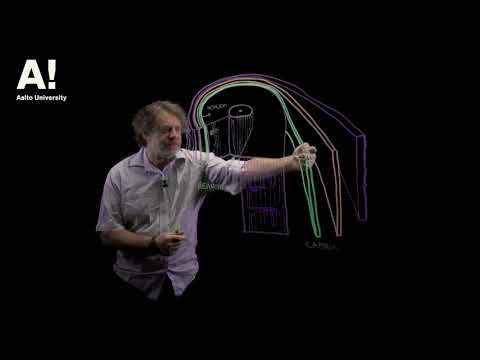
Wood anatomy (9) Illustration of wood tissue
Aalto University - Wood Science
3m 50s495 words~3 min read
YouTube auto captions
Transcript source
YouTube auto captions
This transcript was extracted from YouTube's auto-generated caption track. The transcript below is server-rendered so it can be read, searched, cited, and shared without opening the original YouTube player.
Pull quotes
[0:05]So I want to say something about wood anatomy, and I'm going to start off by talking about the anatomy of the tree.
[0:05]So here we have a a section through a tree and then taking each of the layers out.
[0:05]And then the next layer out, right in the middle, we have something called the pith, then heartwood, and then the next layer out is the sapwood.
[0:05]And then this green layer here, this is known as the cambium or the vascular cambium.
Use this transcript
Related transcript hubs
Watch on YouTube
Share
MORE TRANSCRIPTS


