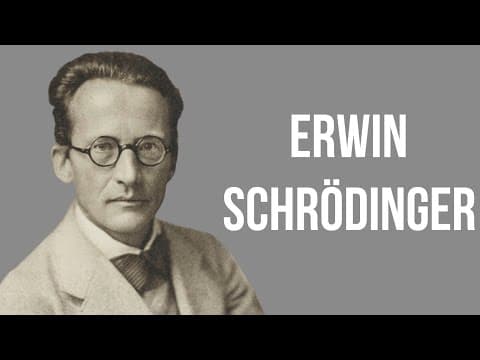
[0:10]Erwin Rudolf Josef Alexander Schrödinger was a Nobel Prize winning Austrian-Irish physicist who developed a number of fundamental results in quantum theory. Schrödinger was born in Erdberg in Austria on August 12th, 1887 to Rudolf Schrödinger and Georgina Amelia Brenda Schrödinger. Rudolph was a cereal cloth producer and a botanist. Erwin's mother, Amelia, was a professor of chemistry at Tuine. He was their only child. His mother was of half Austrian and half English descent. His father was Catholic and his mother was Lutheran. Although he was raised in a religious household as a Lutheran, he himself was an atheist. However, he had strong interests in Eastern religions and pantheism, and he used religious symbolism in his works. He also believed his scientific work was an approach to the Godhead, albeit in an intellectual sense. He was also able to learn English outside school, as his maternal grandmother was British. Between 1906 and 1910, Schrodinger studied at the University of Vienna under the physicists Franz Xner and Friedrich Hasse Nl. He received his doctorate at Vienna under Hasse Nl. He also conducted experimental work with Carl Wilhelm Friedrich Fritz Kosh. In 1911, Schrodinger became an assistant to Exner. At an early age, Schrodinger was strongly influenced by Arthur Schopenhauer. As a result of his extensive reading of Schopenhauer's works, he became deeply interested throughout his life in color theory and philosophy. In his lecture Mind and Matter, he said that the world extended in space and time is but a representation. This is a repetition of the first words of Schopenhauer's main work. Between 1914 and 1918, he participated in war work as a commissioned officer in the Austrian Fortress Artillery. In 1920, he became the assistant to Max V in Jena, and in September 1920 he attained the position of Ordt Professor in Stuttgart. In 1921, he became Ordent Professor in Breslau. In 1921, he moved to the University of Zurich. In 1927, he succeeded Max Plank at the Friedrich Wilhelm University in Berlin. In 1933, Schrödinger decided to leave Germany. He disliked the Nazi's anti-semitism. He became a fellow of Magdalene College at the University of Oxford. Soon after he arrived, he received the Nobel Prize together with Paul Dirac. His position at Oxford did not work out well. His unconventional domestic arrangements, sharing living quarters with two women, were not met with acceptance. In 1934, Schrodinger lectured at Princeton University. He was offered a permanent position there, but did not accept it. Again, his wish to set up house with his wife and his mistress may have created a problem. He had the prospect of a position at the University of Edinburgh, but visa delays occurred and in the end, he took up a position at the University of Graz in Austria in 1936. He had also accepted the offer of chair position at the Department of Physics, Allahabad University in India. In the midst of these tenure issues in 1935, after extensive correspondence with Albert Einstein, he proposed what is now called the Schrödinger's Cat Thought Experiment. In 1938, after the Anschluss, Schrödinger had problems because of his flight from Germany in 1933 and his known opposition to Nazism. He issued a statement recanting this opposition. However, this did not fully appease the new dispensation, and the University of Graz dismissed him from his job for political unreliability. He suffered harassment and received instructions not to leave the country, but he and his wife fled to Italy. From there, he went to visiting positions in Oxford and Ghent University. In the same year, he received a personal invitation from Ireland's T-Shock, Amon Deera, a mathematician himself, to reside in Ireland and agree to help establish an institute for advanced studies in Dublin. He moved to Clontarf in Dublin and lived modestly. A plaque has been erected at his Clontarf residence and at the address of his workplace in Maryon Square. He became the director of the School for Theoretical Physics in 1940 and remained there for 17 years. He wrote around 50 further publications on various topics, including his explorations of unified field theory. In 1944, he wrote What is Life, which contains a discussion of Negentropy and the concept of a complex molecule with a genetic code for living organisms. According to James D. Watson's memoir, DNA: The Secret of Life, Schrödinger's book gave Watson the inspiration to research the gene, which led to the discovery of the DNA double helix structure in 1953. Similarly, Francis Crick, in his autobiographical book What Mad Pursuit, described how he was influenced by Schrödinger's speculations about how genetic information might be stored in molecules. Schrödinger stayed in Dublin until retiring in 1955. He had a lifelong interest in the Vedanta philosophy of Hinduism, which influenced his speculations at the close of What is Life. About the possibility that individual consciousness is only a manifestation of a unitary consciousness pervading the universe. In 1956, he returned to Vienna.
[5:18]At an important lecture during the World Energy Conference, he refused to speak on nuclear energy because of his skepticism about it and gave a philosophical lecture instead. On April 6th, 1920, Schrodinger married Anne Marie Bertel. Schrödinger suffered from tuberculosis and several times in the 1920s stayed at a sanatorium in Arosa. It was there that he formulated his wave equation. When he migrated to Ireland in 1938, he obtained visas for himself, his wife and also another woman, Mrs. Hilda March. March was the wife of an Austrian colleague and Schrödinger had fathered a daughter with her in 1934. Schrödinger wrote personally to the T-Shock, Amon De Valera, to obtain the visa for Mrs. March. In October 1939, the Manju took up residence in Dublin. Schrödinger fathered two further daughters by two different women during his time in Ireland. On January 4th, 1961, Schrödinger died of tuberculosis at the age of 73 in Vienna. He left Anne a widow and was buried in Albach, Austria, in a Catholic cemetery. Although he was not Catholic, the priest in charge of the cemetery permitted the burial after learning Schrödinger was a member of the Pontifical Academy of Sciences. His wife, Annie died on October 3rd, 1965. Schrödinger's grandson, Professor Terry Rudolph, has followed in his footsteps as a quantum physicist and teaches at Imperial College London. Schrödinger had a deep interest in philosophy and was influenced by the works of Arthur Schopenhauer and Baruch Spinoza. He discussed topics such as consciousness, mind-body problem, sense perception, free will and objective reality in his lectures and writings. Early in his life, Schrödinger experimented in the fields of electrical engineering, atmospheric electricity and atmospheric radioactivity, but he usually worked with his former teacher Franz Exner. He also studied vibrational theory, the theory of Brownian movement and mathematical statistics. In 1912, at the request of the editors of the Handbook of Electricity and Magnetism, Schrodinger wrote an article titled Die Electrism. That same year, Schrödinger gave a theoretical estimate of the probable height distribution of radioactive substances, which is required to explain the observed radioactivity of the atmosphere. And in August 1913 executed several experiments in Zheim that confirmed his theoretical estimate and those of Victor Franz Hess. For this work, Schrödinger was awarded the 1920 Haitinger Prize of the Austrian Academy of Sciences. Other experimental studies conducted by the young researcher in 1914 were checking formulas for capillary pressure in gas bubbles and the study of the properties of soft beta radiation appearing in the fall of gamma rays on the surface of metal. The last work he performed together with his friend Fritz Kosh. In 1919, Schrödinger performed his last physical experiment on coherent light and subsequently focused on theoretical studies. In the first years of his career, Schrödinger became acquainted with the ideas of quantum theory, developed in the works of Max Plank, Albert Einstein, Niels Bohr, Arnold Sommerfeld, and others. This knowledge helped him work on some problems in theoretical physics, but the Austrian scientist at the time was not yet ready to part with the traditional methods of classical physics. The first publications of Schrödinger about atomic theory and the theory of spectra began to emerge only from the beginning of the 1920s, after his personal acquaintance with Summerfeld and Wolfgang Pali and his move to Germany. In January 1921, Schrödinger finished his first article on the subject about the framework of the Bohr Sommerfeld effect of the interaction of electrons on some features of the spectra of the Alkali Metals. Of particular interest to him was the introduction of relativistic considerations in quantum theory. In autumn 1922, he analyzed the electron orbits in an atom from a geometric point of view, using methods developed by the mathematician Herman Wale. This work, in which it was shown that quantum orbits are associated with certain geometric properties, was an important step in predicting some of the features of wave mechanics. Earlier in the same year, he created the Schrödinger equation of the relativistic Doppler effect for spectral lines, based on the hypothesis of light quanta and considerations of energy and momentum. He liked the idea of his teacher Exner on the statistical nature of the conservation laws, so he enthusiastically embraced the articles of Bohr, Kramers, and Slater, which suggested the possibility of violation of these laws in individual atomic processes. Although the experiments of Hans Geiger and Walter Bothe soon cast doubt on this, the idea of energy as a statistical concept was a lifelong attraction for Schrödinger and he discussed it in some reports and publications. In January 1926, Schrödinger published in Allender Physic a paper Quantization as an Eigenvalue Problem on wave mechanics and presented what is now known as the Schrödinger equation. In this paper, he gave a derivation of the wave equation for time independent systems and showed that it gave the correct energy Eigen values for a hydrogen-like atom. This paper has been universally celebrated as one of the most important achievements of the 20th century and created a revolution in most areas of quantum mechanics and indeed of all physics and chemistry. A second paper was submitted just four weeks later that solved the quantum harmonic oscillator, rigid rotor, and diatomic molecule problems and gave a new derivation of the Schrödinger equation. A third paper, published in May, showed the equivalence of his approach to that of Heisenberg and gave the treatment of the Stark effect. A fourth paper in the series showed how to treat problems in which the system changes with time as in scattering problems. In this paper, he introduced a complex solution to the wave equation in order to prevent the occurrence of fourth and sixth order differential equations. When he introduced complex numbers in order to lower the order of the differential equations, something magical happened, and all of wave mechanics was at his feet. These papers were his central achievement and were at once recognized as having great significance by the physics community. Schrödinger was not entirely comfortable with the implications of quantum theory. He wrote about the probability interpretation of quantum mechanics, saying, I don't like it, and I'm sorry I ever had anything to do with it. Just in order to ridicule the Copenhagen interpretation of quantum mechanics, he contrived the famous thought experiment called Schrödinger's Cat Paradox. Following his work on quantum mechanics, Schrödinger devoted considerable effort to working on a unified field theory that would unite gravity, electromagnetism, and nuclear forces within the basic framework of general relativity, doing the work with an extended correspondence with Albert Einstein. In 1947, he announced a result, a fine field theory, in a talk at the Royal Irish Academy, but the announcement was criticized by Einstein as preliminary and failed to lead to the desired unified theory. Following the failure of his attempt at unification, Schrödinger gave up his work on unification and turned to other topics.