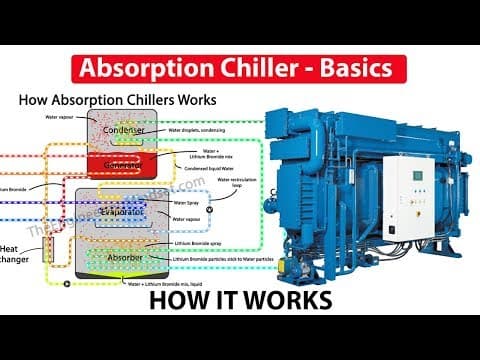
[0:05]Hey there guys, Paul here from theengineeringmindset.com. In this video, we're going to be looking at the basics of absorption chillers and learning how they work. Now, an absorption chiller is different to other chillers because it doesn't have a compressor. Instead, it uses heat to generate cooling. Now, that might seem a little confusing, but don't worry, by the end of this video, you'll understand why and how that works. Another interesting point to note about absorption chillers is that they don't use conventional refrigerants such as R134A or R22. Instead, they use water as a refrigerant. And this water is mixed with either ammonia or lithium bromide. Lithium bromide is the more common version and that's because it's safer and non-toxic. So, we're going to be looking at how the water lithium bromide type chillers will work in this video, but essentially they're very similar. Now, if this is a subject that interests you, then I highly encourage you to check out our other videos. And we've got other videos explaining how water cool chillers work. as well as air cool chillers.
[1:17]So do check out some of these videos. So just before we go in and start to look at how the inside of an absorption chiller works, I need you to understand three important concepts for the basic operation of how these type of chillers work. The first point is that when we boil water, it changes states from liquid to vapor. Now, the water boils at different temperatures under different pressures. If you increase the pressure, then the water boils at much higher temperatures, and if you decrease the pressure, then water boils at much lower temperatures. For example, we used the water boiling at around 100° Celsius, 212° Fahrenheit, and that's because we're at atmospheric pressure, which is around 101 KPA or 14.7 psi. But that is only because all the weight of the atmosphere above us, all the weight of the air which is above us. If we went higher up into the atmosphere, say to the top of Mount Everest, where the atmosphere is much thinner, then we would see boil water would boil at around 70° Celsius, 150° 58° Fahrenheit, and that's because the atmospheric pressure is around 34 KPA, 4.9 psi. And that is because there is less air or atmosphere weighing down on the water. So in the absorption chiller, in the evaporator and the absorber chamber, we're going to have a chamber pressure, a very, very low pressure in there, almost near vacuum. So we're going to have a low pressure of about 0.84 KPA or which is about 0.12 psi. And at that pressure, the water will boil at around 4.5° Celsius or 40° Fahrenheit. Now, if you pass the steam over a cool a pipe containing cold water, then the steam will transfer its its thermal energy over into that pipe, and it will then condense, and the steam will then turn into a liquid water again. So throughout the absorption chiller, we're going to be boiling the water to create it into a steam and then also be condensing it turning it back into a liquid. And you'll see why that is just in a moment. The second thing to understand is that lithium bromide is a salt, just in a liquid form. And salt is attracted to a water moisture. It literally pulls these particles of moisture out of the air and is attracted to it almost magnetically. So if we spray lithium bromide onto the some water vapor, then the two will be attracted together and and will join. The third point to remember is that when water and lithium bromide are mixed together, you can separate them again just by adding heat. So, as you apply heat to this, the two will separate where the lithium bromide particles will become heavier and so they will condense and come towards the bottom of the tank, or the reservoir, and all the water vapor will boil off and head upwards to become steam or water vapor. So you can separate the two just by applying some heat. Okay, so now that we know the very basics of what's happening inside, let's look at the main components of them. So in the top chamber, we'll always have the condenser and the generator. In the lower half of the chiller, we'll always have the evaporator and the absorber, and then on the side down down below near the bottom, we'll also have a heat exchanger. The heat exchanger is just there to improve the efficiency of the system. So it will transfer heat that's coming from the generator into the liquid which is coming from the absorber, and we'll see that in just a moment. So first of all, a mixture of around 60% lithium bromide and 40% water is pumped from the absorber through the heat exchanger, and then rises up and pours into the generator tank at the top of the chiller. Now, this line is often referred to as the weak solution line. And that is because the lithium bromide is mixed with the water, so it's a weak solution. The generator then fills up with this mixture of lithium bromide and water, creating a reservoir. Next, heat is added to the reservoir containing the lithium bromide and water, and this will begin the separation process that we saw earlier. Now, this heat is usually in the form of waste heat and will typically come from hot water or steam that's being pushed around a heat exchanger of of tubes inside the generator. The heat from this hot water or steam causes the lithium bromide and water to separate. All water particles will start to boil off and will fill the condenser with a hot water vapor or steam. Then the heavy lithium bromide particles will sink to the bottom and form a concentrated liquid. This hot liquid flows down to the heat exchanger where it transfers its heat into the weak solution line running in counter flow. Once the concentrated lithium bromide liquid has cooled down, it makes its way to the absorber where it is sprayed onto the chamber and will mix with the water before again being pumped to the generator to repeat the loop. But we will look at this part in more detail in just a minute. Next, we want to condense the hot water vapor in the condenser to bring it back to a liquid. So we pass water in a sealed pipe through the condenser and circulate it around to the cooling tower where it will be able to reject all the heat that it collects. The temperature of the cooling tower water is enough to cause the hot water vapor to condense into a liquid as it comes into contact with the surface of the pipe. So it will rain down and collect in the collection tray just below, just here. Once it collects in the tray, it will start to flow down to the evaporator and will be sprayed into the chamber. The amount of water that can flow is restricted by a small orifice in this pipe. Now, the evaporator, as we mentioned earlier, is a very low pressure, it's it's almost near a vacuum condition. Now, this sudden change in pressure will cause that water that's entering to suddenly flash and drop in temperature into a cold water of around just 4° Celsius, maybe 40° Fahrenheit. A chilled water loop then runs into the evaporator, bringing all the unwanted heat from the building which was collected from collected from the AHUs and the fan coil units, etc. So this cold condensed water will spray over the chilled water tubes and cover the surface of the tube in a thin film of cold water. The chilled water will enter at around 12° Celsius, 54° Fahrenheit, and this will transfer its thermal energy, its heat, all the unwanted heat from the building, it will transfer that through the tube wall and into the low temperature water film, which was sprayed across the outside of the chilled water tubes. Remember, the two waters never mix, they are always kept separate and they are separated by the pipe wall. As this heat transfers into the water on the outside of the tubes, this outer water will evaporate into a steam or water vapor due to the low pressure of the chamber. As it evaporates, it carries away all the unwanted heat with it. And remember, earlier, we did learn how water boils at lower temperatures under low pressure. So the chilled water circuit has now given up all the unwanted heat, and by the time it leaves the chiller, it should be around 7° Celsius, which is approximately 45° Fahrenheit. And this water is now ready to be pumped around the building again to collect more heat and bring it back to the absorption chiller. Another loop will recirculate any water that missed the tubes and didn't boil off into steam or water vapor, and this will be be pumped back to the top of the evaporator and sprayed again and again and again until all of it evaporates into steam. All of this water that's evaporating into water vapor and steam will build up and collect around the evaporator chamber. Now this water vapor or steam is then attracted and pulled towards the strong lithium bromide solution being sprayed in the absorber, almost like a magnetic force. The attraction is so strong that water particles flow by themselves straight to the absorber to be together with the lithium bromide particles. This strong almost magnetic attraction between the water particles and the lithium bromide particles is what causes the vacuum in the chamber. The lithium bromide attraction for the water is so strong that it will pull the water particles inside its own fluid, and it will all mix together. The stronger the concentration of lithium bromide, the stronger the attraction will be for water particles. When the two fluids come in contact, they generate a little heat, and this, as well as the heat collected from the chilled water loop, needs to be removed. So that is why the cooling tower water loop also passes through here. To take the unwanted heat away, now the cooling tower water will also condense any of the residual water vapor particles or the lithium bromide particles and turn this back into a liquid. And once this has occurred, the mixture of lithium bromide and water is collected at the bottom of the tank, in the bottom of the absorber, and it is now ready to be pumped back to the generator again to repeat the entire cycle. So there you have it, that's the basics, the basic operation of how an absorption chiller works. And that is the end of this video. So thanks for watching, I hope this has helped you. Please don't forget to like, subscribe and share, and if you have any comments, leave me in the comment section below. Also don't forget to check out our website, theengineeringmindset.com. And once again, thanks very much for watching.


