[0:00]Every day, millions of people worldwide consume whey protein as part of their diet.It is produced from cow's milk and undergoes several processes in factories to become a high quality protein powder. But how are more than 10,000 bottles of whey protein produced every day? From dairy farms to the production plant, we will uncover the secrets behind the manufacturing of one of the most famous supplements in the industry. Whey protein comes from cow's milk, specifically the liquid part that separates from the curds during cheese production. It has been a byproduct of cheese production for thousands of years. In the past, whey was considered an unwanted byproduct of cheese and other dairy product manufacturing. This liquid was a highly polluting byproduct for the environment, as its disposal could have negative effects on water and soil quality. Over time, as technology and nutritional understanding advanced, the nutritional value of whey, protein and other components of whey became recognized. This led to the development of more efficient and sustainable methods for processing whey into useful products such as protein. The process begins on dairy farms, where cows are specifically bred and kept for milk production. On these farms, it is believed that happy and healthy cows produce high quality milk and quality milk is the first step in making high quality protein supplement. An average dairy cow can produce around 30 liters of milk per day. Cow's milk is composed of 3% protein, and of that protein, 19% is whey protein. Cows are milked twice a day, usually by automated milking machines. During milking, the milk is extracted from the cow's udders. Milk is rich in nutrients, including proteins, fats, carbohydrates and minerals. Freshly harvested milk is temporarily stored in refrigerated storage tanks to keep it fresh and prevent contamination. These tanks are designed to maintain the milk at cold temperatures to prevent bacterial growth and ensure its quality. The milk is transported from dairy farms to the cheese processing factory. Each day fresh milk is transported directly to one of the local cheese factories. Refrigerated transport is typically used to maintain the milk at the right temperature during the journey. In the factory, the milk is unloaded from the transport trucks in specific receiving areas. A quality check of the milk is conducted to ensure it meets the required standards before continuing with the manufacturing process. The freshly arrived milk at the factory is stored in refrigerated storage tanks until it is ready for processing. Before pasteurization, it is essential to check the quality and freshness of the milk to ensure it meets food safety standards. The milk is pumped from the storage tanks through a pipeline system to a heater. In the heater, the milk is heated, typically to around 60 degrees Celsius for approximately 30 minutes. The purpose of this heating process is to eliminate and deactivate any harmful bacteria present in the milk, increasing its safety for consumption. After the heating phase, the pasteurized milk undergoes rapid cooling to reduce its temperature to four degrees Celsius. Rapid cooling stops the heating process and prevents the milk from overcooking, which could negatively affect its quality and taste. Throughout the pasteurization process, the temperature of the milk is carefully monitored and controlled to ensure it remains within specified ranges. After pasteurization, the milk is transported to a specific processing unit designed for separating its components. Pasteurized milk is introduced into a large container and undergoes a mechanical separation process. After pasteurization, a coagulant is added to the milk, leading to the formation of a solid mass known as curd. During this process, the remaining liquid, known as whey, contains concentrated proteins and other soluble components that are separated from the curd, in this cheese factory. The curd is used to make fresh cheese while the remaining whey is directed to a second line of business. A physical method such as filtration is typically used to separate the curd from the whey during the separation process. The resulting liquid fraction is whey, which is rich in whey protein. This phase of the process is essential for obtaining the desired protein component that serves as the basis for whey protein. The liquid whey fraction may contain small amounts of unwanted fats and minerals. In some cases, an additional purification step is performed to remove these components and obtain a cleaner and more protein concentrated whey fraction. Some processing facilities use microfiltration and cross flow filtration to further refine the whey protein fraction. These methods allow for the removal of impurities and concentration of whey proteins, resulting in a purer final whey protein product. This low temperature natural process separates the protein from fats and lactose, resulting in a finished product that is extremely rich in protein and retains important nutrients. The result of this step is a highly concentrated liquid whey fraction with minimal fat carbohydrates and other unwanted components. After filtration, the whey is subjected to the evaporation process. The whey is introduced into industrial evaporators, designed to remove excess water from the liquid fraction. The evaporation process is carried out at a controlled temperature to avoid damaging the proteins present in the whey. The temperature may vary, but is typically kept relatively low to preserve protein quality. Evaporation is a controlled process that gradually removes water from the liquid whey fraction. During this process, water evaporates and turns into vapor, while proteins and other solids remain concentrated. Once a significant portion of the water has been removed, the concentrated liquid whey fraction undergoes a drying process. Drying involves the introduction of hot and cold air into the concentrated liquid stream. Hot air helps further evaporate water, while cold air helps cool the product. This drying process ensures that the final product is in powder form and has minimal residual moisture. Subsequently, the resulting powder is sieved to remove any larger particles and ensure size uniformity. After this stage is completed, the powdered whey is introduced into a mixer to remove any remaining moisture and achieve a homogeneous mixture. Then it is packaged in sacks for sale to wholesalers. The sacks are sent to the protein factory, which is the largest protein factory in the world. It operates like clockwork, 24 hours a day, seven days a week, handling several hundred tons of whey protein and producing thousands of products. In the vast warehouse of the dietary supplement company, thousands of sacks of whey protein powder arrive daily. The materials are then taken from here to the weighing room, where all raw materials are weighed. All raw materials pass through a fine sieve, typically with a two millimeter opening. This ensures that all ingredients are carefully broken down and easy to mix. Whey protein powder is transported to the mixing area, where different flavors are added to give each product its unique and delicious taste. Subsequently, the powdered protein is mixed for a few minutes in these rotating drums. An operator places empty containers on the conveyor belt to start the filling process. In this stage, an automatic filling machine is used to fill the containers with the appropriate amount of protein powder. In this process, a worker uses a vacuum hose to transfer the protein from the sacks to the filling machine. Filling is done precisely to ensure that each container contains the specific amount of protein. After filling, each container undergoes a weighing process to verify that it contains the correct amount of whey protein powder. The containers advance along the conveyor belt to the next stage, where another worker places a measuring spoon in each container and properly closes the corresponding lid. Visual quality control is performed to ensure that the product looks correct and that there are no visible contaminants. Each container is labeled with important information, such as the product's name, nutritional information, usage instructions, expiration date, and batch number. Once the labeling process is completed, an employee inserts a plastic ring into the lid of each container. Next, the containers are directed to a heat sealing machine that seals the plastic rings with heat, ensuring a tight and precise seal. The filled and verified containers are placed in boxes for ease of transportation and distribution. If you want to know how KitKat chocolate is made, watch the video on your screen and please like the video if you enjoyed it and share it with someone who might be interested. Also, subscribe to this channel by activating the notifications to continue learning.Thanks for watching.
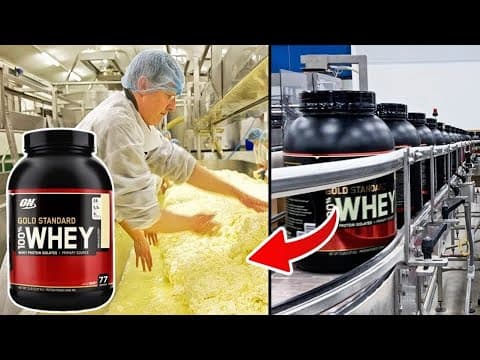
How WHEY PROTEIN is Made In Factories | You Won't Want to Miss This!
Xprocess
8m 56s1,420 words~8 min read
Auto-Generated
Watch on YouTube
Share
MORE TRANSCRIPTS