[0:24]Our next career plays a vital role in the field of medical science. We're in the lab today to meet a medical lab technologist. Hi. Hi, I'm Jody. I'm Brian. Nice to meet you. Nice to meet you. Let's get a lab coat on and get you started. Great. My name is Jody Simmons. I'm a medical laboratory technologist and we're at the Dawson Creek and District Hospital lab. Medical laboratory technologist works in the lab. They run patient samples, blood and body fluids, the tests that are ordered by a doctor and we run them on instruments and we make sure that those results are accurate and precise before we release them to the doctors. A typical day would involve coming in and waking up all our instruments and then we would have to pull quality control material to make sure that our instruments are running correctly. We would be doing any maintenance like pulling apart the instrument and cleaning it before we would want to run any patient samples. What is this machine? We're looking at the inside of a chemistry analyzer. So when someone for example comes in the hospital with a heart attack or a suspected heart attack, this is actually one of the instruments we use to see if there's been damage. So you're always learning about new instruments. Your day is always different. Your day is never the same. You might be learning a new instrument, a new technology. In a small lab like this, we are required to draw blood sometimes so we'll draw the blood and bring it back to the lab. We're looking at tubes and I'm going to tell what this person's blood type is by using my reagents and these tubes. So if you're an A pause patient or if your blood type is O, I'll be able to tell from these from these tests. You're putting drops in tubes and you're using pipettes and small equipment and you're doing maintenance, so it's good to be able to work with your hands. It's good to be very organized so you can organize your workflow and compartmentalize because you have priority specimens as well. You might get pulled from one thing and there's a stat that comes in and it's a lot more has priority over a routine sample and you need to stop what you're doing and work on that stat specimen from the emergency for example. Always double check your work because you do not want to make a mistake. This person's bleeding in the merch and they need blood quickly. You need to work quickly but accurately as well. I don't think people realize how closely we work with other health care professionals. We work with nurses and doctors quite a bit. So the centrifuge is slowing down. It has spun the two samples together, so basically your my patient cells have just been spun. But if you look here, this is my tube. That there is a blood clot. That's a agglutination of a patient cells. So because the blood clumped together within this solution, you know that this is What blood? This is an A person. Because I put A reagent in and the blood clumped. You have an A person. We work shift work, so we have day shifts. Our day shifts start at 7:30 to 4 and then we have a person coming in at 2:30 till 11:00 at night and they're our evening shift. So they're on call all night until the next morning. I was interested in chemistry and biology in high school and then I went on to get a university degree in biochemistry. There is a degree you can get for medical lab technologist, but I have a certification and it's a diploma, so it's a two and a half year program. The advantage of having a degree over the diploma is you do get paid extra and you can also take a management position a little easier than that. But the diploma, everybody is certified. You take a certification exam and everybody is considered certified and you can work anywhere in Canada. There's always opportunities to further advance your education. You could specialize in another department like microbiology. Also the CSMLS, which is our certifying body offers courses online that you can take and further advance. My advice for somebody straight out of school would be to go and do a lab tour, talk to somebody that works in a lab. A good medical laboratory technologist pays attention to detail. They're considerate to others. They really do care about the well-being of people. Even though you're not in the forefront and people don't always see you, it's nice to know that you're having an impact on somebody's life. Jody, thank you so much for showing me around. Nice to meet you. Don't forget to wash your hands. You got it. Thanks. Bye. Once again, I'm Brian for Career Trek reminding you that this career could be yours. See you next time.
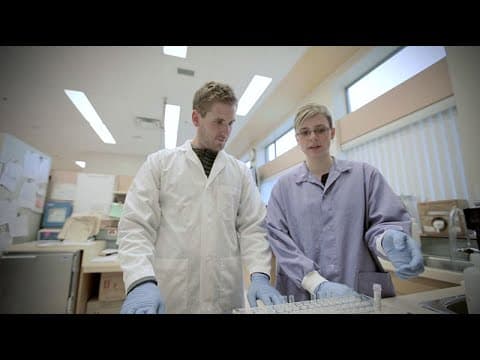
Medical laboratory technologist (Episode 63)
WorkBC's Career Trek
4m 42s843 words~5 min read
YouTube auto captions
Transcript source
YouTube auto captions
This transcript was extracted from YouTube's auto-generated caption track. The transcript below is server-rendered so it can be read, searched, cited, and shared without opening the original YouTube player.
Pull quotes
[0:24]I'm a medical laboratory technologist and we're at the Dawson Creek and District Hospital lab.
[0:24]They run patient samples, blood and body fluids, the tests that are ordered by a doctor and we run them on instruments and we make sure that those results are accurate and precise before we release them to the doctors.
[0:24]A typical day would involve coming in and waking up all our instruments and then we would have to pull quality control material to make sure that our instruments are running correctly.
[0:24]We would be doing any maintenance like pulling apart the instrument and cleaning it before we would want to run any patient samples.
Use this transcript
Related transcript hubs
Watch on YouTube
Share
MORE TRANSCRIPTS


