[0:03]Okay, so today we're looking at tax 5.2, which is Jay Leno's interview with President Obama. So in terms of the gap then, the genre, this is a transcript of a TV pre-recorded interview that was filmed in front of a live audience. The audience is going to be wide for this one. Obviously, we've got the people who are there in the studio as a primary audience, people who are fans of the show. We'll obviously tune in on a weekly basis, um, people who are fans of Jay Leno, and obviously people who are interested in Obama might choose to tune in for this specific episode of The Tonight Show. The purpose is to give air time to the President and thereby his party and political views, as well as being about his politics, we also get an insight into his personal and family life. Um, it also means there's an opportunity to question him on current political issues in the more relaxed context of a friendly interview. Um, so in terms of the context as well, it's going to be part planned, it's likely that he'll have seen the questions beforehand, but there is also a degree of improvisation, so that gives it a similarity to the Diana interview. It follows some rules of conversation, but it's also unusual because they're kind of performing the conversation for the audience there in the studio. What we definitely see is that the cooperation principles are at work, obviously they need to make this conversation function in order to make it a successful piece of television. Okay, so that's all the overview stuff. Let's start to look at some of the details. So we get a kind of typical disco structure here with the welcome and the welcome. Um, so that's typical disco structure to open with a greeting like that. Um, Jay Leno also uses Obama's full address. Welcome the President of the United States, Barack Obama. Okay, the use of his full address gives it a level of formality, and this pause here really creates a sense of excitement and elevates Obama's status. Um, it's just interesting to notice the kind of transcript conventions here, the fact that there's applause. Not much you can say about that. Um, but if you do go on to YouTube and watch the clip, you can see that the audience seemed very pleased to see Obama, so it certainly seems to be a very welcome greeting that he gets. And then this is repeated, so welcome, and then welcome back, sir. Now, um, potentially this is anaforic, but because it's used the repetition of the greeting, it might just be more appropriate to call it repetition. And it just really emphasizes the warm greeting, the positivity that um, he feels about having the President, uh, in on interview. He's appropriately polite, okay? He gives deference to Obama by calling him sir. And that polite pronoun, um, is important in terms of maintaining some formality in the conversation. Um, Obama, kind of, repeats all of these politeness strategies really back and says thank you, it's good to be back, um, to which there is more applause. And then we get really a lot of this phatic talk in the beginning. Well, we're thrilled to have you. Okay. And what the function of that really is, kind of, to break the ice. Obviously, he's just walked onto the show, and it's to ensure this kind of warm, positive opening. Um, and then the President kind of repeats himself, Obama, it is good to be back. So that repetition, but it includes the full verb this time to reinforce his positive position, and all of this helps to get the conversation running smoothly along. Um, and then we get more kind of, um, greetings here. And a happy birthday. Thank you very much. Happy birthday to you. Thank you. So these are agency pads of greetings, um, and it's more phatic talk, basically. So what's happening here is that they're establishing a kind of rapport. Um, there's a little bit of overlap that happens, uh, that happens here as well. And it just shows us really that they're settling in with their greetings. And establishes this positive atmosphere. There's a sense that they kind of, they know each other, they've met before, um, obviously because he says it's good to be back, so clearly he's been on the show before, okay? And the repeat repetition is also just another feature of the fact that this is informal speech, it's very much like a conversation. Um, so the, uh, informality is, is really continued in the elision here from Leno. So how did you celebrate Sunday? Um, there's an elision there, but it's also kind of American colloquialism, which gives it an air of informality. What did you do? Um, we've also got then we go into kind of question and answer agency pairs here. So this is the typical disco structure that I've labeled. There's regular turn taking, politeness principles are observed. We would expect in an interview as well for the interviewee to give longer answers than the person interviewing. And as the interview progresses, that's absolutely, uh, what happens as well. Okay, let's turn over then.
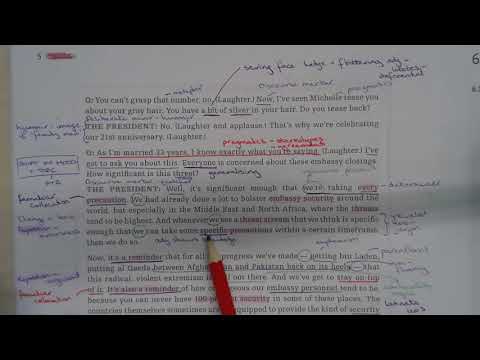
[11:43]So that kind of continues on the second page. We get you can't grasp that number, no. So more agreement from Leno, so more kind of cooperation. That's a metaphor, but it's a really familiar one, so that's keeping everything very accessible for the audience. Um, and there's more laughter, so clearly this is all going down well. Then we get this discourse marker now, which indicates a change in topic. I've seen Michelle tease you about your gray hair. You have a bit of silver in your hair. Do you tease back? Now, in terms of pragmatics, it's a bit of assumed knowledge here. I mean, I think most people in America would know who Michelle Obama is, and but that is a bit of assumed knowledge. Um, and then this is quite relaxed still, isn't it, in terms of what he's suggesting about his gray hair. Leno's aiming for quite a relaxed mood and tone. He encourages Obama's portrayal of himself as a family oriented man by asking another question about his family. Um, so obviously this is a bit of a face threatening act about him getting older, suggesting he's got gray hair. So then what he does is he, he has some kind of face saving strategies, so you have a bit of silver in your hair. So in terms of those strategies, we've got a hedge, in a bit. And then we've got a much more, uh, flattering adjective. Have we silver then gray. Think about the connotations of wealth and everything that are incorporated in that. So what you've got there is kind of like a bit of light teas, and this kind of deferential voice. I mean, he is the President of America, okay? So he needs to be deferential towards him. Um, Obama then starts to really play on kind of, uh, marital stereotypes, really. So he says, no, to which there's laughter and applause, so again, still being well received. That's why we're celebrating our 21st anniversary. Okay, this is a deliberate minor sentence here, this no. So he's really playing up to the stereotypes, like as if I would dare to tease her back. Um, that again is going to help to appeal to these kind of family voters. He's establishing this common ground with them. Um, and Leno really reiterates that because he says, as I'm 33 years, I know exactly what you're saying. Okay, so he really enhances this sense of familiarity by referencing his shared experience of marriage. And in terms of pragmatics, both of them are kind of playing up to this idea of the henpecked husband and they're kind of perpetuating that stereotype. Um, and also, yeah, creating this sense of agreement between them and reinforcing this cooperative principle. So up until now, everything's been quite comfortable for Obama and very much about his family. Um, but then we get this shift here after this laughter. So I've got to ask you about this. Everyone is concerned about these embassy closings. How significant is this threat? Um, now the way that he puts it as being everybody, the way that he generalizes that. That's a kind of classic journalistic technique where in order to commit this face threatening act, he distances himself from it. Um, and then obviously we've got this idea of, uh, it's a threat so there's something dangerous, and that really creates the change in tone. Obama starts off with this, uh, discourse marker, this qualifier, well, which is very much like the one that Diana used, okay? And it suggests perhaps like a classic politician, he's going to kind of answer the question but, but not quite completely. So, well, it's significant enough that we're taking every precaution. We had already done a lot to bolster embassy security around the world, but especially in the Middle East and North Africa where the threats tend to be the highest. And whenever we see a threat stream that we think it's specific enough that we can take some specific precautions within a certain timeframe, then we do so. So a real change in lexis here, isn't there, you know? Um, we've got some of this, um, kind of specialist lexis and jargon, like threat streams, is an example of that jargon. Um, and sort of, uh, repetition of this kind of much more bureaucratic and political lexis about precaution, embassy security. The repetition here about the the threats and the precautions and the security, I think it's very much trying to emphasize the seriousness of the situation. And in terms of the change in lexis, there's definitely a focus here on much more subject specific terms. So a total change in tone really to become much more serious. Interestingly, what he does though is uses inclusive pronouns, we. Okay, which suggests that it's everybody's shared responsibility. Um, we also get the determined every here, we're taking every precaution. And that determiner really helps to show the gravity and the determination. Uh, in a similar way, taking specific precautions. The adjective here implies a sense of knowledge in terms of the precautions that we're taking. Now this all sounds great in terms of a, uh, sort of very subject specific. He sounds very knowledgeable, there's jargon in there. However, if you think about what it actually means, it's all quite vague, okay? So that also fits with that political kind of voice. Um, then we get discourse marker now, to show that there's a shift in topic. Let's just, I'm going to move this up a little bit for you. You can see the bottom section there. Um, it's a reminder for all the progress we've made, getting Bin Laden, putting Al Qaeda between Afghanistan and Pakistan back on its heels. Okay, it doesn't quite make sense and perhaps indicates that he's feeling under a little bit more pressure or was maybe a little bit less confident writing about this.
[17:47]This whole parenthesis section here, though, really, um, shows his knowledge and establishes him as a successful president who's managed to make progress in this area. He continues with this, that this radical, violent extremism is still out there. So this is a nice example of like contrasting that very specific lexis with something that's deliberately vague. Okay, we don't know quite exactly what is still out there. And we've got to stay on top of it. Um, so that's a familiar colocation, so kind of understandable. Um, for the audience, but also slightly imprecise. And then we get a repetition here. It is also a reminder. So creating a bit of text cohesion there and layering up his argument. Of how courageous our embassy personnel tend to be, because you can never have 100% security in some of these places. Still ambiguity. The countries themselves sometimes are ill-equipped to provide the kind of security that you want. Even if we reinforce it, there are still vulnerabilities. And then we get this fronted conjunction and.
[19:35]Now that's also obviously a feature of speech, but it's also adding to his argument and it's making the case for action. And he goes on really to praise these diplomats. And these diplomats, they go out there and they serve every day. Oftentimes, they have their families with them. They do an incredible job and sometimes don't get enough credit. So we're grateful to them and we've got to do everything we can to protect them. Applause. So we put on here we've got some positive adjectives, okay? For example, we've got courageous, incredible, grateful. Um, and all of those really praise his personnel and show that he really values the service that they provide to him. We also get, um, a repetition of the modal verbs in we've got to and we've got to. Partly, that reinforces his kind of argument, but the repetition of the modal verbs there also implies a lack of choice and the necessity of taking preventative measures. So overall, then, we get two voices, really, from Obama. We've got the man of the people, but we's, we also have this authoritative leader. Um, who seems kind of official and in control. And that shift that happens from the informal to the authoritative.