[0:00]California has a reputation for tech billionaires and Hollywood moguls, but the families quietly accumulating the most power in this state don't appear on magazine covers. They don't do interviews, they don't post on X. They own the hotels you sleep in, the gas stations you fill up at, the software that runs your hospital, and the land your neighborhood sits on. And almost none of them have a last name you've ever heard. Today, we are counting down the 10 richest Indian families silently owning California. And the scale of what they control will make you rethink everything you thought you knew about wealth in this country. Number 10, the Shriram family. In the late 1990s, a quiet Indian-American man named Kavitark Ram Shriram wrote a check for $250,000. The company he was betting on had no revenue, no product, no customers, just two Stanford graduate students in a garage with an idea about organizing the internet. That company was Google. Shriram was born in Chennai, India and earned a mathematics degree from Loyola College before eventually landing in the United States, where he worked directly for Jeff Bezos at Amazon in its earliest days. When he left Amazon, he didn't retire. He started looking for the next Bezos. He found two of them in Larry Page and Sergey Brin. That $250,000 initial investment turned into a stake worth hundreds of millions. Today, Kaviderk Ram Shriram sits on the board of Alphabet, Google's parent company, and his venture firm, Sherpalo Ventures, based in Menlo Park, California, continues to quietly deploy capital into the next generation of technology companies. His net worth as of 2025 sits at approximately $3 billion, but the number almost misses the point. Shriram didn't just make money off Google. He helped shape the early decisions, the culture, the direction of the company that now controls over 90% of global internet search. He is not a household name. He has never tried to be. While the two founders of Google became cultural icons, Shriram became something more valuable, the invisible hand that helped guide the engine of the modern internet. He also donated $61 million to Stanford University, a quiet act that says everything about how this family operates. Not loud, not flashy, permanent. Number nine, the Wadhwani family. He was born 10 days after India became a nation in Karachi, a city that would almost immediately stop being part of India. His family fled during the 1947 partition. As a child in Mumbai, he contracted polio. By every statistical measure, Romesh Wadhwani should not be one of the most powerful technology investors in the world. But that is exactly what he became. Wadhwani studied electrical engineering at IIT Bombay, then earned his PhD from Carnegie Melon University. He spent the next several decades building, selling, and dominating the enterprise software world. His company Aspect Development was acquired in 2000 for $9.3 billion at the time, the largest software acquisition in history. He then built Symphony Technology Group, a private equity firm based in Palo Alto, California that quietly acquired 36 companies across enterprise software, growing the portfolio to $2.5 billion in combined revenue with 15,000 employees. The firm's holdings included SurveyMonkey, but Wadhwani wasn't finished. At an age when most billionaires are building museums and giving commencement speeches, he made the bet that defines his legacy. He committed $1 billion of his own personal fortune to build Symphony AI, an enterprise artificial intelligence company targeting the industries that others won't touch. Manufacturing floors, retail supply chains, financial crime detection, and healthcare diagnostics. He did this not with outside investors, not with a venture fund, he wrote the check himself. His current net worth sits around $5 billion. He runs his empire from a mansion in Los Altos, California, logging 70 to 80 hours a week. He is a member of the Gates Buffett Giving Pledge. President Obama appointed him to the board of the Kennedy Center. And yet almost no one in California knows his name. That is not an accident. Number eight, the Aurora family. In 2023, one Indian-American CEO became the highest-paid executive of Indian origin in the United States, earning over $150 million in a single year. His name is Nikesh Arora, and he did it by turning a struggling cybersecurity company into the most powerful security operation on the planet. Aurora was born in Northern India into an army family. Discipline was the language of his childhood. He studied engineering at IITBHU before heading to America for an MBA at Northeastern University and a master's in finance at Boston College. He then climbed to the top of Google, holding senior executive roles for nearly a decade before being recruited by SoftBank, one of the most powerful investment firms in Asia, as its president and heir apparent. He left SoftBank in 2016 and took over Palo Alto Networks, a California-based cybersecurity firm that was solid but not dominant. What he built next was something entirely different. Under Aurora's leadership, Palo Alto Networks transformed from a single product firewall company into a comprehensive cybersecurity platform that now secures governments, hospitals, banks, and Fortune 500 companies across the globe. The company became the gold standard for what modern cybersecurity looks like in the age of artificial intelligence. Headquartered in Santa Clara, California, Palo Alto Networks now commands a market capitalization in the tens of billions. Aurora's personal net worth is approximately $1.4 billion, but his economic footprint and the infrastructure he controls is orders of magnitude larger. He is the general of California's cyber army, and no one elected him. Number seven, the Ullal family. Every time you use ChatGPT, every time a data center processes your medical records, every time a financial institution runs a real-time fraud algorithm, somewhere in that chain, there is hardware running at extraordinary speed, moving extraordinary amounts of data. There is a very good chance it runs on a network built by Jayashree Ullal's company. Ullal was born in London, raised in India, and educated in the United States. She holds a degree from San Francisco State University and an MBA from Santa Clara University. She began her career at Cisco Systems, where she spent nearly two decades building expertise in networking infrastructure before making the move that would define her legacy. In 2008, she became the CEO of Arista Networks, a then obscure networking company based in Santa Clara, California. What she inherited was a niche business. What she built was the spine of modern computing. Arista Networks provides the high-speed ultra-low latency networking hardware that powers hyperscale data centers, the giant server farms run by Microsoft, Amazon, Meta, and Google. As the AI revolution exploded demand for data center capacity, Arista's position became indispensable. The stock reflects it. Since Ullal took over, Arista Networks has delivered returns that have made early investors extraordinarily wealthy. Her own stake in the company gives her a net worth of approximately $4.5 billion, making her the only female Indian-American billionaire in this category. She has also famously private. No reality shows, no podcast circuit, no celebrity friendships, just results compounding year over year, while the infrastructure of artificial intelligence runs quietly through the hardware her company sells. She is not the face of Silicon Valley. She is its skeleton. Number six, the Khosla family. There is a beach south of San Francisco called Martin's Beach. For over a hundred years, California families fished there, surfed there, brought their children there. It was a beloved public stretch of coast. In 2008, Vinod Khosla bought the land surrounding it for $32.5 million, then he locked the gate. What followed was one of the most extraordinary legal battles in California history. The Surfrider Foundation sued, California sued, the case went all the way to the United States Supreme Court, which declined to hear his appeal. Courts repeatedly ruled against him. The state threatened fines of $20 million. Khosla's response, according to one legal observer, was essentially, the fine is irrelevant to a man of his means. The battle is still unresolved in 2025 with a trial scheduled and settlement talks ongoing. This is the character of Vinod Khosla, a man who does not believe the rules that apply to everyone else apply to him, and who has the financial resources to make that belief last for decades. But it is only one chapter. Khosla was co-founder of Sun Microsystems, one of the companies that built the early internet. He then founded Khosla Ventures in Menlo Park, California, becoming one of the most influential venture capitalists in the world, placing early bets on clean energy, biotech, artificial intelligence, and nuclear fusion. His portfolio includes companies that are attempting to rewrite the global energy system. His net worth is approximately $9.2 billion. He is the rare billionaire who simultaneously fights for a greener planet in his investment portfolio and fights against public beach access in his personal life. The contradiction does not appear to bother him. In California, he is a force of nature, literally and legally. Number five, the Bhoosri family. Right now, there are 10,000 companies around the world who cannot issue a paycheck, cannot hire a new employee, cannot file an HR report without going through software built by one Indian-American family in Pleasanton, California. Aneel Bhusri is the co-founder and co-CEO of Workday, the enterprise software company that has become the operating system for how modern corporations manage their people and money. Workday's clients include more than half of the Fortune 500, banks, hospitals, universities, governments. If you work for a major institution, there is a meaningful chance that every promotion you've received, every tax form you've been issued, every vacation day you've tracked, was processed through Workday's platform. Bhusri grew up in the United States, the son of Indian immigrants. He studied computer science at Brown University and then earned an MBA from Stanford before founding Workday in 2005 alongside Dave Duffield. He served on the board of PeopleSoft and watched it get taken over by Oracle in one of the most hostile corporate battles in Silicon Valley history. That loss became fuel. Workday went public in 2012 in one of the most celebrated tech IPOs of its era. The company is now headquartered in Pleasanton, California and carries a market valuation in the tens of billions. Bhusri's personal net worth sits at approximately $8 billion. He is measured, disciplined. He does not generate tabloid headlines. He has never been on a reality television program, or parked a yacht in a harbor as a personal billboard. He built a product so essential, so deeply embedded in the machinery of the global economy, that the companies who use it cannot leave without dismantling their own internal infrastructure. That is not a product. That is a lock. Number four, the Chaudhry family. There is no electricity in the story, no running water, no roads worth mentioning. A village of 800 people in the hills of Himachal Pradesh, where a boy named Jay walked 4 km every day to reach his school, and then studied outside under a tree because it was the only place with enough light. That boy is now worth $17.9 billion. Jay Chaudhry is the richest Indian-American in the United States, the number one immigrant billionaire on the Forbes 2025 list, and the founder and CEO of Zscaler. A cloud security company that controls the digital gateway through which tens of millions of corporate employees access the internet every single day. Here's what that means in plain terms. Every time an employee at one of the 35% of Fortune 500 companies that are Zscaler clients opens a browser, accesses a company application, or connects to the corporate network, that traffic flows through Zscaler's infrastructure first. The company doesn't just sell a product. It sits in the middle of the internet for the world's largest organizations. Chaudhry arrived in the United States in 1980 at the age of 22, boarding a plane for the first time in his life, funded by a Tata industry scholarship to attend the University of Cincinnati. He would go on to earn three master's degrees. He worked at IBM, at NCR, at Unisys, and then, in 1996, he and his wife, Jyoti, quit their jobs and pooled their life savings, approximately $500,000 to launch their first cybersecurity startup. That company sold to VeriSign. Then came another startup, then another, then another. Five companies built, five companies sold. In 2007, he put $50 million of his own money into Zscaler. The company went public in 2018 in the year's most anticipated tech IPO. Chaudhry and his family retained roughly 40% of the company. He does not own a fleet of yachts. He does not race supercars. He still travels commercial. He has said publicly that he has no attachment to money, that the mindset he developed growing up in poverty, where he simply never had money to attach to, became the very thing that made him fearless enough to build an empire. His company now secures the digital infrastructure of Coca-Cola, Siemens, the City of Los Angeles, Air France, and Fannie Mae. He employs thousands across California. He is the most powerful Indian-American in the state, and most Californians have never heard his name. Number three, the Pichai family. He doesn't own the company. He was hired, and yet, Sundar Pichai may exercise more influence over what information 7 billion humans can and cannot find on the internet than any other single individual alive. Pichai was born in Chennai, India in 1972. His family lived in a two-room apartment. He slept on the living room floor with his brother. His father was an electrical engineer at GEC, a British manufacturing company. The family did not own a television until Sundar was 12. When they got a telephone, Pichai, who had an extraordinary memory, memorized every number they dialed. He won a scholarship to IIT Kharagpur, one of the most selective engineering institutes on Earth. He then came to America on a scholarship to Stanford, where he studied material science. He went on to Wharton for his MBA. He joined Google in 2004 and rose steadily, making arguably the single most consequential internal product decision in tech history, championing Google Chrome, a browser that would go on to capture nearly two-thirds of the global browser market and fundamentally lock billions of users into the Google ecosystem. In 2015, he was named Google's CEO. In 2019, he became CEO of Alphabet, the parent company of Google, YouTube, DeepMind, Waymo, and Verily. He now sits atop a company with a market capitalization exceeding $2 trillion. He joined the Forbes Billionaire list in 2025, his personal net worth estimated at approximately $1.1 billion. Modest by the standards of this list, extraordinary by any other standard. He is also the steward of one of California's most critical economic engines. Alphabet employs tens of thousands across the state. Its offices form the backbone of Mountain View's entire economy. Its tax contributions fund California's public infrastructure. Pichai didn't build Google, but he is the reason Google conquered everything. Number two, the Khosrowshahi family. Most CEOs inherit a thriving company and try not to break it. Dara Khosrowshahi inherited a dumpster fire. In 2017, Uber was imploding. Its founder had been forced out amid allegations of sexual harassment, toxic culture, regulatory battles on every continent, and a company-wide scandal that dominated global headlines for months. Uber's reputation was in ruins. Drivers were revolting, cities were banning the app, investors were panicking. Into that chaos walked Khosrowshahi. Born in Tehran, Iran, he was part of a prominent Iranian business family that fled to the United States after the 1979 revolution. He was nine years old when they arrived. His father built a new life from scratch. Dara attended Brown University, graduated with honors in economics, and eventually rose to the top of Expedia, running the travel giant for more than a decade and delivering explosive shareholder return. When the Uber board came calling, the smart money said no. The risk was enormous. The cultural cleanup alone would take years. Khosrowshahi said yes. What followed was one of the most remarkable corporate turnarounds in American business history. He systematically dismantled the toxic internal culture. He navigated Uber through a landmark IPO in 2019. He steered the company through the Covid-19 pandemic when ride-hailing revenue collapsed, pivoting aggressively into Uber Eats, which became a lifeline. He brought Uber to profitability for the first time in the company's history. Uber is now headquartered in San Francisco, California. Its market capitalization has surpassed $150 billion, more than Ford and General Motors combined. It operates in 70 countries. It has fundamentally altered how cities function, how people move, and how restaurants survive. Khosrowshahi's personal net worth is approximately $1.6 billion, but his economic footprint in California, the jobs, the tax revenue, the infrastructure of urban mobility, is a multiplier of that by orders of magnitude. He didn't build Uber, he saved it. And in doing so, he became one of the most consequential business leaders in the state's history. Number one, the Patel Dynasty. In 1942, a Gujarati farm worker with a fourth-grade education and no legal immigration status, walked into a 32-room run down hotel in Sacramento, California. The Japanese-American woman who owned it had just been forced into a wartime internment camp. He leased it for $350 down and $75 a month. He had no hospitality experience, no business background, no English beyond survival. His name was Kanji Manchhu Desai, and what he started that day in Sacramento is the single greatest wealth creation story in the history of California. Possibly in the history of American immigration. Today, the Patel Dynasty descended from the Gujarati community, Desai personally mentored, financed, and recruited, owns more than 60% of all hotels and motels in the United States. Not some hotels, not a lot of hotels, the majority of the entire country. The empire they built is valued at $370 billion. It employs 4 million people. And it started with one undocumented man and a $350 deposit in Sacramento. Desai was not just a businessman. He was an architect of community. After leasing his first hotel, he moved to San Francisco's Hotel Goldfield, which became a headquarters, a landing pad for every new Gujarati immigrant who arrived in California with nothing. He fed them, he housed them. He gave them interest-free handshake loans, no collateral, no repayment schedule. His one piece of advice repeated constantly: if you are a Patel, lease a hotel. By 1954, he had personally helped nearly 30 families enter the hospitality business. Each of those families helped the next. The chain of trust became a machine. The business model was genius in its simplicity. A distressed roadside motel in the early 1970s could be acquired for around $40,000, exactly the threshold required for an immigrant to qualify for US permanent residency under business investment rules. The motel came with living quarters attached, meaning no separate rent. Family members became the entire labor force. No payroll, no outside staffing, profits were reinvested, property improved, sold at a premium, larger property acquired, then repeat. The banks refused them. Insurance companies refused them, assuming immigrant owners would burn properties down for the payout. Racial discrimination was constant. Guests who saw a brown face behind the counter sometimes walked out without a word. After 9/11, some Patel owners put American owned signs in their windows just to survive the hostility. They survived anyway. By the 1980s, Gujarati Patel families dominated California's hotel corridor. By the 1990s, they were the single largest ethnic group in the entire US hotel industry, owning not just roadside motels, but Holiday Inns, Comfort Inns, Marriotts, Hiltons, and Sheratons. Today, the Asian American Hotel Owners Association, which is overwhelmingly Patel-led, represents members who collectively control a hospitality empire larger than the GDP of most countries on Earth. This is not a single family in the traditional sense. It is a dynasty built on a shared last name, a shared region of Gujarat, and a shared code, you helped the person behind you the exact same way someone helped you.
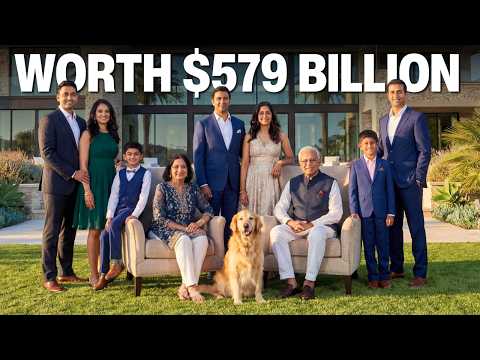
This Is The RICHEST Indian Family That OWNS California... Richer Than Hollywood!
Elevated Status
19m 57s3,372 words~17 min read
YouTube auto captions
Transcript source
YouTube auto captions
This transcript was extracted from YouTube's auto-generated caption track. The transcript below is server-rendered so it can be read, searched, cited, and shared without opening the original YouTube player.
Pull quotes
[0:00]California has a reputation for tech billionaires and Hollywood moguls, but the families quietly accumulating the most power in this state don't appear on magazine covers.
[0:00]They own the hotels you sleep in, the gas stations you fill up at, the software that runs your hospital, and the land your neighborhood sits on.
[0:00]Today, we are counting down the 10 richest Indian families silently owning California.
[0:00]And the scale of what they control will make you rethink everything you thought you knew about wealth in this country.
Use this transcript
Related transcript hubs
Watch on YouTube
Share
MORE TRANSCRIPTS


