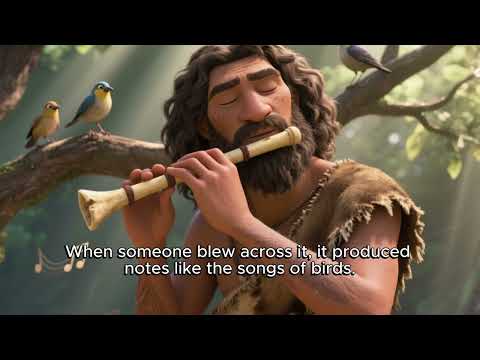
[0:00]Hello teachers, parents, and kids. Welcome to Wonder Kids Academy. The invention of music. Long before people built cities, long before books were written, and long before machines filled the world, humans discovered something that became one of their greatest treasures, music. Music was not invented in a single moment by a single person. Instead, it slowly grew from the sounds of nature, the voices of people, and the rhythms of life itself. The invention of music is really the story of how humans learned to turn sound into art, communication, and emotion. In the beginning, people listened to the world around them. They heard the wind blowing through trees, the rain falling on leaves, the thunder rolling across the sky, and the birds singing in the morning. These natural sounds inspired the earliest humans. They learned that by clapping their hands, stomping their feet, or hitting stones together, they could create their own rhythms. This was the first step toward music, turning everyday actions into patterns of sound. Over time, early humans discovered that their voices could do more than speak. By humming, shouting, or singing, they could imitate the sounds of nature or express feelings. Singing became a way to share emotions, to call out to others, and to celebrate important moments. Voice was the first true musical instrument, and it remains the most powerful one even today. Then came the creation of simple instruments. Bones and sticks could be used to beat rhythms. Hollow logs could be struck like drums. Shells with holes could be blown into like whistles. One of the oldest instruments ever found is a flute made from the bone of a bird, carved over 40,000 years ago. When someone blew across it, it produced notes like the songs of birds. This was one of the earliest signs of humans shaping sound into music. As people began to gather in groups and form communities, music took on new roles. It became a way to bring people together. Around campfires, voices joined in chants and rhythms, creating unity. Music was used in rituals, celebrations, and storytelling. It carried history and culture from one generation to the next, even before writing existed. Through music, knowledge and traditions could be remembered and shared. Please take a second to like our video. This helps our algorithm so that other boys and girls can learn the fun things that you are watching also. Different instruments began to appear across the world. In Africa, drums and rattles created strong rhythms. In Asia, string instruments like the guqin and sitar were developed. In Europe, lyres and harps produced melodies. In the Americas, flutes and percussion instruments became central to ceremonies. Each culture invented new ways of shaping sound, but everywhere, music served the same purpose: to connect people with each other and with the world around them. As time went on, music became more complex. People discovered that different notes could be combined into scales and harmonies. They learned how to arrange sounds into songs, and songs into patterns that told stories without words. Music became a language of its own, able to express joy, sadness, hope, and wonder. Unlike spoken language, music could be understood by anyone, no matter where they came from. The invention of written music marked another great step. Thousands of years ago, ancient civilizations such as the Sumerians and Greeks began creating symbols to record musical sounds. This allowed music to travel farther than the memory of a single person. Written notes could be shared, studied, and performed by others, even across centuries. With this, music could be preserved as part of human history. Throughout the centuries, music kept evolving. In medieval times, choirs sang in cathedrals, filling vast spaces with harmony. During the Renaissance, instruments like the violin and piano began to take shape. In the classical era, composers wrote symphonies and operas that explored new depths of sound. In every age, humans added new layers to the invention of music, building on what came before. But music was never only for kings, temples, or grand stages. It has always lived in everyday life. People sang while working in fields, while rocking babies to sleep, while marching into battle, and while celebrating weddings. Music gave rhythm to daily life, turning ordinary moments into something memorable and meaningful. Today, music surrounds us in countless forms. Technology allows us to record, play, and share music instantly. Instruments from all over the world can be combined, and voices from every culture can be heard. Yet the heart of music has not changed. It is still about rhythm, melody, and emotion. It is still about humans using sound to connect, to express, and to celebrate life. The invention of music is not finished. Every new song, every new instrument, and every new style adds to the story. From ancient bone flutes to modern digital beats, music keeps transforming, but it always carries the same purpose: to move people, to bring them together, and to give sound to the feelings that words alone cannot hold. Music was born from nature, shaped by humanity, and carried forward by every generation. It is one of the greatest inventions not because it was built from stone or metal, but because it was built from the human heart. And as long as people are alive, the invention of music will continue, filling the world with rhythm, melody, and harmony. Thank you for watching this WonderKids Academy Video, and I hope you all have a happy and healthy day. Make sure to check out our YouTube Channel for more fun and educational videos designed especially for preschoolers and young kids. And see you in our next video. Remember to like, share, subscribe, and turn on the notification bell for more interesting videos like this. Please also visit us @ www.wonderkidsacademy.info and see more of what we are all about. Thanks again for watching our video.and see more of what we are all about
How Music Began: Fun History for Kids
WonderKids Academy
6m 57s998 words~5 min read
YouTube auto captions
Transcript source
YouTube auto captions
This transcript was extracted from YouTube's auto-generated caption track. The transcript below is server-rendered so it can be read, searched, cited, and shared without opening the original YouTube player.
Pull quotes
[0:00]Long before people built cities, long before books were written, and long before machines filled the world, humans discovered something that became one of their greatest treasures, music.
[0:00]Instead, it slowly grew from the sounds of nature, the voices of people, and the rhythms of life itself.
[0:00]The invention of music is really the story of how humans learned to turn sound into art, communication, and emotion.
[0:00]They heard the wind blowing through trees, the rain falling on leaves, the thunder rolling across the sky, and the birds singing in the morning.
Use this transcript
Related transcript hubs
Watch on YouTube
Share
MORE TRANSCRIPTS


