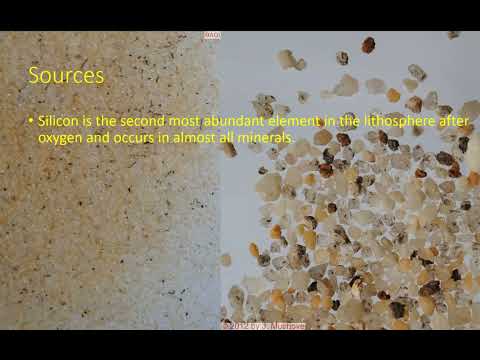
[0:05]Silicon, we're going to look at the element silicon and how it's important for plants. Silicon is part of the cell wall complex often binding with pectin that helps create the outer part of the cell wall. It provides rigidity and protection for the plant. Some plants like rice have a high silicon content, most plants are affected by silicon in some way or another. Silicon may play an important role in lignin synthesis. Lignin is one of the protective structures of the plant. It is a polyphenolic type material. It provides protection. Silicon is really involved in the outer part of the plant for protection. We have silicon accumulators. These are plants that accumulate fair amounts of silicon which include rice. If you've ever seen rice in the field, it's kind of hard on the outside. Another interesting plant is horsetails. These are seedless vascular plants. These are often found in very wet environments. It's called scouring rush because if you take the plant and crumble it up, it functions just like steel wool. It has that high amount of silicon, which makes it very abrasive. That's a trick that many survivalists know. You also have silicon non-accumulators which do not accumulate much silicon on the outside. These include sugarcane and legumes. Legumes are one of the largest plant families. Legumes have a compound leaf and they have a fruit that looks like a bean. There are other effects that silicon has. Silicon in the outer layers of the plant may help prevent fungal infection or insect feeding. If you've got a lot of silicon on the outside of the plant, the plant becomes very abrasive and very difficult to eat. Think of the thick layer like a sheet of glass on the outside of the plant. It helps prevent fungal infection because there are no enzymes that can penetrate through silicon. Silicon may interfere with other elements such as manganese. Aluminum toxicity may be mitigated by silicon. Silicon can dilute other materials that might be toxic. The method of uptake of silicon appears to be selective. We get that idea from some plants being accumulators. It is transported within the xylem. When we look at sufficiency. Sufficiency is not reported because you're never going to find a soil that is deficient in silicon. Therefore, we never talk about sufficiency. Deficiency is going to be more evident in a silicon accumulator. Rice in the horsetail which accumulates silicon may run into a deficiency problem. Any other plant is not going to run into a deficiency. In rice, you get necrotic spots. This rice plant has flecking on it. This flecking has been attributed to a silicon deficiency. Remember, rice is a silicon accumulator. Luxury consumption is not known. There is no real function for the plant to accumulate more silicon than it can use or than it can deposit. Silicon is always available. Toxicity is not known. Virtually all soil has abundant silicon. If silicon were toxic to the plant, the plant would have been taken out of the gene pool a long time ago. Sources of silicon, silicon is the second most abundant element after oxygen in the lithosphere, which is the rocky area of planet Earth. It occurs in almost all minerals. Important silicon containing minerals include quartz, opal, and cristobalite. When you think of silicon, think of sand. Sand is nothing more than pulverized quartz. We've got different size sands in the background. These are all silicon. Imagine the extreme amounts of it that you have in the soil. Therefore, you do not find silicon to be limiting. Soluble silicon in the soil solution is mainly orthosilicic acid, which may form polymers by splitting off water. According to the equation, orthosilicic acid combines to form a polymer that would have silicon in the center of it. You do this by dehydration synthesis. Artificial application. There is never a need to do it because there's always enough silicon in the soil. Remember, it's in sand. It's in clay, it's in silt. It's in all minerals that you find. Silicon is most available in acid soils. As the soil becomes a little bit more acidic, you will find it more available. Therefore, silicon is one of these unique materials. It may be problematic, but you will never have to worry about applying more of it. If you're going to apply more of it, you could simply apply sand. When you're dealing with silicon, you want to remember that it is extremely available. It is most available in acid soils. If you run into a deficiency, your soil pH may need a little correcting. It would get you back to a pH that silicon would be more available at.
Silicon as an essential element for plant growth.
Julia's Science Lab
4m 50s790 words~4 min read
Auto-Generated
Watch on YouTube
Share
MORE TRANSCRIPTS