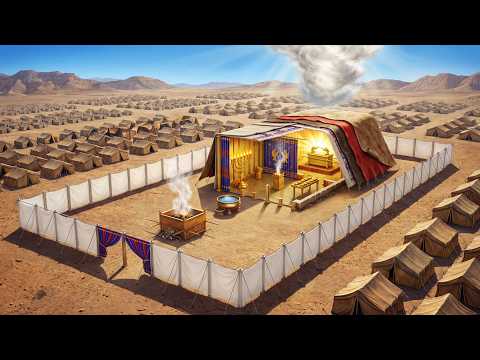
[0:00]How do you build a house for God? Not a cathedral, not a temple carved into a mountain side. A tent. A portable tent designed to be assembled, disassembled and carried across a desert by hand. No blueprints on paper, no power tools, no factory cut lumber. Just 600,000 former slaves standing in the wilderness with Egyptian gold and wood from desert trees. And here's the part that defies logic. This portable tent had to contain the actual presence of the creator of the universe. A presence so holy, so dangerous that approaching it wrongly meant instant death. This is the Tabernacle, the Mishkan, God's portable dwelling place. And what they built in that desert 3,400 years ago, still baffles engineers today. The year was approximately 1450 BC. 14 months had passed since the night of Passover, since the Red Sea parted and Pharaoh's army drowned in the returning waters. Israel was free, but freedom raised a question no one had considered. God had delivered them with 10 plagues. He had walked with them as a pillar of cloud by day and fire by night. But how does an infinite God stay with a finite people? How does the creator of galaxies travel with a nation of nomads? The answer came from God himself. A single command recorded in the Book of Exodus. Let them make me a sanctuary that I may dwell among them. This was not a human idea. God initiated this project. And when Moses climbed Mount Sinai, he didn't just receive the 10 Commandments, he spent 40 days receiving detailed construction plans. Every measurement, every material, every color, every technique. The instruction was absolute. Make it exactly according to the pattern shown you on the mountain. Moses didn't design this. He downloaded it straight from the mind of God. But a blueprint means nothing without builders. So, God hand-picked two men by name. The first was Bezalel from the tribe of Judah. Scripture says he was filled with the spirit of God in wisdom, understanding, knowledge, and all craftsmanship. He was the master of metalwork, woodwork, and stonecutting. The second was Oholiab from the tribe of Dan, an expert in textiles, embroidery, and engraving. Alongside them, worked hundreds of wise-hearted men and women, skilled volunteers who gave their time and talent. And the materials? The gold and silver and bronze had been ripped from Egypt as back payment for 400 years of slavery. The women donated their bronze mirrors. The people gave so generously that Moses had to command them to stop. God had given the vision. He had appointed the workers. He had provided the resources. But one question hung over the project like the desert sun. Could human hands actually build a dwelling place for the Almighty? And if they succeeded, would he actually show up? Before the curtains, before the gold furnishings, before the holy objects. Someone had to solve an engineering problem that shouldn't have been solvable. How do you build a rigid structure, 45 feet long, 15 feet wide, 15 feet tall that can be disassembled by hand, carried by Levites across the wilderness, and reassembled without power tools? Over and over again for 40 years. The solution was a modular frame system, unlike anything the ancient world had seen. The foundation of this frame was 48 boards cut from acacia wood. Acacia was the only tree stubborn enough to grow in the Sinai desert, dense grain, twisted fibers, virtually rot-proof. Each board stood 10 cubits tall, roughly 15 feet, and one and a half cubits wide, about 27 inches. And every single board was completely overlaid with gold. 20 boards formed the south wall. 20 more formed the north. Eight boards, including two special corner pieces, formed the back wall on the west. The east side remained open as the entrance. But here is where the engineering becomes remarkable. At the bottom of each board were two projections called tenons. And each tenon fit precisely into a socket made of solid silver. 100 sockets in total. Each socket weighed one talent, 75 pounds of pure silver. Do the math. That's 7,500 pounds of silver just for the foundation, nearly four tons. Why so much weight at the bottom? Physics. All that mass concentrated at ground level created a low center of gravity. When desert winds screamed across the camp, those 15-foot boards didn't budge. They couldn't. The weight held them fast. But the genius didn't stop there. Five horizontal bars ran across each wall threaded through gold rings attached to the boards. Four of these bars were visible from the outside, but the fifth bar, called the middle bar, ran through the center of the boards themselves, inside the wood. An invisible spine holding everything together. You couldn't see it from outside, but without it, the walls would have buckled. Imagine the sound. The heavy thud of silver meeting sand, the scrape of gold-plated wood sliding into socket. 48 boards rising from the desert floor like golden walls materializing from nothing. And here's what most people miss. Those silver sockets came from the census ransom money. Every Israelite man had paid a half-shekel to redeem his life. That silver was melted down and cast into the foundation. The entire structure literally stood on redemption. No board touched the ground directly. Every piece rested on the price paid for human souls. The skeleton was up. 48 golden boards standing on silver feet locked together by hidden bars. But bones need skin, and what came next would transform this gleaming frame into something that looked from the outside almost ordinary. The Tabernacle didn't have one roof, it had four. Layered on top of each other like skin over muscle over bone. Each layer served a physical purpose, but each layer also told a story. The innermost layer was the most beautiful thing in the entire structure. Ten curtains of fine twisted linen woven with threads of blue, purple, and scarlet against brilliant white. But the linen wasn't just colored, it was embroidered. Cherubim, angelic figures were stitched into the fabric by the hands of master craftsman. This was the ceiling the priests saw when they looked up. Angels woven into fabric. Heaven stretched overhead. The ten curtains were joined together by 50 golden clasps forming one continuous canopy. The second layer was goat hair. 11 curtains, slightly longer than the first layer, joined by bronze clasps instead of gold. We're moving outward now, away from the glory. Goat hair seems rough and primitive compared to embroidered linen, but it was brilliantly practical. When goat hair gets wet, the fibers swell and seal, making it waterproof. When it dries, the fibers relax and breathe. Natural climate control. The Bedouins still use this material today. The third layer was ram skins dyed deep red. No dimensions given in scripture. It was fitted over the goat hair as insulation and additional waterproofing. Red, the color of blood, the color of sacrifice, hidden beneath the outer layer, but present, always present. The fourth and final layer was the skin of the Tachash, most likely the sea cow or dugong from the Red Sea. Tough, weather resistant, and a dull gray brown that blended into the desert landscape. Here is the profound contrast. From outside the camp, the Tabernacle looked like just another tent. Weathered hide stretched over a frame, nothing special, nothing remarkable. You could walk past it and never guess what waited within. But step inside. Gold everywhere. Walls of gold, angels overhead, light dancing on polished metal. The glory was hidden. You had to enter to see it. Feel the weight of those goat hair curtains being hoisted overhead. Hear the rustle of fine linen settling into place. Smell the tanned leather, the lanolin still clinging to the wool. From the outside, a tent. From the inside, a throne room. The structure was complete, frame and covering, bones and skin. But a house isn't a home until it's furnished. And before anyone could step inside God's house, they had to pass through a courtyard. A courtyard that smelled like blood. Before you could enter the Tabernacle, you had to enter the courtyard. And the courtyard wasn't a garden, it was a slaughterhouse. The space was enormous by ancient standards. 100 cubits long, 50 cubits wide, roughly 150 feet by 75 feet. A fence of white linen curtains, 7 and a half feet tall enclosed the entire area, hung on 60 bronze pillars with silver tops. The white linen blazed in the desert sun, pure, clean, blinding. And there was only one way through it, a single gate on the east side, 30 feet wide, marked by an embroidered curtain of blue, purple, scarlet and white. One way in, no back doors, no side entrances. You came through the gate or you didn't come at all. The moment you stepped through that gate, you faced the bronze altar. It was massive, 7 and a half feet square, 4 and a half feet tall. Acacia wood covered entirely in bronze, four horns jutted from its corners. A bronze grating sat inside holding the sacrifices while ash fell to the chamber below. This is where animals died every single day. Lambs, bulls, goats, blood poured out on the horns, fat sizzled on the grate, smoke rose constantly toward heaven. The message was impossible to miss. You cannot approach God without sacrifice. Something has to die. Passed the altar stood the bronze Laver, a large basin filled with water positioned between the altar and the Tabernacle entrance. And here is a detail that always stops me. The Laver was made entirely from the bronze mirrors donated by the women who served at the entrance of the tent of meeting. Think about that. Mirrors, instruments of vanity, tools for examining your own face, were melted down and reformed into an instrument of cleansing. The women traded seeing themselves for the priest's purity. The priests were commanded to wash their hands and feet at this Laver before entering the holy place. The instruction was absolute. Wash or die. Breathe in the air of that courtyard, the metallic tang of blood, the smoke of burning fat, the sizzle of flesh meeting flame. This isn't beautiful. This is brutal. This is the cost of coming close to a holy God. Sacrifice, then cleansing, then and only then, could you approach the door. You've passed the altar. Blood has been shed. You've washed at the Laver. Your hands are clean. Ahead of you, five pillars covered in gold frame an embroidered curtain rippling in the desert wind. Beyond that curtain lies the holy place, and only priests may enter. Five pillars of acacia wood covered in gold mark the entrance. But notice something subtle. These pillars stand on bronze sockets, not silver. A transition point. You're leaving the courtyard of bronze and stepping into the dwelling of gold. Push past the embroidered screen and step inside. The temperature drops. The sounds of the camp, the animals, the children, the commerce, all of it disappears. There are no windows here, no natural light. The only illumination comes from seven flames burning on solid gold. The room stretches 30 feet long, 15 feet wide, 15 feet high. Gold covered walls surround you on every side, and overhead, the linen ceiling with its embroidered cherubim makes you feel as if heaven itself is watching. To your left, on the south side, stands the golden lampstand, the Menorah. One talent of pure gold, 75 pounds hammered from a single piece of metal. Not cast in a mold, not assembled from parts, beaten into shape by human hands, guided by divine design. A central shaft rises with six branches extending from it, three on each side. Seven lamps in total. Each branch is decorated with almond blossoms, buds, and flowers. The lamps burn pure beaten olive oil and they never go out. Tended every morning, lit every evening, this is the only light source in the room. Seven flames dancing, reflecting off golden walls, casting flickering shadows across the space. To your right, on the north side, stands the table of showbread. Acacia wood covered in gold with a decorative molding around the edge. 12 loaves of bread rest on its surface at all times, one loaf for each tribe of Israel. Every Sabbath, the priests replace the old bread with fresh loaves and eat what has been removed. This is the 'Bread of the Presence' or 'Face Bread.' All of Israel represented before God's face every single day. Directly ahead, positioned at the center of the room just before the great veil, stands the Altar of Incense. The smallest of the altars, just 18 inches square and 3 feet tall. Acacia wood overlaid with gold, with four golden horns at its corners. Every morning and every evening, the priest burns a special incense on this altar. The recipe is sacred. Its formula given by God himself and forbidden for any other use. The smoke rises, drifts toward the massive curtain ahead, and curls under its edges toward the presence beyond. Stand there for a moment. Gold everywhere. Walls, lampstand, table, altar. Seven flames casting shadows that dance and flicker. The smell of incense thick in the still air. And ahead of you, a curtain, massive, heavy, embroidered with cherubim in blue, purple, and scarlet. Guardian angels, woven sentinels blocking the way, just as cherubim had guarded the entrance to Eden after the fall.
[19:09]Beyond that curtain is the most dangerous room on earth, and you are not permitted to go. For 364 days a year, this is as far as anyone went. Even the high priest stopped here. But once a year, just once, one man would gather his courage, take blood in his hands, fill the room with incense smoke, and push past that curtain into the presence of the Almighty. What waited behind the veil? The veil was the final barrier, the last line between humanity and divinity. The same material as the inner ceiling, blue, purple, scarlet threads woven into fine white linen, with cherubim embroidered across its surface. Guardian angels, woven sentinels blocking the way, just as cherubim had guarded the entrance to Eden after the fall. The veil hung from four pillars covered in gold, but notice this, these pillars stand on silver sockets, not bronze like the entrance to the holy place. Silver, the metal of redemption. The closer you get to God's presence, the more precious the foundation. Beyond the veil lies a perfect cube. 10 cubits by 10 cubits by 10 cubits.
[19:40]And it is utterly dark. No lampstand here, no windows, no torches, no source of light at all except the glory of God himself. Inside this darkness sits one piece of furniture, the Ark of the Covenant. A chest of acacia wood covered in gold inside and out. 2 and a half cubits long, 1 and a half cubits wide, 1 and a half cubits tall. Gold molding around its rim. Four gold rings at the corners through which gold covered poles are inserted. Poles that are never removed because the Ark must always be ready to move. Inside the Ark rest the stone tablets of the Covenant, the law that Israel broke. A golden jar of manna, the provision that Israel rejected. And later, Aaron's rod that budded, the authority that Israel challenged. Everything inside that chest represented human failure. Broken commands, rejected grace, questioned leadership, all of it sealed away under the lid. But the lid is no ordinary cover. The Mercy Seat, solid gold, not gold over wood like everything else, pure gold beaten into shape. And rising from each end, two cherubim hammered from the same single piece, facing each other. Their wings stretched upward and inward until the tips touch overhead. Their faces look down, always down, gazing at the space between them. That space, on that golden lid, between those two angels, that was the place. The one place in the entire universe where God promised to meet with Moses, where his voice would speak, where his presence would dwell. This was his throne on earth. The intersection of heaven and sand. No one decorated this room. No one cleaned it. No one entered it except one day a year, and even then, only the high priest, and only with blood in one hand and incense in the other. The smoke would fill the space first, hiding the Mercy Seat so the priest wouldn't see God's glory directly and die. Then he would sprinkle blood on the lid, on top of the broken law, covering human failure with evidence of sacrifice. There was no furniture to dust, no lamps to trim, just the Ark, just the angels, just the darkness, and the presence. This was the room where heaven touched earth. Where the creator of galaxies compressed his glory into a space the size of a small bedroom. And between two golden angels on a throne made by human hands, God sat, waiting for the one day a year when blood would cover sin, and a priest would survive his presence. The framework was built. The coverings were stretched. The furniture was placed. The courtyard was enclosed. Every socket, every bar, every curtain, everything was in position. The Tabernacle was complete. But one question remained. Would he come? The first day of the first month of the second year. 14 months since the night death passed over Egypt. One year since the people stood trembling at the base of Sinai while thunder rolled and the mountain burned. And now, finally, the work was finished. Moses himself performed the final assembly, not Bezalel, not the priests, Moses. The man who had received the vision would put the last pieces into place. He placed the silver sockets in the sand, erected the golden boards, inserted the bars to lock them together. He spread the four coverings over the frame, the embroidered linen, the goat hair, the red rams skins, the weathered Tachash hide. He carried the stone tablets and placed them inside the Ark. Set the carrying poles through the rings, laid the Mercy Seat on top. Then he brought the Ark into the Holy of Holies and hung the veil to conceal it. He positioned the table on the north side and arranged the bread. He set the lampstand on the south side and lit its flames. He placed the Altar of Incense before the veil and burned the sacred incense. He hung the screen at the entrance to the Holy place. He set the bronze altar before the door and made the first offerings. He placed the Laver between the altar and the entrance and filled it with water. He erected the linen fence around the courtyard. He hung the gate, and Moses finished the work. He stepped back, surveyed what lay before him. Every detail exactly as God commanded. Not a cubit off, not a color wrong, not a socket misplaced. The work of his hands. The work of Bezalel and Oholiab, the work of hundreds of willing hearts. It stood complete. But completion was never the goal. Habitation was the goal. Would God accept it? And then it happened. The cloud. Not just any cloud, the cloud. The pillar that had led them out of Egypt, that had stood between them and Pharaoh's chariots at the sea, that had hovered over Sinai while the mountain shook. It began to move. It descended from the sky slowly, deliberately, and it covered the tent of meeting. And the glory of the Lord, the Shekinah, the visible, tangible, radiant presence of the living God, filled the Tabernacle. Moses tried to enter. He couldn't. Not because the door was blocked, not because someone stopped him, because the weight of glory was too heavy, too present, too real to push through. This was the same Moses who had climbed Sinai, who had seen the burning bush that wasn't consumed, who had stood in the cleft of the rock while God's goodness passed by, who had spoken with the Almighty face to face. Even he could not enter. This wasn't a vision. This wasn't God appearing briefly and vanishing. This was God moving in. They had followed his blueprint. They had built him a house, and now, he was home. The impossible had happened. A tent made of desert wood and animal skins and melted Egyptian gold had become the dwelling place of the one who spoke the universe into existence. Heaven had touched earth, and the cloud would remain over the Tabernacle by day, fire glowing within it by night, a visible sign that God was present. For the next 40 years, wherever that cloud moved, Israel followed, and wherever it stopped, they made camp. The glory had come, and earth would never be the same. The Tabernacle was not just a tent. It was a declaration. A statement that the God of infinite space wanted to live not in some distant heaven, but in the center of the camp, close enough to visit, near enough to hear. Every detail was intentional. The bloody altar said, 'A price must be paid.' The Laver said, 'Purity is required.' The veil said, 'My holiness is dangerous.' But the Mercy Seat, with its two angels looking down at the place where blood would be sprinkled. The Mercy Seat said, 'Come anyway. There is a way.' They built it with their hands. He filled it with his presence. Human craftsmanship, divine inhabitation. And for the next 400 years, wherever Israel went, God went with them, dwelling in a tent, traveling with his people. One board and silver socket at a time. Which part of the Tabernacle struck you most? The engineering of the framework, the layers that hid glory beneath ordinary hide, the moment the cloud descended and Moses couldn't enter. Please let me know your thoughts in the comments. I look forward to hearing from you.