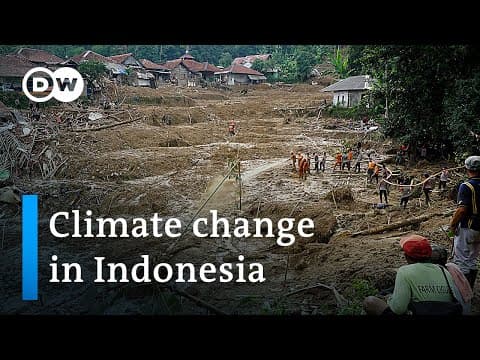
[0:00]Indonesia says it's dedicated to climate targets as it sends delegates to the UN climate change conference this weekend.
[0:07]Meanwhile, people on the ground are already facing the grave consequences of extreme weather.
[0:14]DW's Georg Matthes traveled to West Java where he met villagers reeling from a fatal landslide.
[0:25]On a rainy day, this car wouldn't stand a chance here.
[0:30]We've traveled deep into Indonesia's tropical forest, on the edge of West Java's National Park.
[0:39]Back in January 2019, the place looked very different. After days of heavy rains, part of this hillside gave way, burying about 30 houses.
[0:55]It was 6:00 p.m. and I was about to take a bath when I heard a very loud rumbling.
[1:02]I rushed outside, but I got caught in the landslide. For 4 hours I was buried under the rubble of my house.
[1:10]Aham lost many family members among them his only son.
[1:16]Together with the village chief, he takes me back to where he used to live.
[1:22]There are 33 names are engraved in memory of the victims.
[1:26]This is the stone? Yeah.
[1:32]That's what happens when you violate the traditional law. The forest area up there should not have been turned into paddy fields, but people did it anyway. Why? Because it's necessary.
[1:44]Rules are rules, but we should also think about people's needs. The most important thing here is rice. We need fields.
[1:52]It's a dilemma many villagers face in this part of Indonesia. A growing rural population is trying to make ends meet.
[2:02]Plantations like this one are slowly eating their way into the National Park.
[2:07]But deforestation is only part of the problem. Climate change makes landslides and forest fires worse.
[2:14]Yeah, Java is in the future as we simulate by the climate model projection in the future, the precipitation will be more and more in the rainy season, and in the opposite season in dry season, we we got the indication that less and less rainfall.
[2:32]Back in West Java, farmer Aham and his chief take us to their new village.
[2:39]We are the first camera team to return. They say this shows there's not much interest in them.
[2:46]Aham's new house has the same problems, a wall of mud just behind it.
[2:53]His wife's memories are still fresh.
[2:58]I will always remember our son. I still see his face. He was so young and now he left his sisters behind.
[3:07]He didn't have much of a life. Sometimes that makes me cry. Now even when I hear the rumble of a motorcycle, I'm traumatized.
[3:20]In Desa Sirnaresmi Village, everyone is worried about the next months with the rainy season just having started.
[3:31]Global carbon emissions may seem like a distant problem here.
[3:36]But these communities are the ones most vulnerable to climate change.
[3:43]DW correspondent Georg Matthes joins us now from Jakarta. Georg, it's been almost three years since the devastating landslide and you mentioned in your report that your news team was the first to return since it happened.
[3:55]What struck you the most on this trip?
[4:01]Look, what struck me most is really thinking about climate change and then traveling out there to this remote village was really how real the effect of climate change is, particularly when you talk to elders in the village.
[4:15]They're planting rice twice a year and what they told me is that they can't predict the weather anymore. The weather has practically become unpredictable and that's a very real way of of seeing how climate change is impacting communities like this one.
[4:32]Now, the people you spoke with, they're obviously the ones being impacted directly by climate change. How concerned are they about future climate events?
[4:43]Oh, they're very concerned, obviously because they've been hard hit by climate change and by man-made mistakes of deforestation.
[4:54]But what they told me is it doesn't really help if they if the if the government or if people abroad just play a blame game and say you're deforesting your forest because they said they have no choice, like I said in the report.
[5:05]And so that shows as well that climate change is not just an environmental issue, it's also a social issue. So the solutions to help these people to make them stop cutting trees, eating into the forest, if you want, also has to involve broader solutions like welfare solutions for them.
[5:24]Now, the climate change conference is just around the corner. Talk to us a little bit about the Indonesian government's commitment to combating climate change.
[5:34]Oh, they're very committed. Uh they go to Glasgow with high goals. They want to ramp up efforts, but they're also looking for financial aid to achieve those efforts.
[5:46]They have the plan to reduce emissions by 41% with international help and 29% without international help.
[5:53]And preventing deforestation is a key objective they have on their board. They basically hope to turn Indonesia into a carbon sink by protecting forests and preventing forest fires.
[6:07]DW correspondent Georg Matthes, thank you for your reporting.
[6:14]In Indonesia, coal is king. Globally, it's one of the largest producers and exporters and it's the eighth biggest carbon emitter on the planet.
[6:23]Indonesia is now targeting to be carbon neutral by 2060 and stop building coal-fired plants in a few years.
[6:31]But despite that pledge, a facility in the city of Cilegon is undergoing a massive expansion.
[6:38]And those living in the area fear the plant will further worsen water and air pollution.
[6:44]This enormous coal-fired power plant looms large over this village.
[6:49]Around 14 million homes rely on the energy it produces.
[6:54]But that power comes at a high cost.
[6:57]Nearby residents complain of health problems, environmental degradation and a severe impact on their livelihoods.
[7:05]Suwiro has been a fisherman here nearly all his life. He says the number of fish in the area has plummeted in recent years.
[7:15]There used to be a lot of red snappers and grouper fish here, among others. But now it's difficult to catch any fish here at all.
[7:25]I don't know where they have gone. This was one of the good fishing spots, but now the seabed is covered in coal dust.
[7:35]It's all part of an increasing energy dilemma.
[7:38]On the one hand, Indonesia needs cheap and reliable energy to sustain its growing economy.
[7:44]But at the same time, power plants like this one are harming the very people they were made to serve.
[7:50]Misnan Arullah is a local resident and anti-pollution activist. He says the noxious fumes pumped out by the plant are also making the people sick.
[8:00]Whether they like it or not, the plant is there. The local residents have no option but to adapt to the pollution, regardless of the negative effects on their lives.
[8:14]If they have coughing or breathing difficulties, they simply get some medication.
[8:23]Despite its negative effects, this plant is being expanded with the help of nearly $2 billion from South Korea.
[8:33]In April, Seoul vowed to end funding for overseas coal projects, but the money for this power plant was handed out before that decision.
[8:43]The use of fossil fuels is a problem across Asia.
[8:46]In fact, the Asia-Pacific region accounts for around three quarters of global coal consumption.
[8:53]Until a solution is found, plants like these look set to stay on the map.
[8:58]And for many Indonesians, scenes like this one behind me speak volumes about the country's problem with plastic waste.
[9:05]A new museum near the city of Surabaya features artwork that its founders hope will be a bit shocking.
[9:12]It's a plastic museum built mostly from materials used before, but only once before it was tossed aside.
[9:19]She's the goddess of rice and prosperity, revered here by the Javanese of Indonesia.
[9:27]And this statue of Devi Sri is the beautiful centerpiece of a museum with ugly origins.
[9:33]The statue is made of plastics found in the polluted rivers and on the trashed beaches of Indonesia, a country second only to China for the volume of plastics that wind up in the seas.
[9:44]We want to send a message to the people to stop the use of single use plastics, from plastic water bottles, plastic bags, straws, sachet packaging, Styrofoam and disposable diapers.
[9:57]Those things will later pollute our ocean and world.
[10:01]The plastic waste museum went from concept to near completion in the course of about 3 months.
[10:07]It wasn't hard to find the plastic, much of it discarded domestically or washed ashore from the Pacific Ocean and the South China Sea.
[10:15]Seeing this makes me sad.
[10:18]I'm going to change my life habits. I have to buy reusable things like drinking bottles instead of plastic bottles.
[10:26]I'll switch from a plastic bag to a tote bag, and I'll use a glass for water.
[10:34]That, of course, is music to the ears of the museum's founder, who'd be happy to someday be without any of his plastics museums building materials.
[10:44]Because these plastics are very difficult to recycle, and this waste pollutes our nature and oceans. Starting today, we should stop consuming single-use plastics, because they'll pollute our oceans, which is also our source of food.
[11:00]A museum with a message, one in which the goddess of prosperity would concur.


