[0:00]Welcome to the Automoto Freak channel. Greetings to all viewers, subscribers, supporters. So to the point, the Honda 2.2 ICDDI engine, internally designated N22A, was a significant milestone for Honda. Launched in 2003, it was Honda's first in-house designed and built diesel engine for passenger cars. Prior to this, Honda had relied on diesel engines sourced from other manufacturers like Rover and Isuzu. The N22A aimed to offer diesel efficiency with the refinement and driving characteristics typically associated with Honda's renowned petrol engines. History and versions. The N22A engine was a 2.2 liter, 2,204 cubic centimeters, 4-cylinder, 16-valve common rail turbo diesel unit. It was designed to be lightweight and compact, featuring an all-aluminum block with cast iron cylinder liners. It utilized a common rail direct fuel injection system from Bosch, with electromagnetic injectors operating at 1,600 bar and was equipped with a variable geometry turbocharger, VGT. All versions feature a timing chain. There were primarily two main versions of the N22A. N22A1, typically found in the Honda Accord 7, 2004 to 2008, and CRV 2, 2001 to 2006, and FRV. N22A2, used in the Honda Civic 8, 2006 to 2011, and CRV 3, 2006 to 2012. Both versions generally produced 103 kilowatts, 140 PS, 138 horsepower, at 4,000 RPM and 340 Newton meters, 251 LBFT, of torque at 2,000 RPM. Some later models, post-2006, also integrated a diesel particulate filter, DPF, to meet evolving emission standards, initially Euro 4 compliant. It was later succeeded by the 2.2 IDTC, N22B, in 2008, which brought further refinements and increased power outputs. Review and opinions. Upon its release, the Honda 2.2 ICDDI was largely praised as a groundbreaking engine for Honda. It was seen as exceptionally good for a first attempt at an in-house diesel. Advantages, refinement, and smoothness. A key highlight was its impressive refinement for a four-cylinder diesel. It was often described as petrol-like in its power delivery, revving freely and smoothly without the typical harshness or diesel surge of many contemporaries. Strong performance, with 140 PS and 340 Newton meters of torque, it offered very good performance for its class, providing brisk acceleration and effortless cruising. Excellent fuel economy. Owners consistently reported very good real-world fuel consumption figures, often exceeding 50 miles per gallon, Imperial, in mixed driving. Durability, generally once initial teething problems were addressed, especially for models produced from 2006 onwards, the engine gained a reputation for being robust and capable of high mileages, living up to Honda's reliability image. Timing chain, the use of a timing chain rather than a belt is generally seen as an advantage, as it avoids costly belt replacement intervals. No DPF on early models. Earlier versions, pre-2006, did not have a DPF, which for some owners is a benefit as it removes a potential source of expensive problems. Disadvantages, initial reliability hiccups. Early production engines, roughly 2003 to 2006, did suffer from some recurring issues that could be frustrating and costly. Expensive parts and servicing. Being a technologically advanced engine for its time, replacement parts and repairs can be costly compared to simpler engines. Clutch and dual mass flywheel, DMF, issues, while not strictly an engine fault, the clutch and DMF were often cited as weak points, particularly in the Civic, requiring expensive replacement. This is common across many powerful diesel engines, however. DPF problems, on later models, for models equipped with a DPF, city driving or insufficient regeneration could lead to clogging issues, requiring forced regenerations or costly replacements. Faults and breakdowns. While generally considered reliable in the long run, the N22A engine has some known weak points and common failures. Timing chain stretch and failure. This is one of the most significant reported issues, particularly in the N22A. While designed to be lifetime, the timing chain can stretch, leading to rattling noises, especially on cold start, and potentially causing catastrophic engine damage if not addressed. Some reports even mention the oil pump chain breaking, leading to oil pressure loss and major internal damage. This seems more prevalent in higher mileage examples or those with neglected oil changes. Exhaust manifold cracking. A relatively common issue, especially on the N22A, where the exhaust manifold can crack, leading to exhaust gas leaks, increased noise, and potentially affecting turbo performance. Turbocharger problems, while generally robust, the turbocharger can fail, especially on higher mileage engines or if maintenance has been poor, e.g., infrequent oil changes leading to carbon buildup. Symptoms include whistling noises, smoke, and loss of power. EGR valve clogging, common in most modern diesels, the exhaust gas recirculation, EGR, valve can get clogged with carbon deposits, leading to rough idling, loss of power, and error codes. Crankshaft damper pulley failure. Some instances of the crankshaft damper pulley failing prematurely have been reported, leading to noise or issues with auxiliary belts. High pressure fuel pump issues. While improved over very early diesels, there were some initial reports of high-pressure fuel pump problems, particularly in earlier production batches. Throttle sensor failure, early accord, as noted in an early fleet news review, some very early accord models experienced issues with a faulty throttle sensor, leading to no accelerator response. This was typically resolved by Honda. Hot start problem. Some owners have reported issues with the engine being difficult to start when hot, which could be linked to various sensor or fuel system issues. Fuel consumption. The Honda 2.2 ICDDI was highly efficient for its time. In models like the Civic and Accord, combined fuel consumption figures were often around 5.5 to 6.5 liters per 100 kilometers, 43 to 51 miles per gallon imperial and 36 to 40 miles per gallon US, in real-world mixed driving. On long motorway journeys, figures in the high 50s to low 60s MPG, Imperial, were achievable. In a slightly heavier CRV, consumption would be a little higher, but still impressive. Timing. The Honda 2.2 ICDDI and 22A engine uses a timing chain, not a timing belt. Replacement interval. The timing chain is designed to be a lifetime component, meaning there is no manufacturer specified replacement interval. Issues, as mentioned in the fault section, chain stretch is a known issue, particularly at higher mileages. It's crucial to listen for rattling noises, especially on cold starts, as this indicates potential wear on the chain or its tensioners and guides. While it's designed for life, proactive inspection and replacement, if noises are present, can prevent catastrophic engine damage. Some reports suggest that chain issues were more prevalent on earlier models and that models from around 2006 onwards were improved. Some mechanics suggest that very high mileage cars, e.g., 200,000 km, 125,000 miles plus, might benefit from inspection, especially if noises are present. Oil, oil type, and change interval. Proper oil selection and frequent changes are crucial for the longevity of the N22A engine. Particularly given the known timing chain sensitivity to oil quality and contamination. Oil type. Honda recommends fully synthetic diesel engine oil. Viscosity, the most commonly recommended viscosities are SAE 0W. 30 or SE 5W30. Specifications, the oil should meet ACEA C2 and C3 specifications, especially for models equipped with a diesel particulate filter, DPF. These are mid-SAPS oils designed to protect DPFs. For earlier models without DPF, ACB3 and B4 might be acceptable, but using AC2 and C3 oil is generally safer and compatible. Honda also has its own genuine diesel oils, e.g., Honda diesel oil 0W and 30 synthetic. Oil capacity. The oil capacity for the N22A engine is typically around 5.9 liters, including the oil filter. Change interval. Honda's official recommended interval is often around 20,000 kilometers, 12,500 miles or annually, whichever comes first. However, many specialists and experienced owners strongly advise shorter intervals for optimal longevity, particularly considering the timing chain sensitivity to oil quality and contamination. A more prudent interval would be every 10,000 to 15,000 km, 6,000 and 9,000 miles, or 6 to 12 months, especially if the car is used for frequent short journeys or in stop-and-go city traffic. Regular and timely oil changes with the correct specification oil are paramount in preventing timing chain stretch and turbocharger issues. Overall, the Honda 2.2 ICDDI and 22A engine was a highly successful first venture into in-house diesel production for Honda. It offered a compelling blend of performance, refinement, and fuel economy. While early models had some teething problems, notably with the timing chain and exhaust manifold, later versions proved to be very reliable if properly maintained with the correct oil and regular servicing. It remains a well-regarded engine by many owners, provided its specific maintenance needs are met. Thank you for watching the video, and I invite you to subscribe to the Automoto Freak channel. Greetings to everyone and see you in the next episode. See you soon.
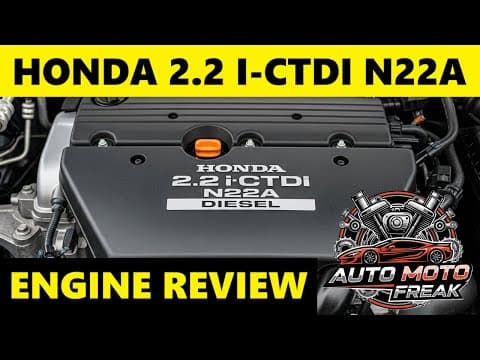
2.2 I-CTDI N22A REVIEW, PROBLEMS, RELIABILITY, FAILURES, FUEL CONSUMPTION, TIMING, OIL?
AUTO MOTO FREAK
11m 20s1,453 words~8 min read
Auto-Generated
Watch on YouTube
Share
MORE TRANSCRIPTS
![Thumbnail for 🔴 [MULTISUB] BABYMONSTER COMEBACK LIVE LET'S CHOOM | Weverse Live PART 1 - [04.05.2026] by Kpopgirls](/_next/image?url=https%3A%2F%2Fimg.youtube.com%2Fvi%2FzT9WpzV7PzA%2Fhqdefault.jpg&w=3840&q=75)