[0:00]You've read the stories, the blind man sees, the storm goes quiet, the dead man walks out of a tomb. And if you're like most people, you've heard these miracles told like isolated episodes, like they happened in random order, scattered across four gospels with no connection between them. But what if I told you there's a sequence? What if every miracle Jesus performed was building toward something? And the order they happened in reveals a pattern most people have never noticed. Because when you lay all of them out, from the very first to the very last, something extraordinary emerges. Jesus wasn't just healing people. He wasn't just proving he was powerful. He was telling a story with every single miracle, and that story has a beginning, a middle, and an end that changes how you understand everything he did. Here's what makes this fascinating. Matthew, Mark, and Luke tell the story of Jesus from similar angles, which is why scholars call them the Synoptic Gospels. Those three primarily used the Greek word dunamis to describe what we call miracles. Dunamis means raw power, inherent ability, a force that can't be stopped. It's where we get the English word dynamic. When Matthew or Mark describe Jesus casting out a demon or calming a storm, they're saying this is dunamis. This is power being unleashed. But the Gospel of John never uses that word, not once. John exclusively uses the Greek word semeion, which means sign. And that distinction matters more than you'd think. A dunamis makes you go, wow, that's incredible. A semeion makes you ask, wait, what does that point to? John chapter 20, verses 30 through 31, tells us exactly why he chose that word. Jesus performed many other signs in the presence of his disciples, which are not written in this book. But these are written that you may believe that Jesus is the Christ, the Son of God, and that believing you may have life in His name. Every miracle was evidence. Every healing was a signature. Every act of power was a signpost pointing somewhere specific, to who Jesus actually is. And there's a third word the New Testament uses. Teras, meaning wonder or prodigy, describing the effect these events had on people who witnessed them. So when Acts chapter 2 verse 22 says God accredited Jesus by miracles, wonders and signs, it's using all three Greek words in one sentence, Dunamis, Teras, and Semeion. Power, astonishment, and meaning. That's the triple lens through which every miracle of Jesus needs to be understood. The Old Testament had its own vocabulary for this. The Hebrew Oth means sign, and Mopheth means wonder, a word that carries the idea of something so conspicuous, so unmistakable, that you can't look away from it. These two words travel together throughout the Hebrew scriptures, appearing side by side in Exodus, Deuteronomy, Nehemiah, Jeremiah. When God brought Israel out of Egypt, Deuteronomy chapter 26 verse 8, says he did it with signs and wonders. The miracles of Jesus aren't a new category. They're the continuation of the same God doing what he's always done. Revealing himself through acts that carry meaning far deeper than the surface event. So let's walk through them, chronologically. And let's watch the story unfold. The very first miracle happens at a wedding, and that matters more than most people realize. John chapter 2, verses 1 through 11. Jesus, his mother and his disciples are at a wedding feast in Cana of Galilee, a region in Northern Israel. Archeologists led by Dr. Tom McCullah have been excavating a site called Khirbet Qana, about 12 km Northwest of Nazareth, and they found possible evidence this may be the actual location, including an underground veneration complex with crosses carved into walls and Greek inscriptions referencing Lord Jesus, plus a shelf carved into bedrock with space for six large stone vessels. The identification isn't settled among scholars, but the findings are intriguing. Now here's a detail that hides in plain sight. John opens this story with the words on the third day. Most people read past it, but John doesn't waste words. The third day in Jewish thought carries the weight of resolution, of God showing up when things seem finished. It's the day Abraham saw the mountain where he'd offer Isaac, Genesis chapter 22 verse 4. It's the day Jonah came out of the fish, and it's the day Jesus would walk out of a tomb. The very first miracle is tagged with a timestamp that points to the resurrection. In first century Jewish culture, a wedding celebration lasted up to a week. Running out of wine wasn't just embarrassing. It was a breach of hospitality that could bring shame on the entire family. Mary tells Jesus, they have no wine. His response, my hour has not yet come, is loaded. In John's gospel, the hour always refers to the cross, John 12:23, John 17:1. So even here at the very first miracle, the shadow of the cross is present. Mary's last recorded words in all of scripture are stunning in their simplicity. Do whatever He tells you. Now here's what the English translation berries. John tells us there were six stone water jars for the Jewish rights of purification. Each holding roughly 20 to 30 gallons. Stone jars were used because unlike clay pots, they couldn't become ritually unclean under Jewish law. To be ceremonially unclean, meant you were temporarily cut off from worship, from community, from the presence of God. Not because of personal sin, but because something about your physical condition or contact put you outside the boundary of ritual purity, Leviticus 6:28, Leviticus 11:33 to 34. These weren't random containers, they were the instruments of the old purification system. And Jesus fills them to the brim and turns their contents into something entirely new. The water that could only wash the outside becomes wine that represents joy, celebration, covenant. John calls this the first of his signs and says it revealed his glory. The very first miracle is a picture of transformation. The old system, good but incomplete, gives way to something overflowing and abundant. And there's more hiding in the numbers. Six jars, not seven. In the Bible, seven is the number of completion, the number of creation finished. Six is one short. It's almost there, but not quite. The jars are full of ritual water, but they're not enough, and Jesus doesn't add a seventh jar. He transforms what's already there. The prophet Joel had spoken of a coming day when the mountains shall drip with wine and all the stream beds of Judah shall flow with water. Joel chapter 3 verse 18. That day has arrived. The Messianic age, the era the prophets said God would step in and restore everything, isn't announced in a temple or on a throne. It begins at a party where the best wine is saved for last. The second miracle is also recorded only in John, chapter 4, verses 43 through 54. A royal official in Capernum has a son who's dying. He travels to find Jesus and begs him to come heal the boy. Jesus says, go, your son will live. And the man believes the word before he sees the evidence. He goes home, and on the road his servants meet him with the news, the boy recovered at the exact hour Jesus spoke. This is the second sign, and it introduces something the first miracle didn't. Distance. Jesus doesn't touch the boy. He doesn't visit the house. He speaks and reality changes miles away. From here, Jesus's ministry explodes in Galilee. Luke chapter 5, verses 4 through 11, records the miraculous catch of fish, where Peter, after fishing all night and catching nothing, obeys Jesus's command to cast his net on the other side. The catch is so massive, it begins to break the nets and nearly sinks two boats. Peter falls to his knees, depart from me, Lord, for I am a sinful man. It's not the fish that undoes Peter. It's the realization of who's standing in his boat. Something about the sheer excess of the catch makes Peter feel the weight of his own smallness. Remember this moment, because we'll come back to another catch of fish at the very end of the story, and everything will be different. Then comes the demon in the Capernum synagogue. Mark chapter 1 verse 23 and Luke chapter 4 both capture this moment. On the Sabbath, a man with an unclean spirit cries out, What do you want with us, Jesus of Nazareth? Have you come to destroy us? I know who you are, the Holy One of God. Something catches your eye in this scene. The demon knows exactly who Jesus is before anyone else does. Jesus silences it with a word. Be quiet. Come out of him. The spirit convulses the man and leaves without injuring him. The crowd is stunned not by the exorcism alone, but by the authority. Other exorcists in the ancient world used elaborate rituals, incantations, physical objects. Jesus just speaks. No formula. No props. Just a command and the darkness obeys. That same day Jesus goes to Peter's house and heals Peter's mother-in-law of a high fever. Mark chapter 1 verse 29 tells us about it, and Matthew and Luke both mention it, too. She gets up immediately and begins serving. The Greek word Luke uses for what she does is diakoneo, and it's the same root word that gives us deacon. Her response to being healed isn't just gratitude. It's ministry. She doesn't sit back and recover. She gets up and starts serving the people around her. That's a pattern you'll see throughout the miracles. Jesus heals and the healed person becomes someone who serves. By evening, the whole town gathers at the door, and Jesus heals many who are sick and cast out many demons. Mark chapter 1 verse 32 describes the scene. Matthew sees in this a fulfillment of Isaiah chapter 53 verse 4. He took up our infirmities and bore our diseases. The prophet's words, written centuries earlier, are playing out in real time on a doorstep in Capernum. Now the miracles begin to cluster, and each one reveals a different dimension of who Jesus is. A leper comes to Jesus. Matthew 8, Mark 1, and Luke 5 all tell this story. In first century Judaism, leprosy made a person ritually unclean. Lepers couldn't enter the temple, couldn't participate in community worship, couldn't even live among their families. They had to cry unclean when anyone approached, a constant verbal reminder that they were outsiders. This man kneels before Jesus and says, Lord, if you are willing, you can make me clean. And Jesus does something no rabbi would do. He touches him. Mark chapter 1 verse 41 says Jesus was moved with compassion. And the Greek word there, splanchnizomai, refers to a gut-level visceral response, something that grips you in your core and won't let go. It's not pity from a distance. It's the feeling of your insides turning over because someone else is suffering. Jesus says, I am willing. Be clean. And the leprosy leaves immediately. Under Jewish law, touching a leper made you unclean. But when Jesus touches the unclean, the uncleanness doesn't transfer to him. His cleanness transfers to the leper. That's a reversal of everything the purity system was built on. Then comes the paralytic lowered through the roof. You'll find this in Mark chapter 2. And both Matthew 9 and Luke 5 record it, too. Four friends carry a paralyzed man to where Jesus is teaching, but the crowd is so thick, they can't get in. So they climb the roof, dig through it, and lower the man on his mat right in front of Jesus. First century roofs in that region were made of wooden beams covered with branches, reads and packed mud. So they literally tore through the ceiling. Mark says, when Jesus saw their faith, and then he says something nobody expected, Son, your sins are forgiven. And the order matters here. He forgives sins first before the healing. The man came for his legs. Jesus starts with his soul. He treats the invisible wound before the visible one. The religious leaders in the room are furious. Who can forgive sins but God alone? And Jesus knows exactly what they're thinking. He asks them, which is easier, to say, your sins are forgiven, or to say, get up, take your mat and walk? Then he heals the man specifically so that you may know that the Son of man has authority on earth to forgive sins. The physical healing is the proof of the invisible one. The body is healed so you can see that something even deeper just happened. The healing of the man with the withered hand happens on a Sabbath. Mark chapter 3 gives us the sharpest account, and Matthew 12 and Luke 6 included as well. The Pharisees are watching to see if Jesus will heal so they can accuse him. Jesus asks a devastating question. Which is lawful on the Sabbath, to do good or to do evil, to save life or to destroy it? They stay silent. Mark chapter 3 verse 5 says Jesus looked at them with anger, deeply grieved at their hardness of heart. Then he heals the man. The Sabbath, the day God set apart at creation for rest and renewal, Genesis chapter 2, verses 2 through 3, was never meant to be a cage. It was meant to be exactly what Jesus is doing in it, restoring people. The Sabbath and healing aren't in conflict. They're the same impulse from the same God. Now let's stop and look at what's happened so far, because the shape of something is becoming visible. Jesus begins by transforming the ordinary, water at a wedding. He moves to healing individuals, one at a time, up close, personal. Then he expands to commanding nature, storms and seas and bread multiplied. He raises the dead, and then he rises himself. Every miracle pushes the boundary further than the last, and his miracles consistently break the barriers that separated people from God and from each other. He touches the leper that no one would touch. He heals on the Sabbath when the religious system said he shouldn't. He feeds Gentiles alongside Jews. He gives sight to a man the Pharisees say was born in sin. He raises a man who's been dead four days, well past the point anyone thought recovery was possible. Every miracle says, the wall you thought was permanent, it isn't. And there's a thread running through every single one that's easy to miss. Jesus always sees the person before he does the miracle. He sees the woman who's been bleeding for 12 years. He sees the man at the pool who's given up. He sees the leper on the margins. He sees the bent over woman who hasn't looked up in 18 years. He sees Bartimaeus when the crowd tells him to shut up. The power is stunning, but the seeing is what breaks your heart. Think about a guy who's been showing up to the same job for years. Every morning, same commute, same desk, same routine. And somewhere along the way, he stopped expecting anything to change. He's not bitter about it. He's just settled. He fills his days the way those servants filled the stone jars, doing what's expected, going through the motions. Then one day, someone asks him a question he hasn't heard in a long time. What would you actually want your life to look like? And he realizes he stopped asking that question years ago. That's the pool of Bethesda. That's Jesus looking at the man who's been lying there for 38 years and asking, Do you want to get well? Because sometimes the hardest part of a miracle isn't the power required to do it. It's the honesty required to admit you need it. The Jesus who turned water into wine is still in the business of taking what feels empty and filling it with something you didn't expect. Maybe you're staring at a situation right now that looks like six stone jars of ordinary water. A job that feels routine, a relationship that feels stuck. A chapter of life that feels like it ran out of wine a long time ago. The miracle at Cana says that's exactly the kind of situation he walks into. He doesn't need you to provide something better. He takes what's there and transforms it. Your part is what Mary told the servants. Do whatever he tells you. Obedience is the jar. He supplies the wine. And there's something else hiding in all of this. Every miracle costs Jesus something. Mark chapter 5 verse 30 says he felt power leave him when the hemorrhaging woman touched him. He weeps before he raises Lazarus. He delays when people beg him to hurry. He heals the ear of the man who came to arrest him. And ultimately, the pattern of the miracles points to the cross. Where the one who healed every sickness, takes every sickness upon himself. Where the one who cast out every demon, faces the full darkness alone. Where the one who raised the dead, dies. The miracles aren't free displays of effortless power. They're acts of costly love. And the cross is where that cost reaches its fullest expression. But the cost doesn't end the story. Because the resurrection proves that the power Jesus displayed in every miracle was real enough to overcome the one thing that nothing else could touch. And there's one more thing. The miracles reveal that Jesus is never in a hurry, but he's never late. He waits two days before going to Lazarus, and the timing is perfect. He lets the storm rage until the disciples are desperate, and then he speaks. He lets the woman bleed for 12 years and the man lie by the pool for 38. And when he finally shows up, the healing is instant. If you're in a season where it feels like God is silent, the miracles tell you he isn't absent. He's working within a timeline you can't see yet. And when he moves, it won't be partial. It won't be half done. It'll be the kind of abundance that fills 12 baskets with leftovers. The miracles of Jesus, taken together chronologically, aren't a disconnected list of impressive events. They're God telling you who he is, written in flesh, one act at a time. Each one reclaims a piece of creation that sin and death and brokenness had stolen. And each one points forward to the ultimate miracle, the resurrection, where death itself is swallowed up, and the creator's original intention for the world is restored. That's the story the miracles tell when you line them up. Not random acts of power. Not isolated church stories. A deliberate, building revelation of who Jesus is and what he came to do. From water to wine, to walking on water, to walking out of a tomb. And it hasn't stopped. Because the same Jesus who performed these signs is alive. He's interceding. He's working. And one day, the final miracle will happen, the one Revelation chapter 21 verse 5 describes. Behold, Behold, I am making all things new. If this open something up for you, help us get it to someone else. Subscribe to Deep Made Simple, leave a comment, even one word makes a difference. Because that's how more people find this. Share it with someone who needs to hear it. Pray for us. God bless you.
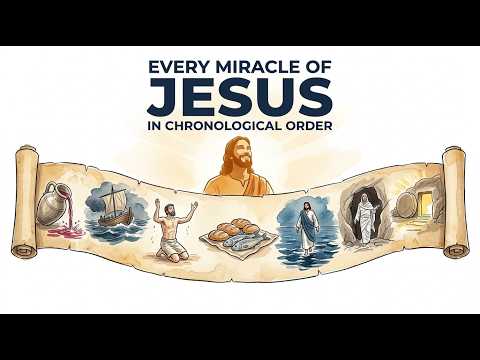
Every Miracle of Jesus in Order: The Pattern Hidden in Plain Sight
Deep Made Simple
20m 11s3,297 words~17 min read
YouTube auto captions
Transcript source
YouTube auto captions
This transcript was extracted from YouTube's auto-generated caption track. The transcript below is server-rendered so it can be read, searched, cited, and shared without opening the original YouTube player.
Pull quotes
[0:00]You've read the stories, the blind man sees, the storm goes quiet, the dead man walks out of a tomb.
[0:00]And if you're like most people, you've heard these miracles told like isolated episodes, like they happened in random order, scattered across four gospels with no connection between them.
[0:00]And the order they happened in reveals a pattern most people have never noticed.
[0:00]Because when you lay all of them out, from the very first to the very last, something extraordinary emerges.
Use this transcript
Related transcript hubs
Watch on YouTube
Share
MORE TRANSCRIPTS


