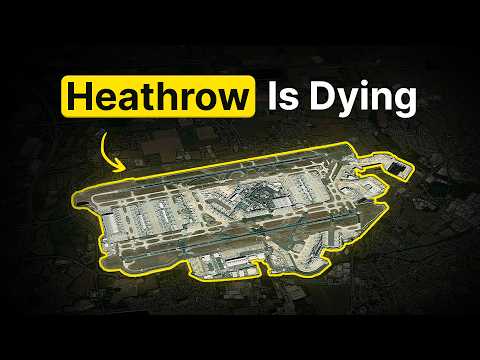
[0:06]This is Atlanta International Airport, the busiest airport in the world. This is Shanghai Pudong International Airport, China's busiest airport by passenger volume. And now, take a look at London Heathrow, Europe's busiest airport by passenger numbers. But did you notice something strange? While both Atlanta and Shanghai operate with five active runways, Heathrow has only two. And the problem is, for almost two decades, those two runways have been operating at full capacity, leaving virtually no room to handle delays, bad weather, or growing passenger demand. As more people pass through Heathrow than ever before, the airport is inching dangerously close to its breaking point. And if it fails to keep up, there is a real risk of losing the crown as Europe's busiest airport within a decade, with serious consequences for the entire British economy. Third runway at Heathrow would unlock further growth and make the UK more open and more connected. Heathrow is the only option which will deliver the economic future this country needs. And it is not as though Heathrow does not want to expand. In fact, the plan for a third runway was first proposed back in 2003. But for the past 20 years, the project has been mired in controversy over environmental concerns, the serious concerns all of us have, including the international world. This is disaster of a project, which will be bad for your economy. Political fist fights. It's been going on for too long now. 40 years is a good reason why it hasn't happened. It ain't gonna happen. And fierce opposition from surrounding communities, whose villages would be wiped off the map entirely. No third runway! When the project finally received formal approval last year, the mayor of London threatened to take the government to court. And even if that hurdle is cleared, the engineering reality is daunting. Building a new runway in the middle of a live operating airport, hemmed in by one of Europe's busiest motorways, will be one of the most complex construction challenges in British history. So, with Britain's aviation future hanging in the balance, will this runway ever be built? And more importantly, can this $65 billion gamble save the UK from an aviation crisis it has spent 20 years creating? To understand how we got here, we need to go back to the very beginning. This is what Heathrow looked like in 1890. It was a small wayside Hamlet in the ancient parish of Harmondsworth, where life revolved around farming and the rhythm of the English countryside. Then, in 1930, Sir Richard Fairey, a prominent British aircraft manufacturer and engineer, paid the local vicar 15,000 pounds for a plot of land just southeast of the Hamlet to build an aerodrome for assembling and testing aircraft. But when the Second World War broke out, the British government seized the Great West Aerodrome, evicted the residents of Heathrow, and laid down multiple runways for a new Royal Air Force base. Before the base could become operational, however, the war ended, and rather than handing the land back, the government repurposed it as London's new public airport, opening it to civilian traffic in 1946. In the years that followed, London Airport underwent rapid expansion to meet surging demand for commercial air travel. By 1961, a new terminal had been built to handle long-haul flights, and in 1966, it was officially renamed Heathrow to distinguish it from London's other airports. Today, Heathrow handles over 80 million passengers a year, connecting over 200 destinations across 84 countries. And most of these passengers aren't even visiting the UK. It's a hub airport, a stopover on the way to somewhere else. But the problem is, its two runways have been operating at full capacity for nearly two decades, handling almost 1300 flights every single day. And by 2050, the demand for all of London's airports combined could reach 400 million passengers per year, more than double today's numbers. So, when the plan for a third runway was put forward in 2003, it should have been a straightforward decision. Instead, it immediately ran into roadblocks. Since then, the plan has been approved and then completely scrapped three times, largely due to ongoing protests and legal challenges. And when you look at Heathrow on a satellite map, the reason becomes clear because its biggest problem is one it cannot change, its location. Take a look at a few other major airports across Europe. Paris Charles de Gaulle, Amsterdam Schiphol, and Frankfurt Airport. Notice how they are all situated outside their respective cities. And if you look closely, their runways sit next to largely green open spaces, giving ample room for future expansion. Heathrow, on the other hand, is engulfed on all sides by residential areas. Homes, schools, and entire communities press right up against the airport boundary. Locals have raised serious concerns about aircraft noise, particularly residents of West and Central London, arguing that expansion will result in a permanent end to any respite from noise pollution. And this constant noise exposure has been linked to reduced sleep, increased stress levels, and a higher risk of heart problems. But that is not the only issue. The M25 motorway, which runs directly along the western edge of Heathrow, is one of the busiest stretches of road in all of Europe. It handles both airport traffic and through traffic circling London, making it notoriously congested. This is precisely why the expansion plan is such a massive engineering hurdle. It calls for the motorway to be shifted 150 meters to the west, lowered, and placed inside a tunnel beneath the new runway. That would mean widespread disruption for the M25 and West London as a whole. And if the third runway finally opens, the increased air traffic and the road traffic that comes with it could put sustained pressure on the M25 long after its completion. On top of all of this, there were also concerns that any expansion at Heathrow would contradict the UK's strict climate change policies and its obligations under the 2015 Paris Agreement. So, to counter this, the then mayor of London, Boris Johnson, a staunch critic of any expansion at Heathrow, came up with an entirely different proposal. I will lie down with you. He suggested building an entirely new airport on reclaimed land in the Thames Estuary, quickly nicknamed by Londoners as Boris Island. The design focused on avoiding many of the problems that traditional land-based airports face. For example, there would be no need for aircraft to fly over densely populated areas of London, which is one of the biggest complaints about Heathrow. Instead, take-offs and landings would all be over water, allowing for 24-hour operation. Pretty similar to Japan's Kansai International Airport, which sits on its own artificial island in Osaka Bay. But if you know anything about Kansai, it's been sinking since its 1994 opening due to the compression of seabed clay beneath the island. In fact, the airport has sunk a massive 38 feet, far exceeding initial predictions and requires continuous, costly maintenance to raise seawalls and prevent flooding. A Thames Estuary Airport would have faced the same fundamental risk, leaving it vulnerable to storm surges, rising tides, and the long-term instability of a seabed foundation. The location raised other concerns too. The nearby Isle of Grain is home to one of the largest liquefied natural gas terminals in the world. Enormous storage tanks of highly flammable gas sitting adjacent to a proposed international airport. The head of national air traffic services didn't mince words when he described it as the very worst spot you could put one. Then there was the question of accessibility. It was suggested that HS1, the high-speed rail link used by Eurostar services from London St Pancras, could connect the airport to Central London in as little as 26 minutes. But even now in 2026, HS1 is already at capacity, so it would need extensive upgrades to support a new airport rail link. As a result, the plan was quickly shelved, dismissing it as a mere fantasy, rather than a realistic alternative to the Heathrow expansion. With the Estuary Plan dead, attention turned to London's second airport, Gatwick. Located 30 miles south of the center of London, it's much further from the city than Heathrow. This gave Gatwick ample space to expand into the lightly populated West Sussex countryside. And at a cost of just $12 billion, the expansion would consist of a second runway to the south of the present site. In between the current terminal and the new proposed runway would be an entirely new terminal, giving Gatwick capacity for up to 700,000 annual flight movements, equating to roughly 50 million passengers. But there was a fundamental problem. You see, Gatwick is largely a leisure and low-cost airline airport. And while it did offer long-haul services from carriers like Emirates and British Airways, most of these routes were overwhelmingly point-to-point. This meant that passengers flying through Gatwick were typically visiting or leaving the UK, compared to 33% of passengers at Heathrow, who used it as a transit hub. On top of that, one important factor this plan missed was that the area immediately south of Gatwick sits on a flood plain, and the proposed plan didn't account for it at all. So, while Gatwick was cheaper and faced fewer environmental hurdles, Heathrow's status as a hub airport was considered more critical for global trade, ultimately justifying the complex, expensive, and higher impact expansion. Yet, in another blow to the project in 2020, the UK Court of Appeals ruled that the government's approval of the Heathrow runway was illegal, on the grounds that it had failed to account for the UK's obligations under the 2015 Paris Agreement, which called for limiting the increase in global temperatures to 1 and 1/2 degrees Celsius. But finally, in January 2025, 22 years after the first proposal, Chancellor Rachel Reeves officially approved the project, stating that expanding Heathrow was necessary to strengthen the UK economy, and that failure to do so would carry a serious economic cost. According to Reeves, the proposed $65 billion expansion would increase the airport's annual flight movements from 480,000 to 740,000, while adding 40 new routes and creating up to 77,000 local jobs. The new runway will be 3 and 1/2 kilometers long and 60 meters wide, positioned to the northwest of the airport. It will sit 1,350 meters from the existing Northern runway, sufficient separation for all three runways to operate simultaneously. New bypass taxiways will also be built around the central runway to ease congestion and improve air traffic flow through the north-south corridor of the airfield. Much of this construction will take place beyond the airport's current boundaries, meaning existing buildings will need to be demolished, power lines rerouted underground, and the terrain will need to be leveled. To handle the extra passenger volume, a new terminal called Terminal 5X will be built to the west of the existing Terminal 5, complete with its own supporting taxiways. And in a later phase, a separate remote facility, Terminal 5X North, will be added in the space between the central runway and the new Northern runway. And the two will be connected by an underground rail link and walkway. Meanwhile, Terminal 2 will also be extended with two new satellite buildings, pushing its capacity to 52 million passengers per year. Beyond the airfield itself, the M25 will be diverted into a tunnel beneath the new runway. And several smaller roads will need to be demolished or rerouted. If everything goes according to plan, Heathrow could see its new third runway by 2035, with passenger numbers climbing to 130 million per year by the end of the decade, roughly a 60% increase from today. But things don't seem to be going according to plan. Because soon after the government announced its approval for the project, Sadiq Khan, the mayor of London, said that he had consulted his lawyers and would challenge any form of expansion at Heathrow. And according to the BBC, a government source acknowledged there was some awkwardness around the mayor's involvement in potential legal battles against government-backed plans, but the source said the move was neither surprising nor concerning because, in their own words, "Sadiq probably won't be mayor of London by the time this comes to pass."
[15:06]So, what do you guys think? Will the third runway finally be built, or is Heathrow destined for yet another delay? Let me know your thoughts in the comments, and if you enjoyed the video, a like and subscribe would be greatly appreciated.


