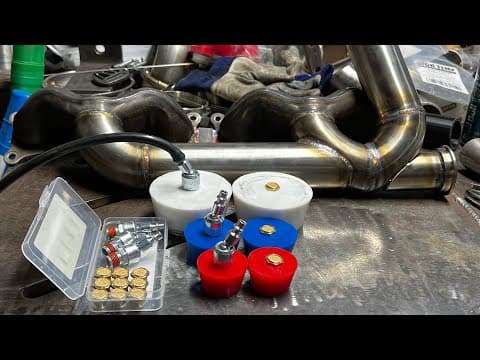
[0:04]What is going on YouTube? Welcome back to the channel. Um, it's been a little while since I've been creating any content. I know. Um, I've been trying to create like little short reels and stuff for you guys. If you guys follow me on Instagram and TikTok, you know the grind has not stopped. But Red Bull, make sure you guys have your daily Red Bull. Um, gets us energized and everything. getting all ready to fabricate some things. But today, I have something different for you guys. Um, like I said, I haven't created any content in a while on my YouTube channel besides for my short reels. If you guys follow me, um, or subscribe to my channel, and you guys been seeing all of my stuff, please give likes, subscribe, share, comment. I appreciate all of that. But now that we have some nice weather, um, you know, we've all been through December, um, snow and everything. It's been very, very cold in the garage. I work in a one-car garage, so I don't really have AC or heating or anything inside of here, so kind of sucks. But, um, we're getting some nice weather. So that means my content will be coming back. So, today I want to show you guys something that I've been, you know, basically I've been working in the garage and everything. I haven't been providing the videos showing that. But if you guys watched me on my TikToks, my Instagram and all that, you see it. But basically, I'm learning more and more, you know, um, practice makes improvement, not practice makes perfect. You'll never perfect. But practice makes improvement and I've been noticing that I need new tools, you know, stuff that can make my jobs easier, um, my work quality higher, higher quality I should say. So, one of those things is back purge plugs. So, I'm going to be showing you guys. These are actually pretty expensive to get if you are if you were to get a kit from like a name brand company or something. But, um, I actually saw a TikTok video on a guy that he made these on a budget. I don't have his TikTok name, if not, I would give you a shout out. I apologize. If you do see this, then you kind of recognize it, um, just say hey, you were the one that made.
[2:13]argon. Hey. The inside of the pipe needs to be filled with argon, sorry. My son's playing with bubbles in the background. But anyways, um, the reason you need to fill the inside of the pipe with argon is because the inside of the pipe does react to the oxygen that's inside there. And it starts to create what's called sugaring. So, I'll try to get some Google pictures or something and provide inside here, you guys can see the difference. But when you weld stainless and you do a proper back purge, the inside of the pipe should look like you welded that as well. So, the way that I used to back purge my manifolds and all my piping and everything before is poor man's back purge, which is aluminum foil. So, the way that that works is you just grab yourself a big ball of aluminum foil, you ball it up, and then you shove it into a pipe and then you hope you have a good seal. It works and then sometimes it doesn't work. So, in my case, no matter how much aluminum foil I stuffed inside here, um, I could never get a proper weld on the inside and I did have some sugaring and everything. But, um, what I used to do is I'll grab my diagram, I'll clean up the inside so the sugaring doesn't interfere with the exhaust flow. But anyways, so, the aluminum foil worked and it didn't work sometimes. And the reason is when you crumble aluminum foil, you still have cracks and everything inside there where oxygen can still get in and your argon can escape out. So, the best thing to do is to have a purge or a purge block or silicone bung or whatever they call these things. Um, the only thing is like I said at the beginning of the videos, these are very expensive. So, for a whole whole kit of these, I believe I seen online, um, these were almost two hundred and fifty bucks just to get the little bungs.
[4:30]Um, the only thing is like I said at the beginning of the videos, these are very expensive. So, for a whole whole kit of these, I believe I seen online, um, these were almost two hundred and fifty bucks just to get the little bungs. Um, but they still withstand a good amount of heat. I kind of melted this one right here because I wanted to test how how resistant they are. So, I put this inside of a V-band. Um, I was welding a hood dump for a Civic that I was doing. Anyways, I put this very, very close to the V-band, which is somewhere like that. And there's not much space inside there. So, basically my weld is going on here. And I had my argon flowing and everything. I had the amps turned up so I can get a nice penetration on the thick, um, like a flange. So, basically this was getting a good amount of heat in there. So, I did start to smoke it out. Um, it did catch on fire on the inside. And when I pulled this off, the silicone was actually dripping on fire, but it wasn't much. I'm not sure if you can really see it in there, but it was just very, very little. So, for the amount of money I spent on this, um, it's kind of hard to weld very, very, very close to it, come like this flange right here. But for everything else, it does work very, very well. So, I, I'm still going to continue to weld my flanges on here. It didn't interfere with my weld or anything. I still got a nice back purge, full penetration. I just sacrificed a little bit of the silicone, which is no big deal. Um, once I give you the prices of these, you'll have no problem with them. So, I have, um, three-inch. So, I have the part numbers for them right here. So, for the white one, is a three-inch up to three and a half inch, because they are tapered, so you can fit, um, whatever swag size between three-inch and three and a half inch. I will say though, it doesn't necessarily fit three-inch. Um, it just barely does. And you kind of have to like squeeze it very, very tight to get it inside. Now, on a V-band, you know, it's a little bit wider than the three-inch because you have that, that recessed inside there that you can see the little lip that your actual pipe sits inside. But it fits perfectly fine onto the to the V-band. But if you were to do it on the flange pipe, you do have to squeeze it in a little bit, but it does seal perfect. It's just a little hard to get in. But the, the white one is three-inch up to three and a half inch, and I'm going to show you guys the part number right here. Hopefully you guys can see that. And then that's the name of it. Hopefully you guys can see that as well. That's for the three-inch. Now, I got another one over here. This one came in a couple of them. This is actually the the one that led me to these. This is the one that the guy was making on TikTok. So, this is actually what led me to find all these other ones. But these are all from the same company. Um, they're high temp masking supply. Like I said before, I believe these are meant for like, um, people who do like powder coating and stuff. You just need a quick little silicone to block it off. And they're going in oven that's only burning up to like 200, 250 degrees. So, this one is uh one and a half inch up to one and three quarters. So, there's that. There's the part number for there as well. And the same name company. And then I have one more which is one, one 875-inch, um, by two. 203. Um, two and a quarter and one and three quarters basically. These only come single as well. The white one also comes single. I'm sorry. I had to order two of those. The red one comes in a pack of five. Um, this one comes in a pack of one, so I also ordered two of these. This is good for like my one and three quarter inch pipes. So, I don't think I necessarily needed these because this one goes up to one and three quarters. But, you know, I wanted to test all of them. Um, I wanted to show you guys all the stuff that they have online and they have a lot more sizes than just these. But these are the pipes that I, these are the pipe sizes that I use the most. So, these are the ones that I wanted to show you guys. Red Bull, don't forget. But anyways, um, so those are my silicone, um, couplers, whatever you guys want to call it. I don't really know, the good name for it. I'm sorry, I kind of stuttering. It's been a while since I made the YouTube videos. But anyways, these are the sizes that I chose. Um, these I feel are going to be what I use most often here in my garage. Next, what you're going to need is breathers. So, these are, these are quarter-inch, I believe that I ordered. But these are basically like exhaust breathers, exhaust flanges. So, what they are is a quarter-inch brass, um, screw or whatever. And they have a whole bunch of brass balls on the inside. Hopefully you camera focuses on that. But anyways, um, what that is, is they stuff a whole bunch of little brass balls inside there. So, dirt is hard to get in or any air is hard to get in, but it's easy for it to breathe out. So, basically these are used like in pneumatics, um, for air cylinders and stuff like that. These are like an exhaust, um, filter, you can call it. So, one, it, it kind of creates like a little restriction for flow to come out. So, on cylinders and stuff, you can also use that as a slowdown. So, you don't have an a cylinder that's extracting full and so, um, retracting and extending super fast. These can slow it down a little bit. But what we use these for is for a breather. So, when you do back purge, you don't want to fully sealed neither because you have argon that's going in there. So, you're doing is you're causing pressure. So, if you go to seal your last weld out of the whole pipe, and you have no breather, what that argon is going to do is going to blow out your weld, which I'll post a picture of that here as well. But you don't want that. So, you want a little bit of a breather. Um, you kind of want a restriction to it as well. That way the argon stays pressurized in there and it's kind of hard, it's kind of hard to explain it, but when you're welding a piece of pipe and you're adding your filler, naturally the filler wants to go inside of the pipe, right? So, with the argon pressure actually helps keep the filler out. So, it keeps a um a bead profile on top of your pipe too. So, that way your bead profile is not concave but convex. So, it makes the bead look a lot nicer, um, stronger. So, it's kind of hard to explain what these are for, but just you'll need these. So, I got these off Amazon. It came in a pack of, uh, pack of 12, sorry. Um, I believe these were like 20 bucks for a pack of 12. So, just go on Amazon and type in, um, brass breathers, or brass fittings, stuff like this. I'll put a links for all of these underneath the description. But these are my breathers. Now, for for my fittings so I can feed my argon into, I couldn't find anything that I really liked. Um, you can use whatever you want. You can use a straight fitting or whatever. But I wanted to get a little fancy with my stuff. So, what I did was I got these airline quarter-inch airline fittings. Um, these you'll put um screw into like an air tool or something. What's nice about these is they have a valve on the back, a ball valve, so that it can swivel. So, the reason I wanted this is if I have a piece of pipe, I don't want my hose to be, you know, straight all the time and then I'll I'll risk kinking the hose or something. So, what these are, they'll swivel, they're 100% sealed. These are rated up to like, I think, 180 psi, so it'll handle 5, 10 psi of argon no problem. So, the only thing I don't like about these is that they're real real big back here. You know, like I said, they're meant for like quarter-inch airline. But I could probably put these to the lathe or something and just machine them down. Um, the reason is because I use five millimeter silicone hose on my regulator. Let me see if I can show you guys that here. I use five millimeter silicone hose here on my back purge regulator. So. So, we're going to go ahead and grab our drill bit. I live I live by Milwaukee. All my tools are Milwaukee. So, I'll grab my Milwaukee drill bit. And then basically I'm just going to grab one of the silicone couplers and I'm just going to try to go right in the middle. It doesn't have to be right in the middle, you know, it's not perfect as long as you get argon in there. And the key is to drill real slow because the faster that you drill through silicone, um, basically what silicone is doing is expanding around the drill bit, so you're not actually cutting. So, you want to drill through it real slow. So I finally made it all the way through. So now I'm going to speed it up. And when you speed it up, what you're trying to do is grab the sharp edges of the drill bit and try to scrape the walls as best as you can.
[13:09]I like to move it back and forth inside, so that way I can grab as much. So, I finally made it all the way through. So now I'm going to speed it up. And when you speed it up, what you're trying to do is grab the sharp edges of the drill bit and try to scrape the walls as best as you can. I like to move it back and forth inside, so that way I can grab as much. So I finally made it all the way through. So now I'm going to speed it up. And when you speed it up, what you're trying to do is grab the sharp edges of the drill bit and try to scrape the walls as best as you can. I like to move it back and forth inside so that way I can grab as much.
[13:47]All right you guys. So, they're both drilled through all the way through. So, now I'm going to go ahead, I'm going to go ahead and grab one of my exhausts. Then I'm going to go ahead and grab one of my feeds. And these come in a pack of six. I'm not sure if I said that earlier. And then basically the whole sizes are a lot different. This hole is a lot smaller than what this is because the drill bit is number 12, which is a lot wider than the threads on this on quarter-inch. But like I said, the silicone likes to expand around the drill bit. It doesn't actually like to cut that good. So, if you can get a bigger drill bit, I'll probably go with like maybe a 13. But like I said, a 12 is pretty good. Um, so now what I'm going to do is I'm going to force this fitting inside there. Try to open up the silicone and then thread it in. So, since it's a real tight fit, it's going to create a seal for me without having to use any glue or any silicone or anything like that. So, let's go ahead and get that on. All right you guys. So, she's screwed in all the way now. She's very, very tight in there. It was a very tight fit, but I wanted it that way. So, now it's fully through. So, now when I feed my argon inside here, when I plug in my silicone hose on here, you'll be able to feed my argon, no problem. So, that's the last one is to create the exhaust. So, let's go ahead and force that one on.
[15:19]I might have to open it up a little. So, it's a very tight grip, like it's actually threading itself.
[15:58]So, it's going to get hard to spin at one point. All right guys, so we got it in, but it's a very, very tight fit. And I barely have anything to grab my fingers with. So, I'm just going to go ahead and grab my small, small adjustable wrench. Snap-on. Anyways, and I'm just going to start threading it in. Let the brass teeth bite itself in into the silicone. And then you can tighten it. It's actually a very tight grip, like it's actually threading itself. So, it's going to get hard to spin at one point.
[16:31]All right, you guys. So, there we have our budget back purge bungs, block offs, whatever you want to call it. So, both holes, my exhaust and my feed. So, let me do one more for you guys. Why not? This one should be a little bit easier because it's not a full silicone. It's actually recessed on the inside. So, I don't have to get through one wall. Let's go ahead and do that. These are the one and three quarters to two and a quarter. making a little bit of a mess here. Silicone everywhere. So, let's get that out of the way. Again, let's do brass fittings. Let's do another feed.
[17:48]These are soaked in oil, so they don't rust, I guess, so they're kind of slippery. But let's do our exhaust. And last but not least, our feed.
[19:20]Okay guys, so for the white ones, these are sold singles. So, those are priced at nine dollars each. Okay, so I ordered two of those, because you need your feed and you need your block. Next is going to be my blue ones. So, my blue ones were priced at eight dollars each because these are also sold singly. So, these were eight dollars each. Uh, the red ones are sold in a pack of five. Those are priced at ten dollars for five. Then my brass exhaust breathers. Those are a pack of 12 for eleven dollars. And last but not least, my quarter-inch airline swivel fittings. Not the regular fittings, you know, a little fancy if you want to call them. These are a pack of six for seventeen dollars. So, total on all of my fittings, my bungs, my, my silicone, um, couplers or whatever you want to call them. I spent seventy-two dollars. So, I'm able to do three-inch pipe to three and a half inch pipe. Uh, one, one and a half inch pipe up to one and three-quarter. One and three-quarter inch pipe up to two and a quarter inch pipe. So, I can do all of those pipes. I can have maintenance done on any of them, if they were to break or whatever. And these came in a pack of five, so these now I have a couple of extras. All of this for seventy-two dollars compared to buying a name brand company. So, I got my T-pipe right here. So, this is a three-inch down to a two-inch pipe. I did all of this in my garage.
[22:13]But I hope you guys enjoy. Um, glad to be back and I will see you guys on the next one.


![Thumbnail for [어쩔수가없다] 박찬욱 감독의 '알려줄 결심' by CJ ENM Movie](/_next/image?url=https%3A%2F%2Fimg.youtube.com%2Fvi%2FRNoFqt26sgE%2Fhqdefault.jpg&w=3840&q=75)