[0:00]The bench press is the goat of upper body exercises. Do this right and you'll see massive gains in your chest as well as your shoulders and arms. But do this wrong and even if it doesn't happen right away, you risk seriously injuring your shoulders and elbows to the point where you may never be able to bench again. The most important part is with step one, set up. The bench press involves a fixed back position against the bench and a fixed hand position on the bar. This can force your joints into positions they shouldn't be in. Preventing this starts with your grip width. Now the closer you grip, the more your triceps will be involved. While this can be a helpful bench variation to grow bigger arms, we want to maximize chest growth. To do so, you'll want to use a relatively wider grip, which research suggests can also make your bench a little bit stronger. But you don't want to go too wide, as this reduces the range of motion your chest goes through and may also increase the risk of shoulder injury. To find the perfect grip width for you, lay down on the bench with your arm straight in front of you. Pull your elbows back until they make a 90° angle. Then, bring your elbows in towards your sides until your thumbs line up with your lower chest. The space between your hands is your ideal grip distance on the bar. After you find the right grip width, for smooth unraking in the next step, position your body such that your eyes are directly under the bar. And when you grab the bar, make sure your thumb isn't on the same side as your fingers. This is known as a suicide grip, and for a reason. Instead, for the most secure grip, I'd recommend keeping your thumb around the bar. Finally, walk your feet back under your knees and plant them firmly into the ground. You're ready for step two, whole body tension. Before you even consider unraking the bar, you need to activate various muscles that will help unlock your strength and keep you stable as you lift. Let's start with the lower body. Use your quads to push your feet down into the ground and use your glutes to drive your knees out. Then, activate your lats by bringing your armpits down to your hips. You can imagine there was a band attached to the bar pulling it back as you try to pull it forward. Next, we want to create an arch in your upper back. Some competitive powerlifters take this to the extreme to help them reduce the range of motion so they can lift more weight. But this may not be the best for growth, and it does require a lot of upper body mobility. A slight arch, however, is something I'd recommend, as it can help make the bench press feel a little more comfortable on your shoulders and may help you recruit more of your chest fibers. Especially if you sit all day in a hunched over posture. But to create it, you are not just arching at your lower back and sticking your ribs out. Instead, simply think about opening up and extending your chest. This should create a little bit of space between your back and the bench as a result. Once you've set your arch, straighten your wrist by pointing your knuckles to the ceiling. Then, through your nose, take a deep 360 breath into your abdomen and brace your core as if someone were about to punch your stomach. You're ready for step three, unraking. This is where most people lose all their tension and mess up their bench press before they even start it. To avoid this, maintain your arch and stay tight, then push the bar up to get it off the rack. From there, you want to use your lats to pull the bar into the starting position right above your shoulders. Then, re-engage your lats by thinking about bending the bar in half. You're ready for step four, descent. The most common mistake people make here has to do with the bar path. Unlike the squat and the deadlift, during a proper bench press, the bar should not travel straight up and down. This form can aggravate the shoulders by placing them in a compromised position, and it also won't be the best form to activate your chest. In fact, one well-executed study compared the bar path of novice benchers who could bench 225 pounds to elite benchers who were lifting well over 400 pounds. As you can see, in both cases, they don't bring the bar straight down. They bring it down and slightly forwards. But it's important you do this properly. First, avoid letting gravity just drop the weight. Instead, actively pull the bar down by using your back muscles to squeeze your shoulder blades together. Focus on pulling the bar down towards your lower chest, right around the level of your nipples. Now, as you do this, your elbows will have to bend, but you want to avoid talking your elbows too close into the body and also avoid the more common mistake of flaring them out to the sides. Instead, to maximize chest activation and minimize shoulder discomfort, keep them tucked at about a 45 to 70° angle away from your body. Think arrow shape instead of T-shape. Now as for how deep to go, to maximize growth, you ideally want to touch your chest with the bar. But some people, especially if they're locked into a rounded posture, don't have the required mobility to do this. Their shoulders will roll forward at the bottom, which can cause discomfort and potential injury. In this case, stop an inch or two above your chest or whatever is most comfortable for you. But once you do reach the bottom position, your forearms should not be bent inward or outward. If they are, to minimize discomfort in your joints, try narrowing or widening your grip to get your elbows stacked directly under your wrists. So by this point, the bar should have traveled down and forward, and now be sitting just above or on your lower chest. You're now ready for step five, ascent. But guys, if you want to maximize growth and minimize injury, I'm sure you can now see the importance of finding the right form for you and your individual structure. And if you need a step-by-step plan that takes care of all the guess work for you, after this video, head on over to builtwithscience.com and take our analysis quiz to find the best program for you and your body. But for now, step five. Quite a bit of recent research has highlighted the importance of the stretch position of an exercise. In the case of the bench press, the bottom position when the chest is fully stretched is likely the most important part for growth. But it's also the hardest part. Most people lose out on chest gains by letting the bar bounce off their chest. Instead, force your chest to work even harder by pausing here for half a second. And as you do this, do not completely relax and let the bar simply sit on top of you. Keep the tension in your legs and upper back and feel your chest working to keep the bar stable. After the slight pause, use your quads to push your feet forward against the ground as if you were doing a leg extension, and then drive the bar up off your chest. But, as we talked about earlier, don't push the bar straight up. If we take a look back at the study I mentioned earlier, novice lifters tend to drive the bar straight up off the chest, whereas elite lifters drive the bar up and backwards off the chest. So although it might feel a little bit weird at first, try to drive the bar back up towards your head so that from the side view, the bar travels in a slight arc. And as you do this, to boost chest activation, don't think about just pushing the weight up. Try thinking about pulling your biceps in, as if you were trying to touch them together. But as you get to the top, avoid letting your shoulder steal gains from your chest by collapsing your upper body and rounding your shoulders forward. Instead, keep your chest up by maintaining the arch in your upper back and squeeze your biceps into your armpits until your arms fully straighten over your shoulders. Exhale through tight lips as you come to the top, take another deep breath in your stomach, brace, and then control the weight back down for another rep. Congrats, you have just done the perfect bench press. You can give these videos a watch next to fix your squat and deadlift, and I'll see you next time.
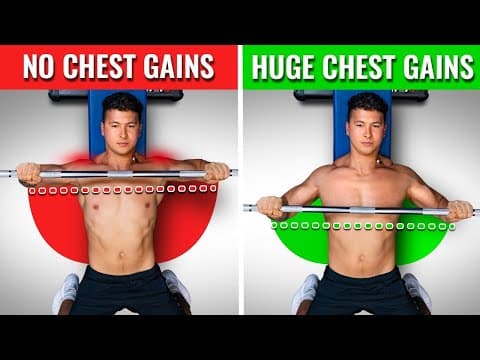
How to PROPERLY Bench Press for Growth (5 Easy Steps)
Jeremy Ethier
8m 5s1,506 words~8 min read
Auto-Generated
Watch on YouTube
Share
MORE TRANSCRIPTS