[0:11]World War II was a global conflict in which Germany, Italy, and Japan, called the Axis Powers, fought against Britain, the Soviet Union, the US, and China from 1939 to 45. Coming to power in 1933, Hitler capitalized on the economic depression that had spread worldwide following the crash of Wall Street. As well as the German resentment of the humiliating treaty of Versailles, signed after Germany's surrender in World War I. Declaring that the Germans were a superior race that needed living space, Lebesraum, Hitler began to rebuild the German military and broke the terms of the treaty of Versailles. Hoping to avoid war, France and Britain allowed Hitler to expand German territory unchecked by uniting with Austria and annexing the German-speaking areas of Czechoslovakia, Sudetenland, before invading the entire country. World War II erupted in Europe in September 1939 when Germany invaded Poland from the west before the Soviet invasion from the east. Britain and France responded by declaring war on Germany, but took little offensive action. In 1940, Germany invaded Denmark and Norway to secure iron supply, followed shortly by successful attacks on Belgium, the Netherlands, and even France. All of these nations were conquered swiftly by mid-1940, thanks to the Blitzkrieg, the German offensive warfare using a rapid overwhelming force concentration designed to achieve quick victory. The British expeditionary force was trapped at Dunkirk, but managed to withdraw by sea back to Britain. Later in the summer of 1940, Germany launched a further attack on Britain exclusively from the air, as the island nation was well protected by the mighty Royal Navy. Although the German Luftwaffe heavily bombed London during the Blitz and other British cities, it was never able to overcome Britain's Royal Air Force and resilience. Italy, led by fascist dictator Mussolini, an ally of Germany, expanded the war even further by invading parts of North Africa and launching an unsuccessful campaign in Greece. In 1941, Germany led the Axis powers against the Soviet Union in the largest surprise land invasion in history, called Operation Barbarossa. Behind the lines, millions of Jews and communists were exterminated in horrible killing factories. Hitler, who had hoped for a quick victory, initially made swift progress deep into the Russian heartland. However, the invasion of the USSR would prove to be the first major German setback as the German forces, Werhmacht, gradually got trapped in a war of attrition due to the country's sheer size, poor roads, brutal winters, and the Soviet scorched earth policy and resilience. In 1943, after the battles of Stalingrad and Kursk, Germany was forced into a full-scale retreat. In the Pacific, Japan, a new power that aimed to strengthen its dominant position in the region and acquire resources for its fast-growing population, seized Manchuria from China in 1931. In December 41, Japan launched a surprise attack on the US Navy base at Pearl Harbor, Hawaii. America, which till then had been supporting Britain and imposing economic sanctions against Japan, officially joined the war against the Axis powers. Japan pursued its expansionist policy throughout the Southeast Asia Pacific region and committed terrible war crimes. But its advances were halted in 1942 after losing the critical Battle of Midway against the US. Germany and Italy suffered a decisive defeat against the British at the Battle of Alamein in Egypt in 1942, which was a turning point of the North African campaign. In 43, after Mussolini's regime collapsed and the Allies landing in Sicily, the Germans moved to quickly take control of Italy, fearing its loss to the Allies. On the Eastern Front, the Soviets became the unlikely allies of the Americans, and the British gradually pursued the Germans across Eastern Europe. In June 1944, American, British, and Canadian forces launched the D-Day invasion, the largest seaborne invasion in history, on the coast of Normandy to begin the liberation of German-occupied France. The Allies also continued the strategic bombing campaign on German cities. Allied forces were closing in on Germany from both fronts, East and West, until May 1945, when Germany surrendered after the Soviets invasion of Berlin and Hitler's suicide. By spring 45, most of Japan's conquests had been liberated, and Allied forces were closing in on the Japanese home islands. Following the bombing campaigns against Japanese cities and Japan's refusal to surrender, the US dropped two atomic bombs on Hiroshima and Nagasaki. Faced also with the Soviet invasion of Manchuria, Japan surrendered in September 1945. World War II was the bloodiest and largest conflict in history, with about 60 million deaths worldwide, many of whom from the Soviet Union and China, as well as Jews exterminated during the Holocaust. The United Nations was created and a sense of political and economic integration began, especially in Europe to forge a sense of common identity. The influence of European Great Powers waned, triggering the decolonization of Africa and Asia, and setting the stage for the emergence of the US and the Soviet Union as new rival superpowers to confront in a Cold War.
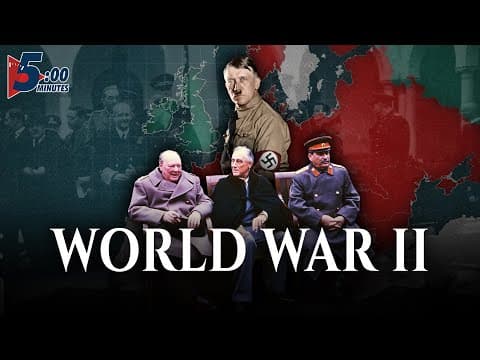
World War 2, Explained in 5 Minutes!
5 MINUTES
5m 50s837 words~5 min read
Auto-Generated
Watch on YouTube
Share
MORE TRANSCRIPTS