[0:01]Welcome to a brand new video of Textile Blog, and in this video, we will go through the complete process of textile manufacturing, from fiber to finished garments.
[0:14]Textiles have been a part of human civilization for centuries, but most people don't know how it all comes together.
[0:23]This time, you learned about the production process that goes into making your cloths, so you can make smarter choices on what to buy next.
[0:34]So, join with me as I take you through the entire journey of textiles manufacturing.
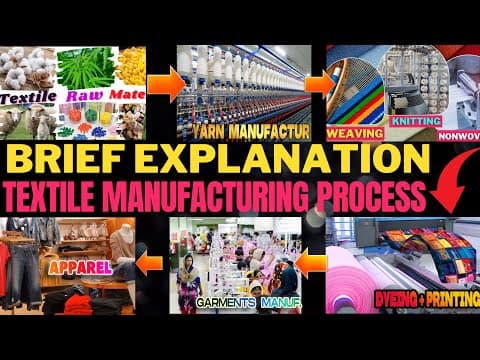
[0:45]Mainly, textile manufacturing begins with the harvesting of raw materials.
[0:50]The fibers are then cleaned, sorted, and blended together to create yarns.
[0:57]Yarn is made into fabric by weaving or knitting it on a loom.
[1:03]Then, the fabrics are dyed or printed in different colors and patterns.
[1:09]Finally, cut and swing together the parts of fabric to get desired garments.
[1:15]Let's get drive into deeper.
[1:20]Source Fiber.
[1:23]The process of textile manufacturing begins with the cultivation of natural fibers.
[1:29]Fibers are also extracted from plant, animal, or mineral sources and processed into a continuous strand called yarn.
[1:40]The different types of fibers include wool, silk, cotton.
[1:46]But today, man-made or synthetic fiber are also used in textile manufacturing, such as rayon, polyester, nylon.
[1:58]Spinning or yarn manufacturing.
[2:01]Yarn manufacturing is the process of turning raw materials into yarn for use in knitting, weaving, or crocheting.
[2:12]Raw materials are sorted, cleaned and mixed together to create the final yarn or thread.
[2:21]There are two classifications of yarns that will be produced by spinning, which are filament and staple yarns.
[2:30]Filament yarn. These yarns are made from long and continuous strands of fiber.
[2:38]Most of them from synthetic and only silk represents for natural fibers in filament.
[2:45]Staple yarn. Staple or spun yarns, in other hand, are made from short length of fibers.
[2:53]It can be found from natural fibers or can be produced using synthetic as staple filament yarns.
[3:03]Process of Staple Yarn Manufacturing started with opening bell of yarn and cleaning the impurities on the surface by using bale opener machine.
[3:15]Then processes are followed by a series of continuous operations, such as blending, mixing, carding, drawing, roving and spinning.
[3:34]And finally, we get the cones of yarn which is used to make fabric.
[3:43]Fabric manufacturing.
[3:46]Fabric is a plain sheet of cloth, which is made by weaving or knitting process.
[3:53]Most fabrics are knitted or woven, but some are produced by non-woven processes, such as braiding, felting, twisting, etcetera.
[4:03]Weaving process.
[4:06]In weaving, two distinct sets of yarns or threads are interlaced at right angles to form a fabric or cloth.
[4:14]The lengthwise threads are called the warp, and the widthwise threads are the weft or filling.
[4:23]Cloth is usually woven on a loom, a device that holds the warp thread in place while filling threads are woven through them.
[4:33]The woven fabrics has a lot of application areas like apparel, home textiles, geo textiles, composites, medical, packing, seat belts, industrial products and so on.
[4:48]Knitting process. Knit fabric is manufactured by interloping from a single set of yarn.
[4:56]In knitting, long needles are used to interlink or knot a series of loops made by one continuous thread.
[5:07]Each loop or knot connects to another one, and when enough loops have been made, the result is a flat piece of material called a fabric.
[5:16]It has particularly a comfortable form of fabric structure for sports, casual wear and also for undergarment.
[5:24]Nonwoven process.
[5:28]Non-woven fabric is made from sheet or web structures bonded together by using a chemical, mechanical, heat or solvent treatment.
[5:39]It's manufactured by special kind of fiber blends and Chemical or Glue mixture.
[5:47]Day by day, non-woven fabrics became very popular among the mass people and used as filter paper, PPE gown, surgical mask, napkin, tea bag fabric, water filter.
[6:02]Wet processing.
[6:05]Fabric wet processing is a process used to dyeing and finishing the fabrics.
[6:11]Dyeing involves the application of colorants to fabric in order for it to become colored.
[6:18]Finishing may involve mechanical and chemical process employed commercially to improve the acceptability of the product.
[6:28]Let's see the general process sequence of dyeing and finishing one by one.
[6:34]The aim of singeing is to burn off the protruding fibers or hairiness of yarn in the fabric surface.
[6:43]Desizing is the process of removing the size material from the warp yarns in woven fabrics.
[6:54]Then the fabrics go through scouring and bleaching process where removes all impurities from fabrics through washing and eliminates unwanted colored matter from the cloth.
[7:06]Bleaching makes the fibers whiter and facilitates the dyeing process.
[7:11]It also makes the fibers more absorbent.
[7:16]And finally, cleaned and white fabrics are transferred to dyeing sections.
[7:20]Dyeing and printing process.
[7:23]Dyeing is the main process where white or gray fabric become decorated by different colors.
[7:30]Dyeing of textile substrate is performed using any of the dyestuff including reactive, direct, sulphur, vat, pigment, acid, and disperse depending upon the dye fiber system compatibility.
[7:48]Printing is known as localized dyeing.
[7:52]Printing gives a special appearance on colored or white fabrics.
[7:58]In finishing section, crease recovery, flame retardant, water repellent, anti pilling, antibacteria, antistatic, moth proofing, softening and hand builder are the special finishing effects that can be added in fabrics by mechanical and chemical processes, according to end use of the finished products.
[8:24]Apparel manufacturing process. Apparel is a final product of textile which known as piece of clothing.
[8:32]Apparel design and manufacturing is the combination of modern art and technology.
[8:39]Design is usually provided by the buyer.
[8:42]Buyers send the technical sheet and artwork of an order to the merchandiser after placing an order.
[8:51]Through the sequence of process at first, patterns are make, and according to pattern sample garments are made for buyer approval.
[9:01]For the bulk production, at first, marker making is done of cut the fabric with high efficiency.
[9:10]Then fabric is laid on a big table which is used for cutting.
[9:15]Fabric needs to cut according to the marker.
[9:23]Stitching or swing is done after the cut pieces are bundled according to size, color, and quantity determined by the swing room.
[9:32]All cutting components of fabric are joined by swing together.
[9:38]Then it's go for ironing and finishing process.
[9:43]Inspection. Garments inspection is an important part of the quality control.
[9:49]After complete apparel or garments inspection is made to find out fault of the garments.
[9:55]Then the garments are packed with the help of accessories.
[10:00]It packs here by using the buyers instructed polybag.
[10:07]Cartooning and shipment. After the garments packing, cartooning is done for reducing the damages of garments.
[10:15]Every garment needs to carton by maintaining buyer's instruction and then shipment start.
[10:22]Most the garment shipment is sent by the sea port to the buyer.
[10:28]That's much for today. In the next episode, we will briefly explain every single process of textile manufacturing one by one.
[10:37]Till then, take care, stay safe.