[0:00]The past year has been weird. Previously, we were able to go through life with a fairly stable sense of reality. We trusted that most people were in some way like us. Sure, people differ in political opinion, but at the end of the day, we all share some common values. That changed. We spent the most monotonous of moments dreaming over weekend parties and tropical getaways. We had a set schedule in a set world where everything seemed unchanged and stable. That changed. Seemingly, in one innocent moment, your sense of reality was corrupted. The way things worked before now don't appear to make sense. Perhaps it was a breakup, a layoff, a pandemic, or maybe you just sat up one night in a cold sweat and realized that everybody's just winging it, and nobody knows why we're here. What we're supposed to do and where we're going. Breakfast appears alien. The weight of your toothbrush is unbearable. Any moment of decision-making is met with dread and despair. You're experiencing what the philosopher called the absurd. Camus argues that humans have a chronic urge to understand the world. We use reason in order to do so. However, from our limited perspective, the world appears unreasonable. This tension between our use of reason and the unreasonable world around us creates the absurd. Camus explores several solutions once we reach this point. For one, we could simply deny the unreasonable world. This is a common choice in which we pretend that the world actually makes sense, and from this, pretend that we can develop and follow distinct goals that give our lives meaning. One example used is denying the seemingly unreasonable fact that we live just to die. Such a horrifying possibility can be countered with a belief that we live in order to be rewarded or punished in the afterlife. Whether we are rewarded or punished is reliant on how we conduct our lives now. Hence, a belief in the afterlife denies the unreasonableness of death and offers us a goal that gives our lives purpose. In a more secular age, we can also see this in those who believe that in making enough money and thereby living a comfortable retirement is a reasonable way to live. Valuing financial security distracts us from the fact that we will nonetheless be financially secure in a world that still makes little sense to us. Almost any systematic conception of the world, from the religious to the financial to the social, must reduce and avoid the fact that it simply cannot account for the complexity and absurdity of reality. But it does make the journey more comfortable and meaningful. However, as Camus argues, denying the incomprehensibility of our existence reduces our freedom. We've tied ourselves to certain plans and in doing so, disengaged from the true totality of our being. Finding out that the afterlife doesn't exist would be crushing. Messing up your retirement plans would be existentially painful. Would we have the strength to move on from these totalizing systems of thought? Another solution would be to abandon reason altogether. Some philosophers, such as Carl Jaspers, even argue that reason is a fairly useless concept, that it is "driven by a despairing desire for metaphysical transcendence." Others, such as Kierkegaard, suggests that the world does in fact have some sort of reason, but that it is outside of human comprehension. Hence, we should nonetheless commit a leap of faith, accepting the fact that we will never fully understand the world, but nonetheless believe. Camus argues that to deny reason itself is intellectually destructive. In order to live fully, we need to tackle the incomprehensibility of life itself, including death, nothingness, morality, and metaphysics. We may not be successful in our struggle to apply reason to the world, but the project itself gives us the potential to truly live. Finally, there is the possible solution of self-obliteration, of taking one's life after confronting the painful futility of the absurd. This is, in a sense, the most extreme example of accepting the absurd. But Camus asks us if such a solution is truly reasonable. He writes, "The absurd is an experience that must be lived through, a point of departure, the equivalent in existence of Descartes's methodical doubt." For Camus, to take one's life is to reject freedom itself, the key to living fully. Camus proposes his solution, which he defines through his idea of the absurd hero. The existentialist Jean-Paul Sartre gives us a clear definition of such an individual. The absurd man wants to live without relinquishing any of his certainty, without a future, without hope, without illusions, and without resignation either. He stares at death with passionate attention, and this fascination liberates him. He experiences the "divine irresponsibility" of the condemned man. For Camus, we must live consistently with the absurd. This entails the adoption of three mindsets. Firstly, to live as an absurd hero is to live in constant revolution. One must constantly revolt against one's circumstances, such as the fact that death is unavoidable and defeat is ever-present. By doing so, we keep the absurd alive, rebelling with a total lucidity that we will never come out victorious. We then find a greater capacity to live in the present. Our task to rebel gives us clarity in what we are to do in our time alive. Secondly, we must reject the idea of eternal freedom. Camus shares Nietzsche's dislike of hope and salvation, the idea that one day we will be free. Instead, we should recognize that we are free at every moment, that heaven is on Earth. Discounting these great hopes, such as the idea that we will understand the world or transcend death or be happy one day, is an important step in appreciating our lives as is. Thirdly, we must live with a sense of passion for life itself. Camus recommends living as much as possible, rather than as good as possible, for the latter is restrictive of our freedom and relies on a relative conception of good. An absurd human knows about his mortality and yet doesn't accept it, knows about the limitation of his reasoning, yet still holds it dear, feels the pleasure and pain of his experiences and yet tries to take in as many as possible. From this, Camus values the artist as the closest to living authentically. The artist lives and creates in the moment, willing to abandon one piece to quickly move on to the next one. They create out of the absurd recognition that nothing is eternal or sacred, but should nonetheless exist. Albert Camus also summarizes his system of philosophy in the myth of Sisyphus, who is condemned by the gods to forever roll a boulder up a mountain, only for it to each time fall back down. Camus asks us to imagine Sisyphus happy for three reasons that illustrate his absurdism. For one, Sisyphus has no illusions about the futility of his existence. He has no conception of a better day or an afterlife. His existence is tied to the here and now. Nonetheless, Sisyphus revolts against his circumstances permanently by giving his all to a task that he will never finish. Despite the futility, he embraces the unreasonableness of it all with absolute lucidity, revolting against nihilism and despair. This awareness allows him to be the master of his own fate. From this, Sisyphus is truly free, even in his condition of eternal condemnation.
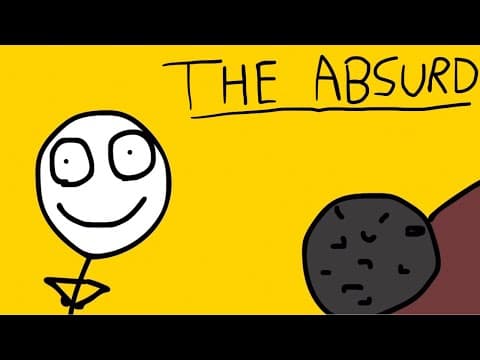
A GUIDE TO ABSURDISM: The Philosophy For Living Fully
Sisyphus 55
7m 19s1,248 words~7 min read
Auto-Generated
Watch on YouTube
Share
MORE TRANSCRIPTS