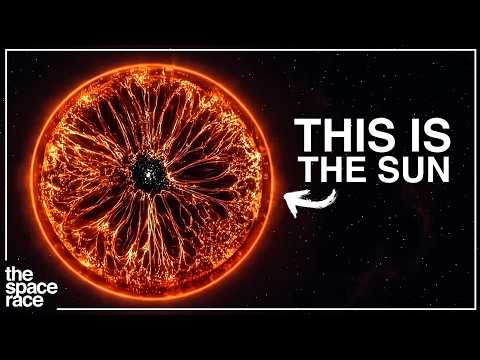
[0:04]You may have heard that the light from our sun takes 8 minutes to reach the Earth. That's the distance it has to travel through space, but you might not know that the light you see every morning is actually older than the great pyramids of Egypt. The journey of that light began in the heart of the sun, and it spent tens of thousands of years fighting its way through hot, radioactive, electromagnetic chaos before it finally broke free and made its way here. The sun has captivated humanity for as long as we have existed, but it's only just now, thanks to some of NASA's most advanced spacecraft, that we're finally beginning to understand how the sun actually works. This is so much more than a giant fireball in the sky, and what NASA has found inside the sun will change the way you see life on Earth forever. You see, it all started with a cloud. The sun is a star and stars don't just come out of nowhere. They are born from these unfathomably large clouds of gas that stretch across hundreds of light years. But where does all of this stuff come from? Well, originally all matter was created at the moment of the Big Bang, but in more recent cosmic history just a few billion years ago, these star forming clouds were actually created by other stars that lived and died and exploded, scattering their collections of hydrogen helium and heavier elements across the galaxy. So, in a way, the sun is made from recycled stardust. Now, over time, that debris will meet up and clump together, and the bigger the collection grows, the more gravity it will develop, and the more debris it will attract until you have this colossal star forming engine that is just waiting to be kicked into action. Eventually, after millions or billions of years of drifting through the galaxy, the cloud will find itself coming too close to a giant star at the same time it just happens to explode into a supernova, and the shock wave from that blast will ripple through the cloud like a hand pressing into a pillow. Once that push is made, gravity begins to take over. Regions of the cloud get compressed into higher densities, which begin to rapidly pull in the surrounding material. This amplifies the force of gravity until these new pockets of dense gas begin to collapse under their own weight, getting hotter and denser until matter is pulled together into a tight knot. This is the seed of a future star. Within our original humongous cloud of gas, there are going to be many star seeds that form from those pockets of higher density. Stars are born in groups, and one of those new seeds will eventually become our sun. There's no light yet in the embryo stage, just a dense dark ball of gas called the protostellar core. The size of this ball is enormous, bigger than our actual solar system, and it will spend a few million years pulling in even more material from what remains of that original cloud, building up a stronger force of gravity and contracting inward, becoming more hot, dense, and small as time moves on. The more you compress a gas, the more likely it is that the particles inside will start crashing into each other. The more they bounce around, the faster they move. The faster they move, the more energy they take on and the more heat they can generate. Eventually, the core will get so hot that the first light begins to appear. This is now something called a protostar. It hasn't come alive just yet, but it is starting to generate energy from all of that compressed gas. After another million years or so, a moment will come that changes everything. When the temperature inside the core reaches 10 million degrees Celsius, a powerful reaction begins to take place. This is a fundamental building block of the universe, it is the source of all life as we know it. At the heart of our protostar, hydrogen atoms become so energized that they start crashing into each other hard enough to begin fusing together and creating new atoms. And the energy released by that fusion is what finally turns the sun into a star. Like flicking a cosmic switch, the light of our solar system has arrived. Meanwhile, outside of the core, our ball of gas has started rotating, and that moment is going to allow some of the material to fight back against the pull of gravity, and the sun won't be able to pull it in. This all happens around the middle, the equator, because this is where the sphere experiences the highest rotational momentum. Everything at the top and the bottom is rotating more slowly, and that's what continues to be pulled down into the core. So, over several more millions of years, our original ball of gas flattens out into a spinning disk with our newly formed sun in the middle. From that disk, all of the planets, moons, and comets of our solar system slowly formed. But still no life or liquid water can exist until the sun powers up enough to spread its warmth through the planets of the inner solar system. Deep inside the star lies its core, a region that makes up about a quarter of the sun's volume, but contains half its energy. The environment down here is almost incomprehensible. The temperature sits at 15 million degrees. The pressure is 250 billion times what you'd feel at the bottom of Earth's oceans. Under these conditions, atoms are fused together and ripped apart. This process releases free electrons from those atoms, and this begins a flow of electricity through the hot, dense soup inside the star. Once the electrons begin to flow, that's when gas has transitioned into something called plasma. This is the fourth state of matter. We know that if you add energy to a solid, it can melt into a liquid. And if we add more energy to that liquid, it can vaporize into a gas. When you add even more energy into that gas, it can become plasma, and that's what the sun is made of, a fourth state of matter that only exists in the most extreme conditions. The source of this energy inside our sun is nuclear fusion. This begins with the lightest and most abundant atoms in the universe, hydrogen. At the core of a hydrogen atom is one proton, which is positively charged, and just like trying to push together two positive ends of a magnet, the protons inside hydrogen atoms have a tendency to repel each other. But the power of the sun is one of the only forces in the universe that's able to push them together. This starts a chain of fusion reactions. Two hydrogen atoms combine into a heavier form of hydrogen called deuterium, which then fuses with another hydrogen atom to become helium 3, and two helium 3 atoms eventually combine into helium 4.
[7:27]This series of events called the proton-proton chain accounts for 99% of all energy the sun produces. But where does the energy come from? Well, it's important to note that inside the fusion process, one plus one does not equal two. That's why two single proton hydrogen atoms fuse together, do not become a dual proton helium atom. They just create a heavier hydrogen, and that process happens again and again at every step in the fusion chain. So now we know that every time this fusion happens, the resulting atom weighs slightly less than the sum of the original atoms that went into it. That means something goes missing, but that missing mass doesn't just disappear. It converts directly into energy. This is what Einstein's famous equation describes. E equals mc squared, energy equals mass times the speed of light multiplied by the speed of light, which is a very large number. In very simple terms, this tells us that even an incredibly small amount of mass can be transformed into an incredibly large amount of energy. It just needs that very special process to be released. Every single second, the sun converts 4.3 million tons of its own mass into pure energy. To put that in perspective, that's roughly equivalent to the mass of 3 million cars being annihilated and turned into energy every second without stopping. The beauty of this system is that it is self-balancing. As the fusion reaction ramps up, the energy it produces pushes outward against the crushing inward pull of gravity. This halts the collapsing process that we talked about earlier, and the sun reaches a level of stability called the hydrostatic equilibrium with gravity pulling in, energy pushing out, and everything in perfect balance for now, at least. So, once energy is created in the core, you might think it shoots straight out into space and reaches Earth in minutes. In reality, the journey from the core to the surface takes an almost unfathomable amount of time, somewhere between 10,000 and 170,000 years. The reason comes back to the sun's interior being so extraordinarily dense. The core alone is about 20 times more dense than iron. So, picture the heaviest black cast iron pan in your grandparents' kitchen, and then try to imagine that it weighs 20 times more while staying the exact same size, and made of electrified 15 million degree plasma. That is the heart of the sun, and that's where the light outside your window comes from. Energy from the core travels outward as particles of light called photons. But those photons don't travel in a straight line, they bounce off other particles inside the sun in every conceivable direction, constantly being absorbed and re-emitted. Imagine trying to walk through a crowded shopping mall with your eyes closed, bouncing off people and walls with every step you take. Inevitably, after thousands of years spent wandering aimlessly, you will arrive at a Cinnabon. Scientists call this process Brownian motion, and during this chaotic wandering, the photons also change from something totally invisible into the daylight that we all know. Near the core, the photons carry so much energy that they're vibrating at an ultra high frequency, far beyond what we call the visible spectrum of light. They start out beyond ultraviolet and into the realm of X-rays, and then by the time they finally reach the surface after tens of thousands of years of wandering the cosmic shopping mall, they finally slow down and cooled off enough to become the visible light and UV rays we are familiar with. This is the amazing process that gives life to you and me and everything else on Earth, and maybe even some other weird places in the solar system. So, just think about all of that the next time you look out your window into another bright, sunny day.