[0:00]You're not lazy, you're not broken, but you might be the problem and this is the reason why you seem mediocre. The reason you can't seem to change no matter what, is because there's a part of your brain whose entire job is to make sure you don't change. You know that feeling that hits around 2:00 AM when you can't sleep and you start replaying all the times that you said you were going to start that project, that program, that workout plan and you just did not. You lie there thinking, I am capable, I know what to do. So why am I the same person that I was last year? This has been happening to you for years. You've stopped telling people what you're working on because you're tired of the awkward silence when they ask how that project is going. You're not mysterious. You're embarrassed and you're starting to believe that maybe this is just who you are. But there's some good news here. You're not fighting yourself, you're fighting the machine that was built to make sure you don't change. It's very important that you understand that your brain is hunting for certainty at all times. Every time you try to grow, every time you try to break out of neutral, a part of your brain is going to send danger. And it's going to flood your entire system with enough threat signals that make you stop before you even start. So you think you're stuck because you lack discipline, but you're actually stuck because your brain is winning. It's doing exactly whatever evolution programmed it to do. Conserve energy, maintain homeostasis, and keep you alive. So mediocrity is not a failure. It's basically the default setting. It's what happens when a machine designed for survival tries to do something different. It was never built for it. And in this case, that is growth. So you've been blaming your willpower when you've been fighting your biology. When were you going to win? No, biology was going to win. So let me walk you through what's actually happening in here. There's five mechanisms at play. And it's very important for me that you see them because this whole thing is going to make sense. First mechanism, your brain puts you in autopilot most of the time. There's a 2025 study, the links in the post by the way. And they tracked a hundred people's daily activities moment by moment for a full week. The findings are very interesting because 65% of everyday behaviors are triggered habitually. Meaning something in your environment kicks them off without even a conscious decision happening. And 85% on habit during execution, so you perform them almost without thinking. Why is this? Well, your brain uses 20% of your body's energy even though it's only 2% of your weight. That is crazy. So to survive, it had to get really efficient. So when you repeat something enough, control shifts from your thinking brain to the prefrontal cortex, so your habit center, which is called the basal ganglia. This is what the moment you feel bored, stressed, tired, your brain automatically defaults to familiar patterns. So scrolling, snacking, procrastinating, and that's why mediocrity feels so effortless. It's almost part of who you are, and growth feels so hard. Because your habit center has been driving while your conscious mind watches literally from the passenger seat. Second mechanism, your habits literally lock you in place. Habits work like this, trigger, action, reward. Your basal ganglia learned that loop and they make it automatic. The more you repeat it, the stronger the neural pathway becomes. And a lot of people don't know that once a habit is fully formed, it can almost run completely independently of the prefrontal regions that helped it build it. So the habit center is going to take over. And this has been shown for years in imaging studies. Which means that even when you know you should change, your old habits are going to fire first. They have a head start because they're faster and they require less energy than thinking does. Third mechanism, your brain gets bored when nothing surprises you. So let's talk about dopamine because everyone gets dopamine wrong. Dopamine isn't primarily a pleasure chemical, it's a motivation and learning signal. Specifically, your dopamine system fires when you experience what's called a reward prediction error. This is just a fancy word to say that something happened that was better or worse than what your brain expected. When rewards are completely predictable, your dopamine neurons go silent. So, you don't get the chemical signal that says do this again. And that has been confirmed across humans, monkeys, rats, for decades. And this is exactly the mediocrity trap. When your day is full of predictable, low stake rewards, so, comfortable routines. When you expect it already. Your dopamine system is going to adapt to that baseline. You feel okay, not miserable, not motivated enough to change, not excited enough to grow. So you're chemically stuck in neutral because your brain is just bored with the predictability. Fourth mechanism, your brain treats growth like it's a threat. There's a region called the anterior cingulate cortex or the ACC and it's basically your brain's warning system. It lights up when there's a conflict between what you want and what feels safe. And this finding has been replicated hundreds of times. A 2024 study identified a specific brain pattern for what they called uncertainty based anxiety. It basically activates your ACC, your amygdala and your insula before you even face any type of challenge. Your brain can predict danger and prepare you to avoid it before the danger is even here. So when your brain detects too much friction, it flips on something called the default mode network. Which is basically the brain system responsible for thinking about yourself, for worrying and for ruminating. So let's go back to that 2:00 AM voice that we talked about in the beginning. The one that says, oh maybe you're just not that type of person. That's your default mode network. And research shows that the same network is overactive in people who ruminate endlessly about failure and self-doubt. And that little voice is not wisdom, it's your brain's self-preservation system, but it's gone haywire. Fifth mechanism, your brain slowly accepts being average as normal. When rewards stay consistently modest, your dopamine system scales down its expectations. It's called a reward adaptation. And a comparison that research make is people with addiction. So people with addiction get used to extremely high reward levels from drugs, right? So then normal life just cannot compete with that. And the same thing happens in reverse with mediocrity. Your baseline keeps dropping. Mediocrity becomes the new normal, and big goals start feeling so unrealistic and honestly, unnecessary for your life. Because you've chemically adapted to expect less from yourself and less from your life. Now that we talked a little bit about the bad news, let's talk about the really good news, and that is that your brain can change. But only if you push through discomfort. I've talked a lot about neuroplasticity in all of my platforms, but it's basically your brain's ability to physically rewire itself. It is real, it is measurable, but the catch that a lot of people don't seem to fully grasp is that it only happens when you engage in effortful, focused learning. Not when you read about it, not when you understand it, when you actually do something hard. A 2025 review confirmed that cognitive training increases gray matter in the prefrontal cortex. So the area responsible for discipline and decision making. There's a very sweet spot that researchers called the Goldilocks zone, which is basically that neuroplasticity only happens when challenges are hard enough to be uncomfortable, but not so hard that you quit. And a good rule of thumb for this is pick something that feels about 70 to 80% achievable. Because if it feels too easy, then it's too easy and whatever, right? But if it feels too impossible, you're going to quit. You have to remember this, your brain has to do work. It has to struggle. Comfort doesn't change you. The only thing that changes you is discomfort. So you've been listening to the science and you're wondering, now that I know all of this, what do I do now? Here are four things that are backed by research that actually work. Number one, do one uncomfortably hard thing every single day. Pick something slightly outside of your comfort zone and do it daily. It doesn't have to be huge, but it has to force your prefrontal cortex to activate because that's what triggers neuroplasticity. Number two, interrupt your autopilot on purpose. When you catch yourself starting a bad habit, stop right then and there and ask yourself, why am I doing this right now? That single question forces conscious control back online and interrupts your habit circuit before it even has time to finish. Number three, chase novelty, not comfort. Try something new. Take a different route home. Talk to a stranger. Novelty spikes dopamine because your brain is actually guessing what's going to happen next. And in that moment of uncertainty is where motivation lives. Number four, always reward the effort, not the outcome. Remember the reward prediction area that we talked about, here's how you use it. The formula is prediction error equals what actually happened, minus what you expected. So small expectations plus big effort equals positive prediction error, equals dopamine hit, equals motivation to keep going. Your brain will eventually adapt to this too, which is why you keep racing the bar. And the bottom line is that you're not broken, you're not lazy, you're not incapable. You were the problem because you've been fighting your biology with willpower alone and that was never going to work. Never. Your brain was designed for survival, not for growth. But now you know the mechanism. Your brain saves energy by autopiloting average behaviors. Your dopamine flat lines on predictable rewards. Your threat systems treats uncertainty as danger, and your rumination loop talks you out of trying. So yes, growth demands that you use this comfort as fuel. Every time you choose a hard thing over an easy thing, you're not just being better. You're physically rewiring your brain through measurable neuroplasticity. There's a line from one of the studies that's worth quoting directly because it summarizes this perfectly. Two-thirds of our everyday behaviors are habits, which means making healthier changes may be less about starting from scratch and more about swapping one habit for another. And yes, mediocrity might be the default, but excellence is conscious and you have the capability of being excellent. You've been fighting the wrong enemy this whole time, but now you know what it actually is, your biology and you know now exactly how to break free from it. I know that was a lot of science, a lot of information, but I hope you find this helpful. I'm doing this because I truly am so passionate about changing behaviors with science, using your biology to your advantage and not fighting against it all the time. If if any of this hit close to home or you know someone that could benefit from this information, please make sure to send it to them and drop me a comment and tell me one habit you're trying to break free from. And if you're new here, I do this every single week, neuroscience translated. Please hit subscribe so it actually sends you a notification every time I post, and next week I'm doing something a little bit different. I'm teaching you how to do research like a scientist without being one, almost the exact method I use to verify claims that I use in episodes like this one. So you can stop trusting random internet gurus and start thinking for yourself. Thank you so much for listening. My name is Anna and this is the Science Barbie. Talk soon. Bye.
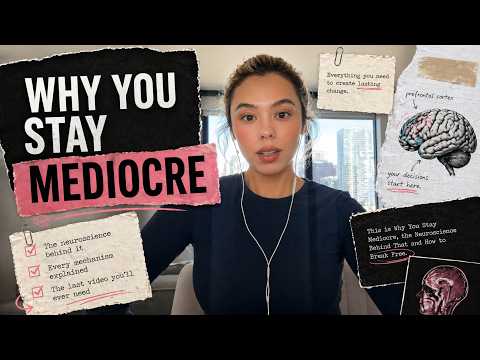
The Neuroscience of Why You Can't Change & The Solution
Anafer
12m 54s2,029 words~11 min read
YouTube auto captions
Transcript source
YouTube auto captions
This transcript was extracted from YouTube's auto-generated caption track. The transcript below is server-rendered so it can be read, searched, cited, and shared without opening the original YouTube player.
Pull quotes
[0:00]You're not lazy, you're not broken, but you might be the problem and this is the reason why you seem mediocre.
[0:00]The reason you can't seem to change no matter what, is because there's a part of your brain whose entire job is to make sure you don't change.
[0:00]You know that feeling that hits around 2:00 AM when you can't sleep and you start replaying all the times that you said you were going to start that project, that program, that workout plan and you just did not.
[0:00]You've stopped telling people what you're working on because you're tired of the awkward silence when they ask how that project is going.
Use this transcript
Related transcript hubs
Watch on YouTube
Share
MORE TRANSCRIPTS


