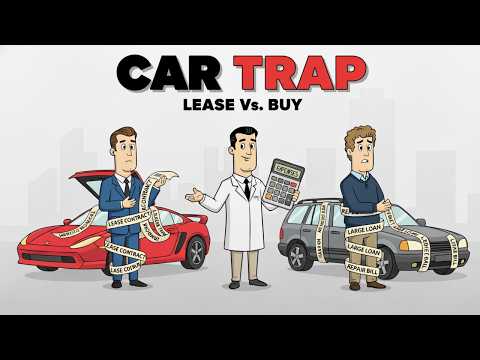
[0:00]Jake leases a car. Marcus buys the same car. They both think they made the smarter choice. They're both wrong, because neither of them ran the actual numbers.
[0:10]And when you do, the gap is way bigger than either of them expected.
[0:14]Let's keep this fair. Jake and Marcus both earn 55,000 a year. They both want the same car, a 30,000 sedan. Same model, same trim, same color.
[0:26]They both walk into the same dealership on the same day. The only difference is what they sign.
[0:32]Jake signs a 36-month lease. $2,000 due at signing, $299 a month. The salesman tells him he's getting a great deal.
[0:40]Low monthly, brand new car, full warranty coverage and in three years he can just hand the keys back and walk away. Simple, clean, no strings attached. At least that's how it sounds.
[0:53]Marcus takes out a 60-month auto loan at 6% interest. His down payment is $3,000 and his monthly is $522. That's $223 more than Jake every single month.
[1:06]The salesman doesn't need to say anything. Marcus can feel that difference already.
[1:11]On Day 1, Jake's pockets are heavier, his payment is lighter and he's driving off the lot feeling like he outsmarted the system.
[1:18]But there's something Jake doesn't realize yet. The structure of his deal is fundamentally different from Marcus's in a way that goes beyond monthly payments.
[1:28]Every dollar Marcus spends is buying him a piece of something. Every dollar Jake spends is renting a piece of something. And that distinction over time is worth tens of thousands of dollars.
[1:39]For three years, Jake is living the dream. Brand new car, that new car smell. Full manufacturer warranty. Something goes wrong mechanically, covered.
[1:50]Needs new brake pads under warranty, covered. Air conditioning dies in July, covered.
[1:58]Jake's only costs are his lease payment, insurance, and gas. That's it. No surprises, no anxiety, no large repair bills showing up out of nowhere.
[2:10]Marcus, different story. He's paying $522 every month and watching his car lose value in real time.
[2:18]The moment he drove off the lot, his $30,000 car was worth around $27,000. By the end of Year 1, it's worth about $23,000. By Year 2, maybe $20,000.
[2:32]Meanwhile, his loan balance is still sitting at around $22,000. That means for the first two years, Marcus owes more than his car is worth. That's called being underwater, and psychologically it feels terrible.
[2:44]Every payment feels like it's going into a hole. Jake sees this, everyone around Marcus sees this.
[2:49]And the verdict seems obvious, Jake made the smart call.
[2:53]Let's run the actual numbers through Year 3. Jake has paid $2,000 down plus 36 months at $299. That's $12,764 total.
[3:05]Marcus has paid $3,000 down plus 36 months at $522. That's $21,792 total.
[3:15]Jake has spent $9,028 less than Marcus. On paper, Jake is winning by nearly 10 grand. That's not a small gap, but Year 3 is where the story takes a turn.
[3:28]Jake's lease is up. He drives back to the dealership and has three options.
[3:34]Option 1, buy the car at its residual value, which is the predetermined price the dealer set at the start of the lease.
[3:41]For a $30,000 car after three years, that's usually around $16,000 to $18,000.
[3:48]Option 2, walk away, hand back the keys, owe nothing. Option 3, lease a brand new car and start the whole cycle again.
[3:59]Jake does what 80% of lessees do, he leases again. New car, new contract, another $2,000 at signing, another $299 a month, another 36 months.
[4:11]He's back to month one. The odometer reads zero. The payment counter, that doesn't reset.
[4:19]Now look at Marcus. He's 36 months into a 60-month loan. He still has 24 payments left. That's frustrating, but here's the difference. Marcus has an end date, it's circled on the calendar.
[4:33]Every single payment he makes brings him one step closer to owning this car outright. Every payment Jake makes brings him one step closer to giving the car back and starting over.
[4:45]This is the fundamental difference between leasing and buying that the monthly payment conversation completely hides.
[4:51]One is a conveyor belt, the other has a finish line.
[4:55]Month 60, Marcus makes his final payment. That's it. Done. The car is his. Title in hand. No more monthly payments.
[5:04]From this point forward, Marcus's only car-related costs are insurance, gas, and maintenance. For the average sedan, that maintenance runs about $100 to $150 a month, oil changes, tires, brakes, the occasional repair.
[5:19]Jake, still swiping his card for $299 every month. He doesn't think about it much because it's just become part of his life. That's the danger of leasing, it normalizes a permanent car payment.
[5:31]It becomes background noise, but background noise still costs money.
[5:36]Let's check the scoreboard at the end of Year 6. Jake has now completed two full leases. His total spend, $2,000 down on Lease 1, $10,764 in payments, $2,000 down on Lease 2, $10,764 in payments.
[5:55]That's $25,528. He owns nothing, no asset, no title, just receipts.
[6:00]Marcus has spent $3,000 down plus $31,320 in loan payments. That's $34,320 total on the loan.
[6:12]But he now has zero monthly payments and owns a car worth approximately $11,000 to $13,000. If we subtract that asset value from his total spend, his effective cost is around $21,000 to $23,000.
[6:28]Jake, $25,528 spent, zero assets. Marcus, roughly $22,000 effective cost and a car in his driveway that he owns. The flip happened quietly, but it happened. And from here every single month that passes makes Marcus's position stronger and Jake's weaker.
[6:50]The monthly payment is the number the dealership puts in front of you. It's the number on the commercial, the number on the website, the number the salesman writes on the little card and slides across the desk.
[7:03]What they don't slide across the desk is the list of conditions attached to that number.
[7:09]Mileage caps. Most standard leases allow 10,000 to 12,000 miles per year. Sounds reasonable until you realize the average American drives about 13,500 miles a year.
[7:23]That means the average driver is over their limit before the lease even ends. The penalty, typically 15 to 25 cents per mile over the cap.
[7:32]If you drive 5,000 miles over your limit across a three-year lease, that's $750 to $1,250 due on the spot when you return the car. And you don't find out until the end. It just shows up on your final bill like a surprise tax.
[7:45]Wear and tear. The dealership inspects the car when you return it. That door ding from the parking lot, the coffee stain on the back seat, the curb rash on the wheel from that one parallel parking attempt, all billable.
[7:59]And normal wear and tear is defined by the leasing company, not by you. What you consider normal, they might consider a $300 charge.
[8:08]Disposition fees. Most people don't even know this exists. When you return a leased car and don't lease another one from the same dealer, you're charged a disposition fee.
[8:18]Typically $300 to $500, just for them to process and resell the vehicle. You're literally paying them to take the car back.
[8:26]And if your life changes mid-lease, you move to a city where you don't need a car, you lose your job, your family situation changes, getting out early can cost you the entire remaining balance of the lease. There's no simple exit. You're locked in.
[8:41]These costs don't show up in the $299, but they show up eventually.
[8:45]If I only showed you the downsides of leasing, I wouldn't be giving you the full picture. Buying has real costs that people like to downplay. Once that manufacturer warranty expires, usually around Year 3 or 4, everything is on you.
[8:59]You brakes wear out, tires need replacing, belts crack. The AC compressor fails on the hottest day of the year.
[9:08]And unlike a leased car, there's no one to call. You're either paying the mechanic or learning to fix it yourself. For a typical sedan, maintenance costs average around $1,200 to $1,800 a year once you're past warranty.
[9:22]Some years it's just oil changes and new tires, other years it's a $2,000 transmission repair that ruins your month.
[9:30]The unpredictability is the part people struggle with. At least with a lease, you know what you're paying every month.
[9:36]And depreciation is real. Your $30,000 car is worth $20,000 after two years and maybe $12,000 after five.
[9:44]That value didn't go anywhere useful. It just evaporated. The difference is that depreciation slows down dramatically after the first few years.
[9:53]A five-year-old car doesn't lose value nearly as fast as a brand new one, so the longer you hold, the less depreciation hurts. Time is the buyer's best friend.
[10:04]Here's where the full story comes together. Over 10 years, Jake has leased three to four cars. Each cycle costs him roughly $12,000 to $13,000 in payments and fees.
[10:15]Add in mileage overages, wear and tear charges and disposition fees across multiple leases, and Jake's total 10-year spend lands somewhere between $45,000 and $52,000.
[10:28]At the end of Year 10, Jake has no car. Or rather, he has a car, but it's not his. It never was.
[10:37]Marcus paid $34,320 for his loan. After that, he spent approximately $10,000 to $14,000 on maintenance and repairs over the next five to seven years of ownership.
[10:50]His total 10-year spend is roughly $44,000 to $48,000. And he still has a car sitting in his driveway, older, sure, but worth $4,000 to $6,000 and fully paid for.
[11:04]When you net it out, Marcus spent less and has an asset. Jake spent more and has nothing.
[11:11]The difference over a decade is somewhere between $15,000 and $25,000 depending on the specific lease terms, maintenance luck and how long Marcus keeps the car. And that's just one car.
[11:23]Most people will repeat this cycle three, four, five times over their adult life. Multiply that gap by five, and you're looking at a six-figure difference in lifetime wealth between someone who habitually leases and someone who buys and holds.
[11:36]I'd be lying if I said leasing never makes sense. There are specific situations where the math tilts in leasing's favor. If you're self-employed or own a business, lease payments can be partially or fully deductible as a business expense depending on how the car is used.
[11:51]That tax advantage can erase the ownership gap entirely, and in some cases, make leasing the clearly smarter move.
[11:59]If you drive a luxury or high-performance car, you know, something where out-of-warranty maintenance is genuinely brutal, leasing keeps you inside the warranty window permanently. When an oil change costs $500 and a brake job costs $4,000, that warranty coverage has real dollar value.
[12:16]Leasing a BMW is a very different conversation than leasing a Honda Civic. And if you're the kind of person who takes the $223 a month you're saving by leasing over buying and puts it into an index fund averaging 8 to 10% annually, you could theoretically come out ahead over a long enough timeline.
[12:33]But that requires discipline that most people simply don't have. Be honest with yourself about whether you'd actually invest that money or just spend it.
[12:43]For the average person driving an average car, buying and holding wins. It's not the exciting answer. Nobody's making TikToks about driving a paid-off sedan, but the math doesn't care about excitement.
[12:55]Jake and Marcus both walked into that dealership thinking they were making the smart play. Jake thought he was saving money. Marcus thought he was building equity. Neither of them actually sat down and ran the numbers past Month 1.
[13:08]The real trap isn't leasing, and it isn't buying. The real trap is making a $30,000 decision based on a monthly payment without ever asking what this costs you over 5 years, 10 years, a lifetime.
[13:20]And if you're thinking about skipping the loan entirely and just paying cash up front, that's a completely different conversation, and the answer might surprise you. But for now, the next time someone slides a monthly payment across the desk and it looks almost too good to be true, ask yourself one question.
[13:36]What does this actually cost me when it's all over? Because that's the only number that matters.


