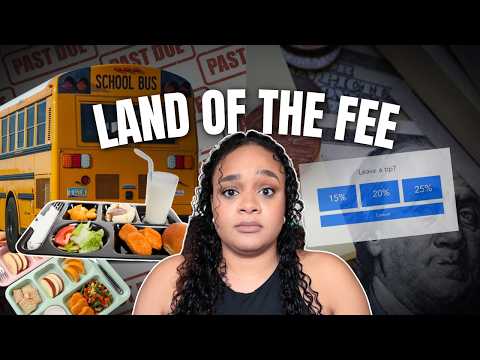
[0:00]There's a very specific version of America that the rest of the world knows. Hollywood, Silicon Valley, the moon landing, Elvis Presley, the invention of the iPhone, Coca-Cola, the American Dream. And then there's the reality. New report reveals 69% say their income is falling behind the cost of living. This morning a young Kentucky man says his life is on hold because a heart condition left him with massive debt despite having health insurance. Millions with student loan debt are facing uncertainty on the potential for higher monthly payments. Not every family can afford to pay. 1/3 of students are in debt. It genuinely is an extraordinary country in a lot of ways. But this video isn't about that version. This video is about the version that doesn't make it into the tourist brochures. The version where you can follow every rule, work hard your entire life, do everything right, and still lose everything because you got sick. Where children are publicly shamed at school for not having enough money for lunch. Where a machine, not even just people anymore, but machines, ask you for a tip after doing the most basic task. Let me show you what I mean. Let me tell you about James. James is in his late thirties. He lives in Colorado, he's got a good job, a family, and he gets health insurance through his employer. By any reasonable measure, we would say that James has done everything right. Well, in 2019, James woke up one morning with tightness in his chest and pain radiating down his left arm. His wife drove him to the emergency room immediately and they admitted him right away. For three days, he was in the hospital. They ran an EKG, a stress test, they did a CT scan and did blood panels every few hours. A cardiologist came in to see him, then another one. They monitored his heart around the clock, put him on medication, made sure he was stable. On day three, they discharged him home. They said it wasn't a heart attack, but it was a serious warning and that he should take better care of his health. James went home, he hugged his kids and felt extremely lucky. And two weeks later, an envelope arrives in the mail. The hospital bill for $112,000. Now, James has health insurance, good insurance even, or so he thought. And his insurance did cover most of his hospital stay. But his share after the insurance paid was $34,000. And just to put that into perspective, the median American household earns around $74,000 per year. So essentially, James was being asked to hand over nearly half of an entire year's income for a three-day stay in the hospital, for a stay that didn't even involve surgery. I don't know about you, but I don't have $34,000 sitting around. Most people don't, and neither did James. He tried to negotiate with the hospital and they came down a little bit on the price, but not enough. So James was left with only one option: he filed for bankruptcy. And here's the thing, this sounds very overdramatic, but this isn't a tragedy. This is an average Tuesday in America. About 530,000 American families file for bankruptcy every year, largely in part due to medical bills. If you're watching this from the UK, or Germany, Canada, France, that number probably just broke your brain a little bit. You're probably doing the math in your head thinking how is this possible? And if you're American watching this, you probably just nodded, because you've heard this story, or maybe you've lived it. Maybe it's your story. That gap between the international confusion and the American shrug is exactly what this video is about. There are five things happening in America right now that are completely legal, completely normalized, and just accepted as simply how things are, that the rest of the world finds genuinely incomprehensible. We're going to look at all five of those things today, and by the end, I think you'll see that they're not actually five separate things. They're one thing, the same thing, wearing five different masks. Let's start with the one that started this whole video, healthcare. Let's talk about numbers for a second because the scale of this is important. Every year, approximately 530,000 Americans file for personal bankruptcy, and the leading cause, the single biggest driver is medical debt. A study published in the American Journal of Public Health found that 66.5% of all personal bankruptcies in the US are in some part due to medical issues, either the bills themselves or the income lost because of a medical illness. To understand how strange that is, let's do a quick comparison. A three-day hospital stay in the United States costs on average around $30,000. In Germany, you can expect to spend around $5,000. In Canada, zero is what you'll pay out of pocket. Zero dollars. Those are the same three days, the same human body, and generally the same standard of medical care, but extremely different numbers on each of those bills. So, why is that? Well, it's because the American healthcare system isn't really a healthcare system. It's a healthcare market. Hospitals are businesses, insurance companies are businesses, pharmaceutical companies are businesses. They have shareholders, they have quarterly earnings calls, they are legally and structurally optimized to do one thing: generate profit. And here's what that means in practice. That means that your hospital has financial incentive to charge as much as the market will bear. And your insurance company has an incentive to pay out as little as possible to maximize their profit. Those two incentives are pointed directly at each other, and you are caught in the middle. And that's not a conspiracy, that's just plain fact. Most other wealthy countries looked at that structure and said, no. Some things are too important, too universal, too fundamental to be left to the market. When your house is on fire, nobody shows up with a card reader and waits for you to pay before they act. The fire department exists because society decided that some services need to be available to everyone unconditionally. Most of the world extended that same logic to healthcare. America didn't. Another piece of this is insurance. In America, most people get their health insurance through their employer, which sounds fine. Until you're sick and can't work, then you lose your job, which means then you lose your insurance, which happens to be at the exact time that you need it the most. The Affordable Care Act, also known as Obamacare, helped with this problem. Millions of people got coverage who didn't have it before, but it didn't change the underlying structure. The profit motive of these companies are still there. The same procedure at the same hospital can cost 10 times more depending on which insurer you have. So adults in America can go bankrupt for getting sick. But surely, surely the children are protected from this kind of financial logic, right? In thousands of American schools, when a child's lunch account runs out, the hot meal gets taken off their tray. Sometimes they get a cold cheese sandwich instead. Sometimes the meal gets thrown in the trash in front of them. And in some states, they can be denied food entirely. The specific policy depends on where you live, but the fact is that this decision, whether a hungry child eats today or not, is left to a patchwork of local laws, rather than a national guarantee. In 2022, total unpaid school lunch debt across the US exceeded $262 million. And the reason for this is probably not what you think. One in six American children lives in a food insecure household, meaning they don't reliably know where their next meal is coming from. And when those children show up to school, the one place that's supposed to be safe, neutral, and educational, they can be publicly marked as the kid who doesn't have money. Some schools have even stamped children's arms with debt notices, like a mark of shame that they carry through the school day. Some schools have even required kids to do chores to work off their balance. And in 2019, a school district in Rhode Island announced that it would deny students their graduation diploma if they had unpaid lunch balances. Denying a diploma for lunch debt in one of the richest countries in the world. In Finland, school meals have been free since 1948. For every child, regardless of the income, as a matter of law. In Sweden, lunch is free for all children through age 16. In the UK, every child in the first three years of primary school gets a free meal. And in Scotland, that age extends even further. Even in much of the developing world, school feeding programs are standard. Often supported by the UN in countries with a fraction of America's GDP. France, to be fair, does subsidize school meals based on a sliding scale of your income. So wealthier families pay more and poorer families pay less. So it's definitely not 100% free, but it's still meaningfully more equitable than what exists in the US. The United States spends more money per capita than almost any country on earth, and it has no national policy guaranteeing any child a meal at school. It has chosen not to make school lunch free, and that's not an accident. It's a choice. So, we have children going into debt for food, and adults going bankrupt for healthcare. Now let's talk about the moment at the end of your restaurant meal when a tablet gets turned towards you displaying 18%, 20%, or 25%. And somehow you're the bad guy if you press no tip. I want to start with a number that most Americans have never heard, and most specifically people outside of America who can probably barely believe is even real. The federal minimum wage for tipped workers in the United States is $2.13 an hour. $2.13 per hour. In the big year of 2026, that number hasn't changed since 1991. So in 30 plus years, while inflation has roughly doubled the cost of living, the legal minimum wage for a waiter or a bartender has not moved a single cent. The assumption built into US law is that tips will make up the difference. And if tips don't cover the difference, employers are technically required to top up the wage to the standard minimum. Technically, but in practice, enforcement of this almost never happens. Wage theft is rampant and workers are left to absorb the risk. So this means that when you sit down at a restaurant in America, you are not just a customer. Oh no. You are functionally part of your server's payroll. That restaurant has outsourced a significant portion of its labor costs to you, the client, on a voluntary basis, enforced entirely by social pressure. And it used to just be at restaurants, which can be annoying, but okay, it's understandable. But now tipping culture has metastasized. It's at coffee shops now, take out windows, food trucks, hotel front desks, airport kiosks, even the self-checkout machines at grocery stores now are asking for a tip. A machine, asking you for a tip. And the expected percentage has crept up as well. It used to be that 15% was the standard. Now most tip screens start at 18%. Many of them start at 20%, 22%, 25%. And there's always that third option at the bottom in slightly smaller font. No tip, that you have to actively choose while the cashier watches you. The easy version of the story is that Americans are annoyed about tipping culture. And yes, that's true, but that's not the full story of what's actually happening. What's really happening is that workers are being held hostage by a broken system, and the annoying tip culture is just a symptom of that. The real problem is that a full-time server in America cannot live on their legal wage without tips. That's not normal. In Japan, tipping is considered rude, not just slightly awkward, but legitimately actually offensive. Because the implication when you tip someone in Japan is that that person is underpaid and needs your charity. And they're not, they're very well paid. Service workers in Japan actually earn a living wage. So the idea of them needing tips would be an insult. In Australia, the minimum wage for hospitality workers is around $21 per hour. Tips do happen, but they're considered a bonus and they're not required for your survival. The difference between those countries and America isn't necessarily the culture. It's not that Americans are more generous and Japanese people are more proud. It's simply the labor laws, that's it. And since we're on the subject of labor law, let's talk about what happens when your boss decides they simply don't want you around anymore.
[11:45]In 49 of the 50 United States, your employer can fire you today, right now, while you're watching this video. For no reason at all, without notice, without severance, without even any explanation at all if they don't want to give you one. The only legal requirement is that the reason, if there is one, can't be explicitly illegal. So technically they can't fire you for your race or your religion. But we just don't need you anymore is a totally valid reason, or we're going in a different direction. Totally fine. Or even, no reason, here's your last paycheck, your desk has been cleared. Completely, entirely, 100% legal. This is called at will employment, and it's the default in every US state except Montana. Most Americans have just gotten to the point where we accept this as how employment works. It's just the deal. You work, they pay you, and either of you can walk away at any time. But that's not how employment works in most of the world. In Germany, if a company wants to let someone go, they have to provide social justification. They have to demonstrate a legitimate reason for firing you. They have to follow a process, and termination without cause is not justified. In France, it's a very similar process, and workers can take unfair dismissal to labor court. Reinstatement is common, which means you often end up getting your job back. In the UK, employees with more than two years of service have full unfair dismissal protection. So you can't just get rid of them when you want to. You have to follow an entire process and you have to document causes, there are hearings, etcetera. And in Japan, terminating an employee without significant justification is so legally difficult and culturally unusual that lifetime employment at a single company was, until recently, basically the norm. Now, the standard American defense of at will employment, and I know some of you are going to say, is, yeah, okay, but workers can quit at any time too. It goes both ways. And yeah, that's true, you can quit a job without any notice, which is a real freedom, if you want to call it that. But here's the thing about it goes both ways. Your employer has lawyers. Your employer has an HR department. Your employer has six months of operating reserves, institutional knowledge, and 20 other people who can absorb your work while they recruit your replacement. And you have rent due on the first. So the freedom, yes, is technically symmetrical, but the power is not. So in an argument between a corporation and an individual with a mortgage and two kids, mutual does not mean equal. So we have medical bankruptcy, children being shamed for lunch debt, workers depending on tips to survive, and jobs that can vanish without warning. And now we can get to the final piece, the one that might be the most personally painful for a lot of people watching this. That job that you just lost, well, you needed a degree to get that job, and that degree costs you $50,000. And you're going to be paying it off for the next 20 years. Americans currently hold $1.77 trillion in student loan debt. Trillion with a T. The average person who took out loans to get a bachelor's degree owes around $37,000 when they graduate. And the average monthly payment for that is around $500 for somewhere between the next 10 and 20 years. So that's a debt incurred at age 18, before you're legally even allowed to have an alcoholic drink with your friends. That's going to follow you now well into your 30s and 40s. And here's the part that makes me so mad and honestly doesn't get talked about enough. This wasn't always how it worked. After World War II, the GI bill made college essentially free for returning veterans. And it worked. It did what it was intended to do. The American middle class exploded. College became the path, not a luxury or an elite privilege, but a legitimate reasonable expectation for ordinary people. Throughout the 1960s and 70s, state governments heavily subsidized public universities. Tuition at a state school was minimal. Adjusted for inflation, it was a fraction of what it is today. Then, starting in the 80s, state funding for higher education began to be cut. Universities had to find the money elsewhere because it was no longer coming from the government. So, tuition prices went up. And to help the students afford it, the federal government expanded student loan programs. Private lenders even got involved and offered the same. A whole industry grew up around the idea of lending money to 18-year-olds for their college degrees. And here's the perverse outcome of that. Once these loans were readily available, universities lost the pressure to keep costs down. They could raise tuition because they knew their students could just borrow more. So that's exactly what they did. Administration bloated, facilities expanded, amenities multiplied, and the tuition kept climbing and climbing. Between 1980 and today, the cost of college in America has increased by over 1,000%. And the cost of everything else has increased only by about 236%. And here's the part that ties directly back to where we started. Remember the man who filed for bankruptcy after his hospital bill? Well, fun fact, student loans cannot be discharged in bankruptcy. Almost every other type of debt can be. Credit card debt, medical debt, business loans, you name it. You can declare bankruptcy and get a free start, but student loans will follow you. They can garnish your wages, they can take your tax refund, they can follow you until you die. The debt that you took on at age 18 for a degree that you needed to participate into the economy is legally treated as more binding than almost any other financial obligation you'll ever have. Germany abolished tuition fees at public universities in 2014. And not just for Germans, but for international students too. Because their thinking was, educated people benefit society. So, society should pay for education. In Norway, education is free. In France, students can expect to pay roughly $900 to $1,000 per year for a public university. Even the UK, which has tuition relatively high by European standards, has an income contingent repayment system. Where you only pay when you earn above a certain threshold, and the debt is forgiven after 30 years no matter what. The United States is one of the wealthiest countries in the world in the history of human civilization. So this is not a question of whether America can afford to do things differently. It's a question of whether it has chosen to. And up to today, the answer is no. We have a country where you can go bankrupt for getting sick, where children accrue debt for food, where workers legally cannot survive on their wage without the generosity of strangers. Where your job can evaporate without warning, where the cost of the education you need to get that job will follow you for decades. These are not five separate problems. They are one problem, wearing five different masks. Let's look at them again. When you get sick in America, the cost is yours, not the government's, not your community's, fully 100% yours. When a child can't afford lunch, the cost falls on their family, not the school or the state. When a restaurant can't pay its workers a living wage, the cost then gets transferred onto the customer. And when the economy turns and a company needs to cut costs, that cost is born by the worker who loses his job. And when a young person needs an education to compete in the modern society, the cost is a personal debt that follows on around for 20 years or more. Every single one of these things exists because of the same underlying choice. At some point, whether through policy or ideology, through decades of political decisions, America has decided that the cost of being human is an individual problem. Getting sick is your problem, being hungry is your problem, having a job is your problem, getting an education is your problem. Every other wealthy country made a different calculation. They said, some costs are too fundamental, too universal, too human to be left to the individual to decide. So we will share that burden. That's what a society is for. America looked at that calculation and said, no. We believe in the individual, we believe in self-reliance. We believe that if you work hard, you'll be fine. And if you're not fine, maybe you didn't work hard enough. The things that we talked about today are not a secret, and they're not really even hidden. If you're American or you know any Americans, we all know about medical bankruptcies. We know that they exist. We've lived through the lunch debt. We've experienced the tip guilt, the sudden firing, and the burden of having a student loan payment for years and years. What's interesting is not that these things exist, but it's that they've been normalized. They've been accepted for so long and built into the furniture of daily life so thoroughly that it takes completely stepping outside, or having someone from the outside point it out, to actually see how strange it is. And surprisingly, or maybe not surprisingly, this list is nowhere near finished. Not even close. We haven't talked about paid family leave, or the lack thereof, mandatory vacation days, the price of insulin, prison labor, the fact that the US is one of three countries on earth without federally mandated maternity leave. So if you want a part two, let me know in the comments which one you want to hear about first, because apparently, we could be here for a while.


