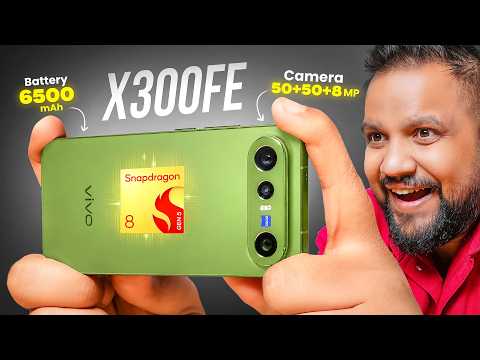
[0:00]Until now, Vivo's FE phone has been a slightly cut down, slightly cheaper version of the flagship phone. But with the X300 FE, Vivo flips that idea completely. Because right here is a no nonsense compact flagship with top of the line specs. You get Snapdragon 8 Gen 5, proper triple rear camera setup with telephoto camera no less. You get IP 69 rating, you get wireless charging, you get a large battery, a 120 Hz AMOLED display and a whole lot more. So yeah, let's talk more about the X300 FE, which is one of the most interesting phones to launch in 2026. If you're watching me for the first time, I'm Ershad. This is Trakin Tech English, your destination for detailed, incisive, gadget reviews. Now, I want to start with the most striking evolution from its predecessor. It has to be the design. It's quite an upgrade and in my opinion, the X300 FE has to be the most aesthetically pleasing compact smartphone in the market right now. Firstly, the camera module looks super sleek, super premium, and it sits on this nice little island bar at the top, looks pretty cool. And more importantly, this size is just perfect for one-handed usage, and you also get a very premium aluminum railing as well. Also, it's just 7.9 mm thick. Basically, it's a premium, lovely finished compact phone. Now, this is the Urban Olive variant of the phone, and it's a green color, and I love this color more than the other two colors that are available. So, basically, you've got a Noir black option and a Lilac purple option as well. But I must mention this, it's not glass at the back. It's a fiber glass back with a metal sand anti-glare coating, so it, when the light hits it, there is absolutely no reflection. But if you're asking me if I missed glass, then definitely during my usage, not. Primarily because it still feels very premium, and more importantly, it helps keep the weight low. I don't think it's a reason for complaint at all. Now, as for durability, you get short sensation core on the display. You also get IP 69 rating as well. Now, talking about the display, it's a 6.31 inch display. The perfect Goldie Locks size. And apart from that, it's a 1.5K AMOLED panel with 120 Hz refresh rate and a peak brightness of 5,000 nits. It also has the SGS Blue Light certification for improved eye comfort if you're looking at the screen for a long time. Now, if you take a look at the bezels, it has ultra-slim bezels, which is rare for a device that is this compact, by the way. And of course, you do get HDR support on both Netflix and YouTube, and when we checked videos on this, the HDR gradation has been done well. And when you switch to the professional color mode, you will notice that the colors are pretty close to accurate. And to close out the multimedia experience, the speakers, despite being inside a small physical space, have been tuned well. They do sound good. Take a listen to it for yourself and let me know what you guys think in the comments.
[2:35]Now, coming to the focus of the X300 FE, it has to be the camera, and the hardware is the same as the X200 FE. What you get is the Sony IMX 921 50 MP primary camera. You get the 50 MP 3x telephoto camera, which is the Sony IMX 882. You also get an 8-megapixel ultra-wide and a 50 MP selfie camera with autofocus at the front. Now, while the hardware is similar to the X200 FE, the processing and the software have improved drastically. Also, notable addition is the support for the 200 mm Gen2 Teleconverter module this year. Anyway, when I said that the processing has improved, it's mainly because of the new ISP that you get with the Snapdragon 8 Gen 5. It's a 20-bit ISP similar to the one used in the Italy Gen 5, which has 4x the dynamic range compared to an 18-bit ISP. And because of this, the multi-stack processing like HDR and portraits have improved compared to the X200 FE. But let's cut through all that talk and take a look at the samples shot with the phone. So, the first thing you notice is that the primary camera captures a whole lot of detail. Even the colors with the ZIS natural preset, especially, are very close to neutral. The HDR performance, like I said, is very good. The phone does a great job of capturing highlights and shadows while maintaining low noise in the darker portions. But in some cases, you do see some detail loss in the shadows, but otherwise, it's fine. Now, when you're shooting people against a very harsh backlight, you can see that the X300 FE again does a fantastic job of ensuring that the face is lit up nicely, and you also have a very good exposure on the rear. Now, when you talk about portraits, Vivo rarely ever misses. So, the edge detection is very good. The boca is creamy, almost like a DSLR, and the colors are spot on, too. Now, for skin tones, the ZIS natural looks very accurate, while Vivid does boost things a bit, which was to be expected, so I would stick to ZIS natural. Now, along with all of this, you also get Vivo's street photography mode with a lot of different color styles. I like the fact that you also get the Pro mode with the street photography style, which gives you a little bit more flexibility. Now, in low light, it does a fairly good job with the primary camera, but you do see some noise in certain situations. Now, when it comes to selfies, the 50 MP autofocus cameras takes good selfies in daylight. You can clearly see some of the overexposed highlights here, but hopefully it can be fixed with a software update. Now, when you look at the ultra-wide, it performs just like most 8 megapixels do. By that, what I mean is that you get decent daylight shots, average low-light shots, and serviceable 1080p 30 FPS video recording. But zoom is where the phone gets a lot of fun. See, by default, you can do 3x or 73 mm captures. Up to 6x or, you know, 146 mm captures, and the image quality is great. In fact, even at 10x, I can work with the kind of shots that we've taken here. Beyond that, however, AI takes over, and the image looks a little too heavily processed. And that's where the teleconverter module comes in handy. Because you can immediately add 200 mm to the already available 73 mm and increase the reach. Even up to 400 mm, which is basically like a 2x crop, the images look fantastic. And since the phone has such a tiny footprint, adding that teleconverter module didn't add too much weight or it didn't feel cumbersome at all. So actually, walking around with it in the street and shooting with it, felt more comfortable than the X300 Ultra, by the way. Now finally talking about video, you can shoot 8K 30 FPS with the main camera, which I kind of like. You also get 4K 120 FPS, which is nice, too. The stabilization is good, the picture quality is good, even the dynamic range is nice. By the way, if you want to get the best quality video, go into the settings and switch on the high bitrate video option. So, it bumps up from 8 Mbps to 24 Mbps. Anyway, even with the 3x camera and the selfie camera, you can shoot 4K 60 FPS video. And we're showing it to you on screen right now, it looks pretty good. Overall, despite being a compact phone and using the same hardware as the X200 FE, I still feel like the X300 FE's camera performance has improved. And it's a strong highlight for the phone. All right, like I promised, let's talk a little bit in detail about the Snapdragon 8 Gen 5 performance that you get with the X300 FE. Now, for those who don't know, the Snapdragon 8 Gen 5 uses a Qualcomm Orion CPU and has a peak of 3.8 GHz. Along with 12 GB of LPDDR5X RAM and 512 GB of UFS 4.1 storage, you will have no problems with daily performance for sure. I mean, in our testing, we didn't notice any starters, any lags whatsoever. It's a smooth experience. In fact, even our benchmark numbers are pretty strong. So, we got over 3 million Antutu. You get excellent CPU stability and the highest single core in Geekbench. Vivo has nailed the performance tuning here, especially for the compact form factor, and it is one of our best performing Snapdragon 8 Gen 5 phones. Another thing is that the Adreno GPU uses a slice dark architecture, which focuses on sustained performance over peak performance, which I kind of prefer, especially for a phone of this size. So, the efficiency is clearly visible because we did run a few tests. So, in lighter games like BGMI and COD, you get proper 120 FPS and they run very smoothly, so that's good. But even in Genshin Impact, we got 59.2 FPS average FPS, and it's almost on par with the performance of other Snapdragon 8 Gen 5 phones, which have a larger chassis. Which is a very important point to note because it does all of this without even getting hot inside this compact form factor. I think if you ask me, the X300 FE has to be the best tuned Vivo phone in terms of performance that I've tested in a long time. This is where I ask myself a question, and I want to ask you the same question as well. So, if you have a compact flagship like the X300 FE, would you rather take a superbly tuned Snapdragon 8 Gen 5, or would you still want the Snapdragon 8 Gen 5 inside this compact form factor, but it would be throttled and won't give you sustained performance? So, what would you pick? I'd pick the former, and this is what happens when you start testing phones in detail. It gives you such added perspective, you know. Now, for the battery, you get a 6,500 mAh battery with 90W wired charging support and 40W wireless charging support as well. During testing, we averaged about 6 hours of screen on time, but this is just the initial run. So, we have to test it in detail, so stay tuned for our, you know, long-term review, which I'm sure we should do for this phone. What do you guys think? Let me know in the comments. All right, now talking about the software, the phone runs on Origin OS 6 based on Android 16, and I love the fact that Vivo's actually promising 5 years of software updates and 7 years of security updates. Now, of course, with Origin OS 6, you get the full suite of features. You get Origin Island, you get AI tools, Office Kit, one-tap transfer, and more importantly, the very new Shake and Share feature. Basically, it's been introduced with the X300 Ultra and the X300 FE. If you shake both the phones at the same time, they sort of connect and share files. While the software is fluid, I do have a few complaints. Firstly, lock screen poster is on by default, you'll have to switch that off, and if you don't switch off the notifications, then the V App Store will keep sending you one notification to download an app every day. Now moving on, the haptics have been tuned exceptionally well. It's a very good X-axis motor, it's tuned very well, and it feels tight and crisp when you're actually typing on the phone. And this is particularly good because it's a tiny phone, to actually tune it really well, is something that Vivo's done well. Now, talking about the connectivity and ports on the X300 FE, you get support for dual nano SIM cards, but you also do have eSIM support, which is nice. As for the 5G band support, you get 18 5G band support, you get Wi-Fi 7, Bluetooth 6 and even NFC. And you know what, I actually wanted to push the performance of the Snapdragon X80 modem RF system, so the 5G connection was very good. But even on Wi-Fi, we tried GeForce now on this phone, on this tiny display, and it was a lot of fun because it was very stable. But I have one disappointment with the hardware, it's USB 2.0. In 2026, on a phone that is priced this much, it should have been faster USB speeds. Now, overall, if you look at it, the X300 FE is arguably one of the best compact flagships that you can buy in 2026. It has the looks to kill, it has the power to thrill, and it has cameras that fit the bill. I think I should stop now. Anyway, the pricing of the phone reflects the current state of the market, and I'm sure that you have very strong opinions about it. So, I really want to know what your opinions are in the comment section. And I'll see you guys in the next one. Until then, keep tracking, stay safe.