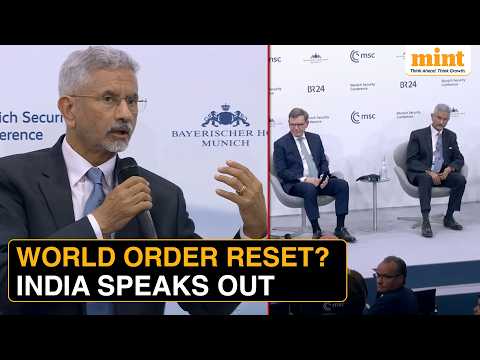
[0:02]And we can welcome Indian Minister of Foreign Affairs, Jayachanka, and German Minister of Foreign Affairs, Mr. Vadepool.
[0:15]Yes, I'm I've been practicing.
[0:20]Our topic this this afternoon is navigating uncertainty in a world in disarray.
[0:28]These are pretty, pretty dramatic words that that we that we have here.
[0:35]And I was wondering whether I might start by getting your reaction to this morning's speech by Secretary Rubio.
[0:45]And whether you think that it's added or reduced a little bit of of uncertainty.
[0:52]Minister Vadepool.
[0:55]Yeah, thank you. Thank you for having me. Good morning, everybody. Yes, this was uh, I would really uh, admit this was the speech I expected from from Secretary Rubio.
[1:06]We, I think both of us know him for a long time. We know where he is. We know that he is a true partner.
[1:15]We know especially with regard to the congressional delegation, we can welcome here in Berlin that we have really true partners in the United States of America.
[1:23]So, uh, I would really say we have uh, of course a common ground. We have a big story made in in history.
[1:34]He was looking back and saying, okay, we we overcame the whole situation in the Cold War.
[1:40]The iron curtain fell. Germany was reunited, and this is also the root cause of all of that was that we had a strong position that the United States were with us, were with Germany, and this was uh, I would really say the precondition for everything.
[1:58]And the most important sentence for me was let's do it again. So he was looking forward. This is good. This uh, this uh can be again a success story.
[2:10]Both of us have to contribute to it. We have our positions, sometimes we differ. But I would also say if we talk about uncertainties,
[2:18]besides this, for Germany and for Europe, it's absolutely clear, we need new global partners as I'm sitting here next to my friend Jai.
[2:29]I would say India is one of the most important partners for Germany. We will come to it later on, uh, I I assume, but uh, this is this is absolutely clear.
[2:41]Europe has really uh actively to seek for new global partners who share our values, firstly, and of course who share our interests.
[2:54]And uh as far as I see, there is a there's really a readiness. There are a lot of countries uh interested in having uh kind of partnership with that, not not a concrete alliance as as NATO is, but also a partnership.
[3:06]So uh this is what we're striving for. I want to come back to that point, but let me get your reaction uh first Minister.
[3:12]Well, uh to to be fair, I was just coming in. I was just landing in at that time. I listened to parts of that speech but but That is a very diplomatic answer.
[3:22]No, but it's it happens to be true. So it happens to be true. But no, but look my sense of the parts I heard was that he was capturing both the change as well as uh a degree of continuity and a degree of reassurance.
[3:41]I mean that was how I heard it. Uh, which was not change as something which was a very abrupt, you know, a complete departure from everything, but uh really making the point that look a lot of things need to reflect uh the the transformations which are underway and that the US the US itself had changed and was going to approach a lot of issues and organizations uh and situations uh differently from the past.
[4:10]So, I I I mean, to me there was uh both both sides of it, the continuity side and the change side. And frankly, uh it in many ways it uh I think as Johan said, it confirms to uh what I've heard from Secretary Rubio over the last year.
[4:30]I think given all the all the sessions that we've had uh so so far at at Munich.
[4:37]Uh the theme is that we are going into some new world order. I wonder whether you could both define it a little bit uh for me, but also how do you navigate it Minister Vandepool?
[4:51]I would still say and this was also, um, I would say very clear message from from Secretary Rubio, that we have to be aware, uh, and we have to stay stick to our international rules based order, which is of course in first line the the United Nations.
[5:14]This is our board of peace and we we keep it like that. We have of course to reform it. We have to make it more effective as Rubio said this morning.
[5:24]And of course, UN has to deliver, uh and not only to stand at the sidelines and uh we are absolutely clear, we are we are supporting the UNAT process.
[5:35]We as Chief 4 uh Alliance uh together with with Brazil and and Japan uh are very much in favor of of giving uh the United Nations a face of the 21st century.
[5:47]Uh and not only reflecting what was after the Second World War. So, uh this is still uh the framework we are working in.
[5:59]And of course, as I said before, besides these clear alliances, we do have, we are member of the European Union, we are member of NATO.
[6:07]We are looking for global partners with with whom we want to work more concretely, more effective, more closely together.
[6:14]And India is is is a very best example for for for that.
[6:17]And so that was a deeper reason that Germany was very very active and bringing the free trade agreement to a success.
[6:24]So this must be music to your ears, but then you've been hearing for many, many years that there has to be a reform, um of of the UN and particularly a reform of the UN Security Council.
[6:40]Do you think that that is a more viable uh or a more likely outcome?
[6:43]I think it's a more urgent outcome, urgently needed outcome, but I'd like to kind of walk back a little bit to your question to Johan.
[6:53]You know, look, all said and done, we have we've had an order, we still have an order.
[6:59]It's messy, it's imperfect. It has a lot of room for betterment, but it's still there, you know.
[7:11]Uh and uh we've seen that change happening. I mean, at one level, it's, you know, some parts of it have been very gradual and progressive.
[7:20]But the last five years there've been a series of shocks which have accelerated that. I think COVID was a shock, the conflict in Ukraine was a shock.
[7:29]What's happening in the Middle East was a shock. So, uh and and uh in in, you know, uh even in Europe, some years ago, Brexit was a shock.
[7:44]Uh and uh now the the change uh in the stance of of uh the United States, uh I think, uh you know, as as the most powerful country and the rise of China and the and the impact that it's had on international systems and practices, uh I think all of this, it's like it's building, it's building, it's building.
[8:00]And suddenly, the cumulative impact of that is is hitting us all. Uh so, uh we are today, you know, it's it's not I know the last year has been a very dramatic year.
[8:14]But I would still argue, it's not just last year. It's it's really been building over the last decade, particularly over the last five years.
[8:24]Uh and uh and we don't have an answer. I mean, what we are seeing is the impact of it on the international system.
[8:31]Uh and uh now we are seeing, okay, how does it take the shock, what will happen? It will take time. But to the extent I can give you a kind of an analytical uh concept to deal with it.
[8:44]I would say, uh, you know, it's world is heading towards greater multipolarity. Uh that uh there will be many more independent or autonomous uh centers of decision making.
[9:00]Probably the most interesting for many of us is Europe, uh because we have seen uh in some ways a a sort of a strategic reawakening of Europe uh in the last few years.
[9:10]Uh so, what Europe does with itself, how does Europe relate to others, uh is very important. So, this, you know, in that context for us, when we looked at all the big polls, I think the one which was most uh under realized was our relationship with Europe.
[9:30]And within Europe, in fact, in many ways, our relationship with Germany. Uh and uh if I were to say, uh what has changed in the recent past, we've had really two big back-to-back events, uh in India.
[9:44]Uh the visit of Chancellor Merch. Uh I think it was his first visit to uh to Asia.
[9:53]Uh and uh then the India Europe uh FTA which President Von der Land described as the mother of all deals. Uh so, I think the two of them actually are creating a new landscape between us.
[10:06]And uh we we uh hope to take it forward. But I would just add one last point that, you know,
[10:13]relationships don't happen just by visits and agreements and headline news or even discussions here.
[10:20]They need a lot of comfort building. You know, at different levels in the systems people need to know each other, call each other, discuss with each other, uh throw ideas at each other.
[10:36]Uh and uh we need India and Europe and India and Germany to work, to build that level of comfort, which I think is eminently uh feasible.
[10:45]And that's really what I see as the task before us. Do you think that if um Minister Vadepool, do you think that two, three years ago, you would not have had such a deepening relationship with with India?
[10:59]And to to what extent, um is this relationship part of the way that you're thinking about China?
[11:07]Um, no. I uh to to be honest two or three years ago I wouldn't have expected that we would come to that very level uh of cooperation uh between us and between the European Union and India as well.
[11:24]Um as as uh Jashi correctly said, uh we we're just uh building up a new center of sovereignty here in Europe.
[11:34]And of course, he referred to the shocks uh we had in the last years. and of course, the last one was only Greenland.
[11:41]Before that of course the the Russian war of aggression and so on and so on, uh we we all remember that.
[11:49]And the conclusion from our side was that really um we have to bring Europe uh to a new level.
[11:54]or in the decision making process to come to a qualified majority voting, uh to be really uh able to act, uh when it comes to foreign policy.
[12:05]And also with regard to our enlargement process, the Chancellor just yesterday answered to a question from the Western Balkans that we are very open, uh to the enlargement process.
[12:17]We're not only looking to the Western Balkans, but perhaps also to other countries, not only in the East but also perhaps in the north.
[12:24]So, and uh India of course was always, I would say on our radar, but it shows uh we oversold sometimes the opportunities which which are laying ahead.
[12:37]And when but when we realized that, um I think we we made steps forward.
[12:43]And we know each other for some for some times, not only we personally but also our governments. And this is a longer line which also former governments in Germany took.
[12:54]And for that very reason there was a there was a common ground. And I would like to quote my friend Jashi with a very important uh sentence, which is which makes perhaps clear.
[13:08]And he said, quote and quote, predictability today carries a huge premium in global politics.
[13:17]And this is so true. And uh I think it perhaps it it needed these shocks that we were aware that we know where India is and that you are predictable and that we trust you.
[13:31]And vice versa, perhaps. And so this initiated uh what what happened. And this of course, makes a categorical difference to China.
[13:42]We are both democracies, we have freedom of speech, we have rule of law. Uh and that of of course, means means means really a lot for us.
[13:54]And so India is a very uh different partner to us uh compared to China.
[14:00]Um Minister Jaishankar, when um one of your themes has been strategic autonomy.
[14:10]Um following the recent agreement with the US, um the trade agreement where you are now um forced to wean Russia of of uh wean India of of Russian oil.
[14:26]Does that not impact your strategic autonomy because that's how you were explaining it in the past.
[14:34]No, uh look, uh I think uh one we are very, uh very much wedded to strategic autonomy, uh because uh it's very much a part of our history and our evolution.
[14:50]Uh and it's uh Can you exercise the strategic autonomy today as much as you want? No, well, we do and we've always done.
[14:58]I I think, you know, it's it's something which is, uh, which is very deep and it's it's something which cuts across the political, uh, spectrum as well.
[15:10]Uh, where the, uh, energy issues are concerned, look what, you know, this is today a complex market.
[15:17]I think oil companies in India, as in Europe, as probably in other parts of the world, look at availability, look at cost, look at risks, and take the decisions that they feel is in the best interest.
[15:30]So I I I would say and you know, we have a position which which you know on that.
[15:37]So I don't, uh, you know, want to rehash the polemics of that. I think that phase has passed.
[15:46]Uh today, uh when, uh you know, coming to Munich, uh very honestly, I'm kind of coming here in the afterglow of an India EU FTA and a very successful visit of Chancellor Merch.
[16:00]So, I would rather, look, uh, you know, uh, we are not in 22, we are not in 23, we are not even in 25.
[16:09]Uh, so many things are changing and so many of us are doing our calculations and recalculations.
[16:15]It's important for us to say, uh, what are the touch points, what are the common grounds, where is it we can strengthen each other.
[16:23]We would not I mean, we talk to each other quite often. We would not necessarily agree on everything, but I do believe that that by doing that, and if there is an inclination to find, uh, common ground and overlaps, uh, uh that that would happen.
[16:38]But if the bottom line of your question is, would I remain independent-minded and make my decisions and, you know, uh, would I make choices which sometimes may not agree with your thinking or his thinking or somebody else is thinking there? Yes, it can happen.
[16:55]Is your, this is question for both of you. Is this new world order that's emerging, one in which there are coalitions that get formed for specific, um, issues, whether it sometimes it works for trade, sometimes in this is the sort of the Mark Carney view of uh, of the of the future.
[17:19]I would say yes, uh, coalition is perhaps a good phrase. Not alliances, but but uh specific coalitions.
[17:30]And of course, uh that that includes that that is this is this is not only for one sector. You cannot have a coalition only oriented perhaps on the economic sector if you have not an uncommon understanding, a basic understanding on on other sectors as well.
[17:46]So we are also cooperating on the defense sector very closely. We are cooperating when it comes to, uh, build resilience against climate change. We are cooperating when it comes to defending democracies and and and all these international rules based standards and so on. So,
[18:09]um I would I would say, uh new world, a good new world, uh is ahead, is achievable.
[18:15]Of course, we we have to strengthen our efforts, the EO has to be to to become capable to to be effective on that on the world stage.
[18:24]We are working on that as I just said. But for Germany is it's absolutely clear that we are looking beyond Europe and not only over the Atlantic Ocean uh to the west.
[18:38]Uh where are our partners? Where are possible partners uh on other continents? And we are finding them. This is the fortunate situation we're in.
[18:48]This is often been in Jay's strategy. Uh yes. I mean, uh I obviously like most of us in the room followed uh Prime Minister Carney's speech in Davos with a lot of attention.
[19:03]But bear in mind, you know, Carney is speaking as the Prime Minister of an alliance country, of a of a treaty partner. Uh whereas, and for a treaty partner, in a way, this is new ground that he's breaking.
[19:20]Uh whereas for a country like India, which never went into that kind of uh, you know, treaty based relationships or alliances, we've been in that frame of mind for a long time.
[19:33]I mean, that is part of the strategic autonomy, uh thinking which belief that I spoke to you about. So, if you look at it, you know, we are, we have quad, uh which is with the US, Japan, Australia, very important in the Indo-Pacific.
[19:48]We've had BRICS, uh originally with Brazil, Russia, uh China, then South Africa, now five more are added on.
[19:56]We have a number, you know, if I actually uh count them, I think we have probably more than 20 of these trilateral or more than trilateral combinations. In fact, we just did one with Canada, with Mr. Carney, uh India, Australia and Canada, uh on a You're deepening your relationship with Brazil as well, aren't you?
[20:16]Yes, yes, indeed. We have one with India, Brazil, South Africa. Uh so we are as three developing democratic, uh countries.
[20:29]So for us, this kind of a coalition or working working groups, call it what you would. But essentially, uh an effective, practical, agenda-based coming together of countries on a regular basis.
[20:41]This has been very much the hallmark of Indian diplomacy now for about two decades.
[20:46]I'm going to open it up for question after this one for uh Minister Vadepool. What what do you think of the a world of made up of spheres of influence?
[21:00]And what is your sphere? Uh yeah, the of course our our sphere is is of course Europe. But I Of course, of course I I have to realize that there are powers who has who are trying to have that spheres of spheres of of influence.
[21:20]And of course, in a way, we have to build up resilience in Europe against that. So that is a very a very good reason for us to look for these partners. And like India does have a lot of partners.
[21:36]So do we as Europeans, as Germans, with a long lasting relationship with with Japan, a big friendship. I was just in Australia, New Zealand and uh visited uh Singapore and the the Pacific Islands.
[21:50]I will spend my next longer visit to Latin America. So being in Brazil, Argentina, perhaps also Chile. So, uh we have a lot of partners and of course, I would also have to mention the African continent as well. Uh but I I think the new thing is,
[22:08]uh some years ago, uh there was one of the first question you raised here correctly was did you expect that very development? And I I answered no.
[22:17]Because some years ago we also we firstly considered these countries is being member of the BRICS. And and that is a in a sort of alienated us from them.
[22:32]And that was wrong. So, uh now we realized that of course, we have a lot of differences, uh with especially Russia, that has not to be underscored here. They are very, very fundamental. And also with China, but we have a lot of things in common with countries like India, like Brazil.
[22:54]And why not focusing on these common interests and common values? So this is I think the new view Europe and Germany is is is putting on the work.
[23:06]It's very interesting. There was a question over there. Yes, go ahead.
[23:14]Thank you very much. Thank you very much. This is Dalal from Palestine.
[23:18]I want to touch upon the India Middle East Europe economic corridor, the IMEC, which didn't which we did not hear today.
[23:25]It is framed as a platform for connectivity, stability and shared prosperity.
[23:32]How does India, in in vision IMEC contributing to a regional stability in a way that is inclusive of Palestine and the Palestinian rights and consistent with international law and the two-state solution, so that economic solutions and integration, and the trade road competitions that brings also Europe and Germany to the board, do not proceed alongside political exclusion of the Palestinian rights? Thank you.
[23:56]Uh well, you know, we have our long-standing position on Palestine, which you're familiar with.
[24:04]Uh and when we embarked with a set of partners on the IMEC, uh the purpose of the IMEC is really to address connectivity, logistics issues and improve the economy.
[24:16]So I would be careful sort of mixing up the two issues. The purpose of the IMEC is not to solve the Palestinian issue or to to somewhere contribute or strengthen or.
[24:29]So I I, you know, uh, I I do think each of those issues is important, but I would not take one as the solution, uh for the other.
[24:38]Is IMEC progressing? Is something that I think President Trump was quite excited. You know, uh, uh answer is kind of yes, but not at the pace at which uh people initially expected it to, which is understandable because there was a big conflict going on in the Middle East.
[24:58]And everybody's attention was on that conflict. But what I do see, I mean, when I come to Europe, especially when I, you know, meet people, countries, governments, leaders, businesses from Mediterranean Europe, but not only from Mediterranean Europe, from Germany as well, from France, there's a big European interest in IMEC.
[25:17]There's a big Indian interest in IMEC. We are the two ends of it. Remember this is the historical trade route of, you know, hundreds if not thousands of years.
[25:29]So we are trying, you know, yesterday, I think Chancellor Merch used this coming back from a vacation from history.
[25:35]I think when you come back from the vacation, you'll discover IMEC is also part of history, which you need to reinvent.
[25:43]There's another question down there. Yeah. Brankice Jankovic from Serbia, human rights expert. My question is for uh Minister Vadupul.
[25:52]Um you are also uh well known as uh credible and reliable leaders, and I cannot agree more what you quoted about predictability. And my question is, maybe for billion dollars, how to ensure, how to promote, and ensure that predictability became a special value on the global uh level. How to do that? And uh what do you see, what was the biggest maybe perhaps mistakes EU uh made last two years in in relationship uh within the other partners?
[26:36]I think predictability, I think you have to give an example, um, um in in predictability. And uh you should work together with other partners who live uh for that very standard.
[26:54]And we have to defend what we called the international rules-based order, um especially the UN system.
[27:06]So, um I would I would say, if we if we if we are clear with that, uh I am and and we work together with partners who are also predictable, um I would say we bring more certainty to the world order, which is so much so much needed.
[27:26]And also, we should address if uh this was violated. And this perhaps could be uh the test for the European Union to be more clearer in the future.
[27:38]There are uh some occasions, if I remember, uh if I look back the last the last two years, of course, where we could have been been clearer. A good example, perhaps I do put it this way, was our reaction on, of course, the Greenland act uh issue in the last few weeks, where Europe was absolutely clear where we are and the Chancellor just reiterated it yesterday that we are of course defending the sovereignty uh of the Kingdom of Denmark.
[28:11]and of Greenland, as we were defending and are defending the sovereignty of Ukraine. So, this, uh, we we cannot be uh divided on on on these issues.
[28:24]But we have to be clear and we have to be sustainable on these questions. I think we can take one last question down there. Yeah. Uh sorry, sorry. It's the gentleman at the back. Sorry.
[28:42]Uh thank you. My name is Daisuke Kaway from Tokyo, Japan. My question is about the Quad as a Foreign Ex Minister Jaishankar mentioned.
[28:50]As the last year, the Quad Summit was cancelled and uh we haven't seen, I mean, such a unity, strong unity among Quad members in the second Trump administration.
[29:03]Do you see possibly or um the Quad unity will be sustainable in the Trump second administration? Thank you.
[29:13]Um just a point of correction. I wouldn't say the Quad Summit was cancelled because it was never specifically scheduled. It didn't take place. Yes, that's correct.
[29:22]But at the same time, I would point to the fact that the first meeting with Secretary Rubio held the day he became Secretary of State was the Quad Foreign Ministers meeting. And then he did a meeting again in July, uh in uh in Washington, for which all of us went.
[29:44]So we actually had two Quad foreign ministers meeting. And I want to assure you that the other parts of the Quad, the various mechanisms, all of those are going on.
[29:55]So the fact that the Quad did not take place at the summit level, itself I won't overread uh read it.
[30:06]So do stay tuned. Thank you very much indeed for both of you and we will be watching this budding relationship back at the at the S T. Thank you.


