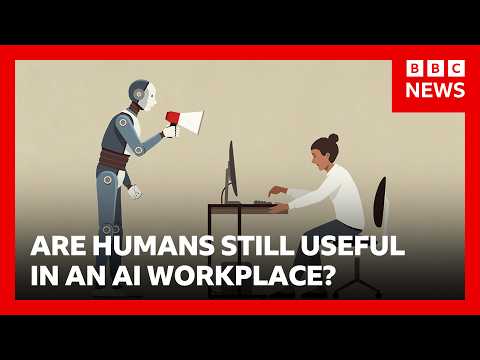
[0:09]Hello, welcome to AI decoded. We talk about AI and how it's going to change our jobs constantly. But here's the honest truth, most of us don't yet fully understand what that will mean to the future of work. We know it's coming, perhaps faster than many of us expected. The question I ask my clients is, if an AI could take over all of your team's task, who would you keep and why? That question is strategic. And the answer matters to me, not just intellectually, but because I have two daughters at home. They're five and nine, and right now, as you can see, they feel invincible. But I keep wondering, what is the world of work they will step into? We need to build a future where humans matter more, not less. It's not about whether AI replaces us, of course, there will be some jobs that do go, but how we redesign the workplace around it? What does that actually look like in practice? In this program, we're going to try and make sense of all that. We've brought together three guests who have talked about this subject more than most. Bernard Marr writes about AI and business for Forbes. He's advised some of the world's largest organizations on how to use AI effectively. Ella Hafalts is an associate professor at the Fryer University in Amsterdam. She spent the last two years studying what happens when employees start using AI tools at work. And of course, our very own colleague Prila Lacani, CEO of Century Tech, the AI Education Company. Welcome to the three of you. Thanks for being with us. Um, Priya, I'm going to start with you, let me put to you the premise of our program. How do we create an AI workplace of the future in which humans still matter? I love the fact that you start our program with the most profound question. No warming up. That's what we're all asking. That's what it's about. Okay. Well, look, the way in which we do this is I think we have to think about, look, if everyone has AI across the board, it is going to be the humans that create the difference. And so, how are we now going to upskill the people within the workforce so that they can thrive in that environment? Now, if you think about all of the changes that are taking place and the companies that are, you know, seeing changes with AI, they're reporting positive changes. What's really interesting is those changes take place with tasks. You know, your role and your job, if you think about it, it's about repetitive tasks, automating tasks. But what it's struggling with still is that sort of strategic direction and that judgment. And so, I think companies need to be thinking about, you know, how much are we actually investing in innovation? How much are we investing in our people to have the time to be skilled in this area, so that we can then differentiate ourselves and humans will then still be able to flourish in an age where we have this sort of AI augmented workplace. Bernard, let's fast forward to 2030, the beginning of the next decade. How widely do you think AI will have changed the average job? Help us understand that first of all, and how you think it will reshape the average workplace. Yes, so this is what I try to help companies understand and what I'm seeing is that AI will completely transform our jobs. For me, AI is a superpower that will, we can all use, it's almost like having a genie on your shoulder that allows you to do pretty much anything or at least a lot of tasks that previously you needed someone else to help you with. And for me, there are three types of AI that will transform our work in the future. The first one is generative AI, so we are used to chatbots like ChatGPT and Claude and and Gemini, and we use them to answer questions and if you think about a financial advisor, for example, they can now offload the data analysis to the chatbot, they can draft reports and they can hopefully spend a bit more time building interpersonal relationships with their clients. Then we have agentic AI, so the AI that can do things, that can operate software, that can look things up on the internet, fill out forms, and do those repetitive jobs that Priya's talking about, the jobs that you do again and again and again in the same format. Exactly, and IBM is a good example. They have automated a lot of their HR tasks, all the repetitive tasks, so if you work in HR today, you actually want to think about how AI is transforming the company, how we need to train, retrain our people, rethink our jobs and actually you get bogged down by answering the same questions again about pension contributions, about, um, vacation time and so on.
[5:11]So, we can give AI those jobs and these AIs can now fill out forms, they can search data for you. Um, and then we have physical AI and this is another component, so we've so far we've talked about all the cognitive work. Physical robots are getting better as well. They're starting to understand the physical world much better, we know how the emergence of world models. So humanoid robots, for example, they can be trained by simply watching videos of how we do things on YouTube. They can learn from that. Right.
[5:45]And and and all of those will mean tasks will change. Right. But you've said that if if we were to look at where we are right now, it's not necessarily the AI is replacing the jobs instantly. It's that AI is hollowing them out in what sense? So what AI does, it it will perform the task that we actually don't necessarily like. So one part of the job. It's the repetitive task is I work with a company and their chief AI officer actually went into the organization to ask everyone, what are the things you don't like in your job? That you would love the AI to do for you. Because we in our jobs, we're not running out of things to do. They're not, we will never run out of questions and problems to solve. What we get distracted by day-to-day is all the things the form filling, the the the things that take up our time. So in a positive sense, there could be a freedom that this creates to to focus on more creative parts of the business. Exactly. What I believe is that it will make our work more human and actually more enjoyable because we don't get distracted by all the things that we almost shouldn't waste our amazing human potential to to work on. Well, that feels like a good place to bring in Ella. Um, because your research Ella has taken you to very different companies in the Netherlands, and it reveals that employees are already using these large language models in their work. In ways that managers can't easily see. In what ways are they using them? Yeah, so we've been studying ChatGPT since 2022, so just after it came out, we thought we have to look at this. And we started talking to people already then about how are you using this in your work? And we found out that they were playing around with it first of all at home, using it for all the silly kind of things that maybe you're familiar with, you know, make me look a different way, write a poem, etc. But then they started figuring out, hey, this could be useful for work, and so unbeknownst to managers, without kind of approval, they started to use this technology for brainstorming, uh for search as a kind of replacement for Google, for structuring information, polishing text, all these different ways that they were just letting it creep into their everyday work, and it can sound kind of innocent in these little parts, but it has bigger consequences. Well, like what? Well, what we found for example in our interviews is people were so happy to not have to bother their colleagues with questions. So previously I'd have to go and ask my manager or I'd have to bring in my business partner, who knows this framework, but now I don't need them. I can just ask ChatGPT, and so easy, convenient, ask ChatGPT. So that organic self-learning on the job, the the exchange of information between colleagues, which, which is creative within an industry, you worry that that element is being lost. Yeah, so we see this as a real challenge for particularly managers, who might not realize that this is happening, this erosion of the social ties between people. And that's a lot of what organizations are for. We're meant to share knowledge and learn from one another and also check the quality and accuracy of what's coming out of these interactions. You see, what Ella's describing there, Priya, is that this is already happening organically, one employee at a time. And if we are to start thinking strategically about this, rather than asking the question, oh, is it going to replace my job? This is the sort of thing that CEOs and managers are going to have to get a grip of. How is it working to the benefit of the company and are we all using it in the same way, in the same direction? Yeah, well, I think that in the last year, I've certainly seen a lot of businesses around the world talking about having some form of plan, some some form of policy and a strategy because it's not just the sorts of ways of just using something to maybe brainstorm instead of going to a colleague. You know, you can't be putting personal data or commercially sensitive data into tools that you have a personal account for at home. And so there I think most CEOs over the last 12 to 18 months have said, right, this AI thing, we have to do something. And what was so interesting is that because of this program actually, quite a few people will reach out on LinkedIn or write to me or meet me and say, Priya. And they're CEOs of like 30, 50 companies, right? So they'll come up to you and they'll say, Priya, we're using AI. And because I'm nice, right, I'll smile and be really encouraging and say that's amazing. So in the back of my head, I'm just thinking, what are you talking about? And actually when you when you dig deeper, what you find is they've bought co-pilot licenses for all of their staff and they're just finishing off their emails using AI. Whereas, I think what we'll start to see, because, you know, people are starting to say this now. How come and we covered this on this program, Christian, very deeply, the MIT report that said that, you know, 95% of organizations aren't getting return on investment from AI. And then there was another report by McKinsey actually 1% of companies are getting return on investment. Companies are now desperate. They're saying how can I be part of the 1%? Okay, two fast thoughts before we talk about how we adapt to this. Um, if you want an example of what Priya's talking about there, Bernard, um, the idea that CEOs think they're using it, when really they're not, you only need to go and look at some of the job ads currently on LinkedIn.
[11:29]100%, and what we are still seeing is jobs, the job descriptions almost of the last century is how we've always done jobs instead of thinking how will AI truly change our jobs. Think you you talked about coding, uh coding now and tropix Claude can perform they they use they they use code to automate 80% of their coding tasks. So the jobs need to change and what we need to do is we need to fundamentally rethink our jobs and how we as humans bring the best of what we have is the strategic thinking is the creativity and creative problem solving, emotional intelligence, building connections with other people. These things AI can't do and we can bring. And what humans actually need to do is they need to be able to delegate effectively to the AI. And what I'm seeing is that jobs are being elevated and almost frontline employees are now becoming managers of a of a set of AI tools that will work for them and they need to oversee it. New layer of employees almost. Um, listen, I'm I I want to turn to how then we we train for the jobs of the future. I want to play you this clip. This is the CEO of BlackRock, massive company, Larry Fink, talking to Simon Jack, our Economics Editor this week, some of the things that he says might just surprise you. AI is going to create an enormous amount of jobs. Most people are not focusing in part of the letter that I wrote about how many jobs is going to be creating related to electricians and welders and and plumbers. So we should be telling our kids to be electricians rather than lawyers or fund managers. If you think about, um, how the average worker has been portrayed on television. Generally, the average plumber had their overalls or their pants, you know, hanging below their waistline, overweight. We need to embrace that those type of jobs are just as good for many people. Post World War II, we built a foundation of education, and we said to all the young people, go to college, go to college, go to college. And we probably overdid it, and so many people who probably should not have gone into banking or media or law, probably should have been a great worker and with their hands and, and we need to now rebalance that approach. So Ella, he doesn't think that people should spend inordinate amounts of money on a university degree. Right? But we've already established that there's, there's not a job that is AI proof. That's a myth. So, how do you skill for a job in a future that we can't yet define? Yeah, it's a great question. It's one that we bring to our students. So I teach a course within our International Business Administration program, and in this course, we specifically ask, who am I in the age of AI? And this is really something that students also need to be engaged in this conversation. There's no point in saying don't use AI. It's a part of their world. What we need to help them think about, it's similar to what Bernard was saying, is what do I bring to the table now? And these students are working with social enterprises, they're solving real world problems, alongside that, they're reflecting on this question, while also fine tuning an AI model to understand how the technical side of things works. And to me, that's what a university education is about, it's about having critical conversations, learning the latest research on this, but also building your own opinion and your own perspective and your own path that also suits your, your ideals towards what the future should be.
[16:09]This is your world, I think, Priya, as well at at Century Tech. You you're training people for jobs that might not yet have been defined or even technology that's not there. So for for parents and for for young people who might be watching, how how should they think about their education and what they do? Yeah, I think AI is definitely trying a spotlight on education and the flaws in education, and the fact that if we even talk about school education, college education, how we actually treasure what we measure in education. So it's the assessment process that actually I think is the is the problem. Right? People want to train children and have them study and learn curricular that's very much built towards an end sort of high stakes assessment. Now it used to be we take that for granted. We go to university or we go to college to further education college school and it it it's a currency, right? That certificate you end up with with those grades, that's a currency actually means something in the real world. And what Larry Fink is saying is, you know, does it, what you need to do is think about education and what it's for. Right? We need to give foundational knowledge. I really am a big believer in that, and I just don't think we can just Google everything or search for everything, because we won't be able to develop those crucial skills and build judgment. So foundational. Yeah, foundational knowledge is number one. Number two, then applied, right? How does this actually work in the real world? How do I solve problems? And then the third that I've sort of I like to call learning agility. This ability to learn how to learn so that we don't end up with generations, you know, cohorts of students leaving formal education and then thinking, hang on. That's not what you said it would be, it's not a conveyor belt to a job. Now what do I do? But but what about what about Bernard those those I mean, you'll hear a lot of people say, oh, well, my my child is studying as an accountant and, uh, they're being trained on spreadsheets and profit and loss accounts, but all of that can now be done by AI. But that is the stepping stone to the next level within the company. What if we remove the jobs, the lower level jobs that elevate us higher up in the company? That that's a challenge. I mean, I have three children, they're all just getting ready for university, or in university, this is something I think about every single day. I I completely agree with what you just said. I wrote a book called Future Skills in which I look at the 20 skills we will need for the future. Three of them are technically related, so we need to understand AI and what it can do. Beyond this, it's what makes us truly human, is our empathy, is our critical thinking, is our strategic problem solving and is our ability to learn and continuously relearn. These things are absolutely vital. So what we need is companies need to understand that they need employees in the future. So they need to create tracks into these organizations, that allow young people to come in. At the moment, I almost feel that there's a wrong emphasis. The emphasis is on driving efficiency and cutting costs. And that's easy. I can look at my existing processes and what I do and think, okay, AI can almost do the jobs of most junior roles, so I simply cut those roles. It's like if I cut those roles, I also cut off my future employees. And also the ability to completely rethink how you work as an organization. And this is something that I see very little happening in the real world. I see this in a few AI native companies, but most companies don't get that. And there's a really good example of this, Ella, um, in a in a very successful company called Klarna. Uh, people will be familiar with it. The CEO there replaced around 700 jobs with a chatbot powered by Open AI. Massive cost cutting exercise. And then, that was sometime last year, and then by December, the company announced a huge recruitment drive because the work delivered by AI was of a lower quality, but more importantly, customers wanted a human in the loop. They wanted that empathy and that foundational knowledge that Priya talked about.
[21:09]That makes so much sense, and these sorts of moves are motivated by all sorts of different incentives in the end. But we do need to understand that that AI hype can often lead to decisions that are regretted. And that's why it's so important to have a good technical understanding, what can this stuff actually do? And as Bernard's saying, really think about the future. We're hearing a lot of talk at the moment about diamond shaped organizations, so you've got a few people at the top, a kind of heavy middle of experienced workers, and then we don't need many entry level positions. But what does that mean in terms of a funnel? This, uh, this doesn't make a whole lot of sense if you're thinking about how you're going to train newcomers. So what then, Ella? What if you're a CEO watching this, and you're you're toying with this idea of cutting your lower level? What what would be your advice to them? I think it depends on the strategy, are you looking for a long-term proposition or is there something that's only oriented towards the short-term. So those temporal horizons make all the difference, and if you're really looking to grow a culture and a company that's going to remain distinctive, then you do need to pay attention to those entry-level jobs. Not just that, though, how are entry-level people actually going to meaningfully interact with your more senior level management, when no one wants to bother each other because we've all been told we need to be busy and efficient for a long time, then people are not going to reach out with their silly questions. But that's how you actually build relationships, find mentors, figure out how things work. Which brings us to an audience question. I did love our audience questions. They do email. Keep coming, keep coming. So this one is from Said Almarri in Dubai, um, who runs operations across two organizations. And I'm paraphrasing his email, Ella, because it's it it's quite a long one. But essentially, he says, AI hasn't just made my team faster, it has given us 'operating leverage'. So there is a man who has fundamentally, Bernard, reimagined how his organization works and how AI is structured within it. Are the CEOs you speak to day-to-day doing that? No. I think some of them do, and those will be the successful CEOs of the future. Um, and I I think we need to fundamentally rethink how we do work and how humans fit into that. And what an individual can do. I even see this in my own job, in my own work. So I I used to spend the first hour of my day reading my emails. I get pitches every day from tech companies telling me about all the latest developments and all the case studies and I get newsletters and I try to sift through this to understand what I need to focus on. Now, I have an AI to do this for me. The AI will read it, the AI already knows what I know, and then turns this into a podcast for me. So when I go get up in the morning, I walk my dog, listen to the podcast, and then I can come back to my office with with a good idea of what I want to do more research on. So I then set another AI agent off to do this research for me while I can think strategically, when I can think about how do I develop relationships with some of the CEOs I'm working with. That is really empowering. And in the past, I would have had to employ a number of people to do this for me. But in that, in that example that that Said has just given us, Ella, I mean, his AI, as as as commendable as it is, is replacing the jobs that consultants and agencies would have done. So at some position in the food chain, we have to be pretty blunt about this. There are jobs going. One thing in the in the interim is also to look at this and go, does this have a long-term value proposition? So kind of like the Klarna example, and here I mean, using AI can kind of cause us to overestimate what we're able to achieve sometimes. To our own expertise, something might look like it's good quality code, or a good quality image, or a good quality website. Will that actually hold up to to the world? Then they mentioned, uh, AI is a genie, and you know, Genies are tricksters. We call it a spirited technology. It comes at you with all sorts of little quirks and random, you know, the extra fingers. These things can get solved, but it takes a trained eye to actually detect the the spirited quirks of AI. And we need to maintain experts at every level of this process. So, I'm I'm happy if if people are making it work for themselves, but it shouldn't be seen as something that can be easily replicated. Okay, well, since we're talking about efficiency and we're near the end of the program, um, I thought I would show you this, just to lighten the mood a little, which I spotted on X this week. Uh, it does appear to me to be the most important development so far, or the development with the furthest reaching consequences. This is from a trade show in Switzerland. It's a robot that autonomously pours, cooks, and folds the perfect crap. It does.
[27:42]It's Swiss, it's not French. In fact, I'm surprised the French have not yet called an emergency summit on this. Uh, whether it is actually AI, or whether it's just clever automation, I'm not so sure, but it has made me wonder, Priya, You're talking to the person who lives next to, has befriended and like serves coffee every day to the people who run the famous crap stand in London. I draw a line. I'm officially drawing a line on crap. Is there nothing sacred? No, there is. I want my craps made by Veronica at the Hempstead Crap Stand. I don't want Bernard's improving bot, he's improving robot flipping my craps. I'd love to see a robot peeing off the ceiling, Yeah, yeah. That's where the human comes in. Yeah, if that gets her way, it'll be on spot the crap, and it will go and scrub it off for you. Facial intelligence.
[28:53]Okay, well, next week on AI Decoded, we're going to explore actually one area of work that is changing, how artificial intelligence is transforming the world of advertising. Uh from big shared campaigns to messages tailored specifically for you. Uh, you might have some thoughts on that, so if you do want to take part, please email us at aidecoded@bbc.co.uk and maybe we can incorporate some of those thoughts in the program.
[29:26]Thank you very much to Bernard. Thanks, Ella. Thank you, Priya, uh, for your thoughts this week. That's all we have time for. Just a reminder that you can watch this episode and all our back catalogue on the AI Decoded YouTube playlist. Have a look at that, and also on the BBC Iplayer. Thanks very much for watching.
[29:55]We'll see you next week.


