[0:00]Hello and welcome to my part two video for Black Panther. There is a part one video already on my YouTube channel, so please check that out. I'm going to continue talking about Black Panther for A-Level Media Studies in this video. It's worth making a note that even though Disney own Marvel Studios, one of their subsidiary companies, when they bought Marvel Studios, they actually agreed that they would have very minimal creative influence over the products that Marvel made. So, even though Walt Disney is part of the ownership, Marvel Studios still have quite a lot of power and independence when it comes to the films that they make. And Walt Disney as a company don't get hugely involved with the actual creative decisions made in the production of the film. Marvel started off as a comic book company many years ago, and they have historically been involved in making a large range of comic book products. whether that's the actual comic books, graphic novels, TV programs, films, animations, um, so they are a diversified company. They work in a lot of different areas across the media industry. That means they have a lot of experience at making products, and it also means that they have quite a large pre-sold audience as a company. Lots of people really enjoy Marvel made products, and they will go and see them at the cinema or watch them on TV when they come out. Marvel own the rights to a lot of their characters that were developed through their comic books in the past. And sometimes what they do is they sell the rights to those particular characters to other companies, which they have done with other characters in the past. And that means that it enables them to get more funding for the projects they want to do. However, they did retain the rights to Black Panther because they knew that they wanted to make it at some point. So, uh, Black Panther is one of the ones that they still have the rights to. Some people argue that because Marvel have found a successful formula, the idea of a superhero movie based on shared universes, they obviously have a lot of films that fit into this category. They kind of repeat this formula multiple times in their products. So, have a look at some of the other products they make, how many of them are part of giant franchises with prequels, sequels, and shared universes. This helps to make their films a lot less risky and a lot more mainstream and profitable. And this is really reflective of Hesmondhalgh's ideas, as well as Curran and Seaton's ideas as well. There are a number of factors that people might say make Black Panther a low risk, high success film. So, have a think about the fact that it is based on a very successful existing franchise, part of a shared universe with millions of fans worldwide. Uh, being made by two of the biggest companies in the world, Marvel as part of Walt Disney. The fact that it had a high budget, some very famous actors within it, based on a very popular genre at the moment in time, superhero movies. So, there are lots of elements that make this film seem low risk, mainstream and that potentially might, uh, hint that it is highly likely to have been profitable. However, it's also worth considering any elements of the film that might make it seem more risky, or less mainstream and more niche. For example, Black Panther is one of the lesser known Marvel characters. There are other characters that are much more well known, um, and so perhaps making a movie that is based around one of the lesser known characters might have been seen to have been a little risky. Having a film with an almost entirely black cast, it sounds ridiculous in this day and age, but it's it's very rare. And it's because it is still seen as quite a risk. However, maybe they're trying to appeal to a modern audience, a more diverse audience, people who are used to growing up in, um, culturally diverse countries. So perhaps Marvel is trying to cash in on this, maybe you could be very cynical and say that they are trying to, um, get themselves some good publicity by showing how diverse they are. It could be seen as tokenism, making a film, um, about black actors and characters. Some people might say they are doing it, uh, you know, for good reasons, to increase diversity, and certainly it might be appealing for many audiences. In the past films that have had black actors in lead roles tended to have been more typically social realist style films. Um, so films that are based in urban areas, quite gritty, grim, um, you know, based around things like crime and poverty. Um, or they tend to be kind of very, very overtly comic roles. And so perhaps there's been a lack of diversity in terms of the roles on offer for black actors within the film industry over the last 100 years. So this film does stand out as being quite different in that it offers a variety of roles to black actors and actresses that are really quite positive roles. Um, that are quite different to the roles available to black actors in the past. To have black actors playing superheroes, um, to have them, um, playing kings, queens, um, and, uh, leaders, um, that are seen in a very positive way. are, um, and still is quite unusual and would be very appealing to audiences looking for something a little different. Likewise, roles for women in film and certainly in superhero films have been quite limited over the last 100 years. We've seen a lot of damsel in distress characters for women within superhero movies and other genres as well. And women are often given the slightly weaker, more vulnerable victim type based roles. We've seen things like Wonder Woman, uh, Captain Marvel over the last few years, which have opened up roles for stronger, more dominant, powerful, positive female role models within the superhero genre. And this film reflects that with their lead female actresses and characters within the movie being quite powerful, dominant, sometimes quite aggressive, showing leadership qualities, um, and showing that they are just as strong as the male characters, sometimes even stronger. And this would be quite appealing for a female audience as well who perhaps is getting a little bit tired of the older gender stereotypes in movies. The mainstream media has often tended to ignore these issues, and very rarely do they get tackled in a way that has actually brought about positive change. And so, um, this film was a film that came out at a time, um, in terms of cultural, and historical, and political context, um, that tackled a lot of these social issues. And that's why it appealed to a lot of people from ethnic minority backgrounds, because they felt as though suddenly people were recognizing them as actors, were including them as characters within movies and were tackling issues of, of race and discrimination, um, within society. Another reason why Disney may have talked to Marvel Studios about choosing this moment in the last few years to release Black Panther and start working on that part of the franchise, is that Disney have really been trying to change the way that people view, um, the way that Disney have tackled ethnicity in the past. Previous Disney films, particularly those aimed at family audiences, have sometimes been criticized for their lack of diversity, um, and the way that they perhaps, uh, failed to represent people from ethnic minority backgrounds, or the ways in which they have often, uh, fallen back on quite kind of old-fashioned stereotypes of ethnicity and race. In the last few years, Disney have been trying to tackle this idea and perhaps get some more positive, um, publicity for them in terms of ethnicity. So, they have released Moana, uh, and Coco, and some other films that have been, um, more focused on people from ethnic minority backgrounds. And so perhaps Black Panther is just part of this strategy that Disney has to try and change the way that people view them in terms of, um, the way they represent ethnicity and race within their movies. Black Panther was given a 12A certificate in the cinema by the BBFC in the UK. Um, the 12A certificate, um, hopefully you know that means that you can go and see it on your own if you are 12 and over. But you can also be taken to go and see it if you are under 12 as long as you are accompanied by an adult. If you have seen the film, have a think about, um, why that might have been a controversial certificate. There is quite a lot of violence within the film, so there's people being stabbed, um, shot, um, and, uh, it is quite aggressive. A lot, there's a lot of fighting scenes, a lot of stunts, and so, um, there were some people arguing that perhaps the 12A certificate was a little bit too low or a little bit too relaxed, especially because a lot of adults who took their children to see it perhaps didn't know what the film was going to be about, or who perhaps didn't expect that much violence. However, the BBFC kind of argued that, um, it was a superhero movie, it was part of the Marvel franchise, um, and that if they knew the other films within the franchise, they could expect the same levels of violence and fighting from those movies as they could in Black Panther. Also, there is the argument that the actual fighting you see in Black Panther is quite fantasy-based. It's not particularly realistic, there's a lot of CGI and, uh, but there is a lot of stunt work as well, um, and, um, it's, it's also quite backed up by this, um, strong moral code. So the idea is that when we do see violence, we understand that a lot of the violence we see is wrong. Um, we are told quite clearly that, you know, some of the violence is disapproved of, or that some of the violence, you know, often only happens because they are retaliating in self-defense, they're trying to protect themselves from an aggressor. And so, um, the violence isn't just there for the sake of being violent. Um, the film companies were able to justify the amount of conflict that was in the films. The regulation system means that the BBFC only classify the films in the UK. And there are lots of other companies in other countries that regulate films too, and they all have slightly different rules. And that does make it quite complex because the film companies like Marvel and Disney were trying to ensure their film was appropriate for a whole range of countries because they wanted this global distribution. They might have to ensure, for example, that the film is less violent for some countries that have much stricter regulations, and they then may have to re-edit or re-cut the film for the countries that are a bit more open and liberal and have perhaps more relaxed laws about violence. In fact, distributing products to other countries can have an impact not just on the age certificate and the amount of violence you can have, but also on the marketing materials. There might be very deliberate choices, um, that the producers make about things like the trailers and the posters. That might have been made specifically to ensure the products were suitable for a whole range of countries. So, for example, the actual trailer did show a lot of stunt sequences, a lot of the combat scenes, but they didn't really show anything particularly graphic within those trailers at all to keep it suitable for a family audience. There are a range of posters on offer with each one featuring a different character from the film. And this is a great way of targeting different audiences. You have posters that might appeal to young female audiences, some that might appeal to older male audiences. You have a group poster that is designed perhaps to target those people who are, um, maybe specifically looking for a film that has, um, a very diverse cast in terms of ethnicity. You might be focusing on the Marvel and Disney logos to appeal to those pre-sold audiences of those companies. There is also a poster that was specifically made for the Chinese market. Um, and this actually did cause quite a lot of controversy because whereas the other posters made for other countries showed the actors like Chadwick Boseman with their face displayed. The poster that was, um, distributed within China actually covered the actor's faces with their masks, and so it meant that the actual Black Panther character his face was covered, and it so it was very hard to tell that the actor was black. Now, the production company, the distribution company, Disney defended themselves and said it wasn't intentional. We didn't mean to cover up his ethnicity. It was simply to show off the Black Panther mask, and perhaps to appeal to those audiences who may be familiar with the costume. Um, however, some people did say that it might have been indicative that in China and other Asian countries, it might be a lot harder to distribute and sell a film that had lead black actors. Um, because they said it might make the film more marketable. So this is the end of my part two video on Black Panther. If you haven't watched part one, please go to my YouTube channel and check out part one now.
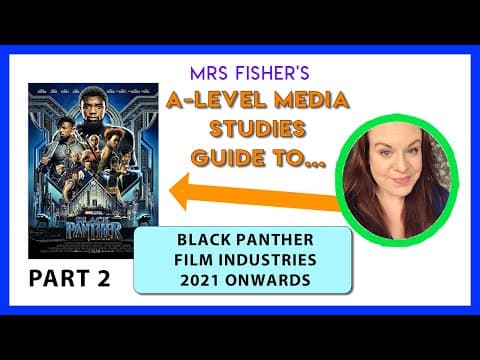
A-Level Media Studies - Black Panther Part 2 - Industries
Mrs Fisher
13m 24s2,328 words~12 min read
Auto-Generated
Watch on YouTube
Share
MORE TRANSCRIPTS