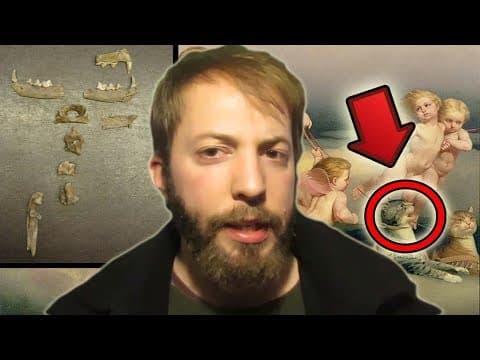
[0:22]Hello my dear friends, how are you? My name is Arith Herger and today I'm going to talk about fertility magic and a feline cult linked to the Norse goddess Freya. An archaeological perspective, focusing on mythological accounts and shamanic practices related to fertility and burials. But before we start this video, let me just tell you that this video is in honor of my best friend, Mr. Tiko, my cat, who passed away January 2018 and it was precisely because of this that I started researching about cats in the Norse culture. And I thought it would be interesting to share with you what I came up with during my research. If you have been around this channel for the past year, you probably knew Mr. Tico. He was on my very first video one year ago and occasionally he would appear in some of my videos. And I dearly miss him and well, this video is also in honor of his memory. Let's get started. Archeology, the study of faunal remains. It's an interesting branch of archaeology which helps us to understand what type of animals our ancestors consumed. Well, it seems a little bit dull, right? Nowadays if we want to know what people eat, we just scroll down their Instagram profile. But archaeozoology isn't just about our ancestors eating habits. We find faunal remains in burial contexts and not always what we have in front of us is simply a waste deposit. Our ancestors, especially in northern Europe, sacrificed animals in rituals and as offerings to the gods. It wasn't at random. There are patterns. So we must figure it out what was the real purpose. In this video, I will focus on cats. Well, it's quite clear the importance of cats in Egypt, but when it comes to northern Europe, especially in Scandinavian archaeology, the lack of information about cats is unsettling because cat remains are found in burials and as offerings in specific rituals, but people don't seem to care much. But beyond these remains, there was a purpose, there was a cult and there was the attempt to communicate with the divine. At first glance, cats seem of no importance in the Norse culture, but it would seem their importance was far greater than any other animal. Norse religion was part of everyday life and it's centered on the shared experiences between man and nature. So animals are present in both the material and the literary culture. Jewelry, ritualistic objects, decorations and in sacrificial rituals. Now, in archaeology, when it comes to animals, we give more importance to the most abundant findings, which indicate that to a certain society, those specific animals were of great importance, especially as ritualistic sacrifices to the gods. Hence, their abundance. But on the other hand, not finding the physical evidence of an animal or finding only a few specific contexts, but have it present in loads of material culture, says a lot about their importance. An animal rarely used in sacrifices, had more importance to a society. It was too dear and probably even sacred to give it to the gods so willingly and in great quantities. So the lack of cats in archaeological findings for northern Europe may indicate that such animal's importance was far greater in the everyday activities of a society, even in terms of magic. Now, horses and dogs are the most abundant symbolic findings in the Norse archaeological record. Not only as sacrificed animals, but also in burials of people with distinction, animals linked to nobility, to someone with high status. But cats, being rare, especially in northern countries and also expensive and linked to one of the most powerful and highly worshipped goddesses of Norse mythology, Freya,
[4:59]were too important and to even accompany nobility into the grave. Freya's cart is driven by cats. Her special animal is the cat, particularly males. Freya is a goddess of fertility as well as sorcery, magic and saire. Now, for instance, this example I'm about to tell you. In Erik the Red's Saga, from the Saga of the Greenlanders, there is an account of an important sorceress with gloves made of white cat's fur. This might be far-fetched, but there is a suggestion here that cats may have played an important part in both fertility rituals and female magic, associated with the goddess Freya. The cat might have been one of the most powerful animal spirits to aid a Volva, a sorceress of the Norse society, aiding in supernatural magical activities. Another perspective. The Norse mythological accounts are Icelandic works created or put to parchment during a time already greatly influenced by Christianity. Now, Christianity absolutely disapproved of female sexuality and pagan rituals, and therefore every mythological account concerning that seems to be missing or a great gap in the information is quite clear concerning goddesses. Now, Freya's cats have no names. They seem to be the only animals belonging to a deity that have no name. While all the names of other gods' steeds are very well documented and known to us, and in the literary sources, maybe that was the intention, trying to wipe out the magical connections to women and the role of women in the Norse society. So it seems to me that cats were more significant in the Norse society than generally assumed. They can be found in myths, legends, sagas, heart burials, magical references and items and in some cases, in sacrificial activities. Cats may have been animals linked to very specific fertility cults of Freya performed by an elite because not everyone could get a cat as I have said in northern Europe, especially Iceland, they were rare and expensive and difficult to obtain. In archaeology, we look for the facts, not the truth. The truth is far more complex and impossible to attain. We do not know what was inside the mind of our ancestors. Every person is unique and therefore the emotions and intentions vary greatly. But we can make an educated guess, comparisons with other cultures and we can make an interpretation of what we find in an archaeological excavation. So it seems cats to the north mostly add ritualistic connotations. Like other animals, they were more than just food or companions. Now, let's try to start from the beginning. Obviously, this was not a very smart assessment. We can't start from the end. Well, anyway, cats were introduced in Scandinavia as domestic animals when in the far north, people started to make contact with far southern cultures, in which cats were already symbols of fertility and linked to certain deities. So by the end of the Bronze Age and during the Iron Age, we have the earliest findings of domesticated cats in the north during the migration period. But only during the Viking Age with the increasing trade with other cultures, did the cat become a common animal in the north. However, it must be taken into consideration that Neolithic Scandinavians already venerated felines before they domesticated them. Wild cats have been found buried in human-made pits and covered with red ochre. As I've said before, cats can be found in a variety of contexts related to the north. In mythology, we have a couple of accounts, like the binding of the wolf Fenrir. The gods had a magical dwarf-made chain to bind Fenrir and this chain was made by six impossible things. One of which was the noise a cat makes in footfalls, which is interesting. It's something imperceptible to the human hearing, but it may be implied that this sort of magic uses a sort of cat essence, the very spirit of the animal. Just because you can't see it or hear it doesn't mean it doesn't exist. Well, another account, the account of Thor when he visits Utgard. Here both Thor and Loki are tested on what it seems to be trials of strength and agility, but all the trials are tests of wits and to teach the gods about humbleness, humility. There is a great deal of magical work here. Thor tries to lift Utgard Loki's cat and it's impossible because it's the world serpent Jormungandr transformed into a cat by magic. This shows the link between cats as domesticated animals, but also companions in magical work. So it's a small wonder cats are the animals closely associated with witches. But about that, on another video. We have accounts of traditional Scandinavian pagan practices concerning the fertility of crops and linked to cats. For instance, people used to place a pan of milk in cornfields as a refreshment for Freya's cats. This would greatly please the goddess who in a gesture of gratitude would protect the people's crops from bad weather and other inconvenient situations that could endanger the crops. So, it's quite possible that the Norse, especially farmers, were very kind to cats and fed them in honor to the goddess Freya and to ensure fertility in their lives. In Norse art, we also have the representation of cats. One of the best known examples is the Osberg ship burial where we can see carved on a processional wagon, cats. And the Osberg ship is something I would like to make a video of because there are very interesting evidences that this is a burial of a female sear, a sorceress, linked to the cult of Freya. So it wouldn't be surprising finding the depiction of cats in some of the art, in the objects buried there. But let's take a look at that. Let's start with the back of the wagon where you can see the carvings of cats. Here, let me show you in more detail. Cats have been represented in this fine piece of art, not meant to be used in this world, but as a form of transportation for the deceased woman to use in the afterlife. Let me show you in detail one of the examples. There, a cute little fellow. Although that one right there, I'm not sure if it's a cat or some kind of squirrel. Another example of the Osberg.
[12:41]absolute outstanding work of craftsmanship. And remembering that this might be the burial of a priestess of Freya or a powerful sorceress connected to Freya, there we have in detail the carving of cat's heads. Now, before we jump into Norse burials and the archaeological perspective, I think it's necessary to have a rapid understanding of cats in shamanism, Norse shamanism. Animals played an important role in ancient societies, especially societies with a spirituality based on shamanistic practices. And the Norse societies weren't different from that reality. Animal sacrifices were common and not just performed by the masses. On important ceremonies and as gifts to the gods, in fact, the great majority of animal sacrifices was linked to the transformative spiritual process of individuals. In shamanism individuals could shapeshift into animals or had spiritual animals as companions, such as the fylgjur, guardian spirits, helping spirits, often accompanying the practitioners of saeder, Norse magic, shamanism.
[14:02]And such spirits were often in the form of animals. The understanding we have of sacrificial animals in burials, in cremation contexts, is that in the cremation process, bodies are physically transformed and combining the bodies of sacrificed animals, a new spiritual entity is created and the individual embodies the power of the animal. I've talked about this before, in the Norse shamanic perspective of the spirit. The matter and the spirit are not a separated reality. And in order to release the spiritual form, the matter must be destroyed to release the essence, the power, the force, the migin. Cremation is interpreted as transformation and the most common animal sacrifice was cremation. But then we also have animal sacrifices in burial contexts, unburned remains. So in here, there is no transformation. There is something else. Cremation is probably to infuse the deceased with animal characteristics. And so on that line of thought, unburnt animal sacrifices in burials could mean transportation if we keep in mind the shamanic view. We know that shamans evoke animal spirits through a variety of ways, including sacrificing the animals. In burial context, this could mean the animals are the steeds used by the deceased to get the person to the right place to communicate with the right deity or deities or simply to make the spiritual journey. This may be one of the reasons why horses were the most common animals to be sacrificed. But what about rare animals, cats? Well, cats could mean sacrifices performed by the nobility. We are talking about an exotic and expensive animal in old Norse societies. So it wouldn't have been sacrificed lightly. So it seems clear that the sacrifices of cats in old Norse societies were for a very special purpose, linked to magic, fertility, and if it was to be used as a steed, so certainly it was to carry the deceased to the goddess Freya. If we take in mind that if a horse was the shamanic transport of Odin, then perhaps cats were Freya's. Animal sacrifices were used by the Norse to facilitate contact with the world of the gods. The sacrificial animals were selected according to the god people wished to communicate with. In terms of burials, finally. Things are not that simple, obviously, but what I mean is, for instance, you find a comb with the representation of a fish carved on the item. It's not just a representation of providing the dead with items for their hygiene in the afterlife. It also represents the importance of the Viking Age fish economy, indicating the high social status of the person buried there. But such burial goods are not just the representation of daily life or social status. As I've said, animals in burial context represent a means of transportation in death. Animal sacrifice was the most common kind of sacrifice performed by the old Norse societies. The majority of the sacrifices were of domestic animals, but occasionally humans and rare animals such as cats. Sacrificing cats was not that common and such animals were probably reserved for special occasions, times of strife, famine to contact a specific deity in times of extreme need. Now, let me show you the map of Scandinavia so you can have a better perception of what I'm about to show you. As you know, Uppsala in Sweden was the place for the major sacrifices every nine years. Seven different animal species were found there, including the cat. There was also a very important Norse cult site where the cat as a sacrificed animal was found in Leir, Denmark. Two of the most important sacrificing sites of old Norse religion included cats in the group of sacrificed animals. There are other places where cats were found as sacrificial offerings such as in the sacrificial bog site of Skedemos, Upkra, both in Sweden, and also Burka. Of course. And in Ga, at the Tonglandundalu Valley in Iceland. I almost made a knot with my tongue pronouncing that. In these sites what was found was mostly cats' jaws. Now, this is interesting because the jaw was considered to be the mechanism which emitted the voice of the soul. Probably related to the breath as a key material or substance of Saire magic, the very thing used to chant. Now, there are cases of entire cats being buried, which have no markings on the bones of having been skinned for their fur or used as food. They were buried intact with great respect for what the animal represents. And I mean food because there are burials with food wastes, older burials, but when they were forgotten, people made waste deposits and occasionally made them in grave sites, unknowingly. But also certain animals were consumed as part of the sacrificial ceremony or ritual, and the rest was given to the gods as offerings. But this is not the case with cats. Cats weren't eaten, and if they ever were in Norse society, was in extreme situations. But certainly no one starving would eat a cat and go through the trouble of burying it with the dead, harmoniously arranging the grave and in some cases, like the bog of Skademos, cat remains along with offerings of gold. So it is probable that cats in burials were linked to either magical practices of fertility connected to Freya, or as I have said, to be the animal companions, steeds, fylgjur, helping spirits of the person buried. And if that is the shamanic purpose, and since cats were linked to fertility and Freya, maybe cats were buried with female shamans. Who knows? Remember, mixing human and animal bones, which was common in the Viking Age, suggests a shamanic transformation of the dead in the afterlife, infusing the deceased with the characteristics of the animal.
[21:20]In conclusion, sacrificing cats may have been used to bring peace and fertility to the place where they were sacrificed. Or in the case of the major animal sacrifices, to ensure fertility in the kingdoms in general. And let's not forget that cats seem to turn up in important and remarkable locations. It may also have been to appease the goddess Freya instead of sending a human sacrifice, a volva, a sorceress, people would send Freya's favorite animal for her to keep. To ensure fertility and prosperity. The cat's rarity in Scandinavian archaeology as a sacrificed animal or linked to magic and ritual isn't due to the to its late introduction in Scandinavia. Rather, the cat held more significance to Norse people other than just a pet or a helping spirit. It's use as a sacrifice was only in special occasions and for special people. The cat in Norse culture seems to have been connected to death and spiritual journey. All right friends, thank you so much for watching and well, I hope you have enjoyed this video. Quite long, I know, but I think I have achieved what I intended. To make a proper video in honor of Mr. Tico, my best friend, who passed away recently. Wherever he is, I hope he is in Freya's loving harms. Well, once again, thank you so much for watching and see you.


