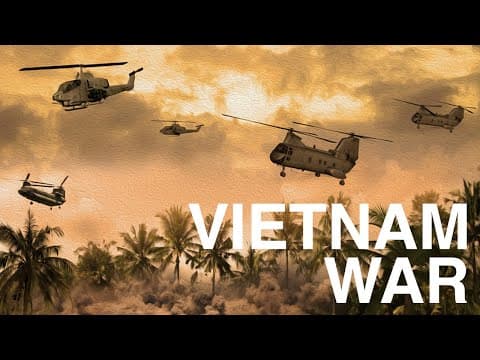
[0:36]The Vietnam War began in good faith, by good people with good intentions, but some two decades later, it was all over. For the Vietnamese, it was not a war about communism, it was a war for independence, a war for Vietnam. But a combination of American overconfidence, Cold War tensions, and imperialist tendencies the Americans had previously fought so hard against, made the war in Vietnam one of America's darkest pages in its short but dense history. By the end of the war, more than 58,000 Americans would die, as too were 250,000 South Vietnamese soldiers. Over a million North Vietnamese soldiers and Viet Cong guerrillas would also perish, as well as over 2 million civilians from both the North and the South, and thousands more from Laos and Cambodia.
[1:35]The French conquest of Indochina began in 1858. They boasted about bringing their civilization to Vietnam, beginning the construction of roads and bridges. But the Vietnamese did not take well to their French colonizers, just as they hadn't to earlier invasions by the Chinese. The French were the enemy, and the Vietnamese people struggled for independence. In 1919, at the end of the Great War, American President Woodrow Wilson went to Paris to help rebuild a new world, and advocated for the independence of colonized nations. Upon his stay in France, a man appeared with a petition for the president, signed by himself and other Vietnamese nationalists, asking that Vietnam too become an independent state. The president's secretary promised to show it to Wilson, but there is no evidence he ever did. Throughout his career, this man would go by some 70 names, but eventually settle for the most enlightened one, Ho Chi Minh. After taking part in a demonstration against a puppet emperor, Ho Chi Minh was marked for arrest, and fled Vietnam in 1911, remaining in exile for 30 years. When he discovered the anti-colonial writings of Lenin, he became a communist. His fuel was for an independent Vietnam. By 1940, the Second World War had come. Germany had conquered most of Western Europe, including France, and the Japanese began to occupy Vietnam. To help fight the Japanese invaders, Ho Chi Minh returned to Vietnam, and founded a revolutionary movement, which he named the Vietnam Independence League, the Viet Minh. This new fighting force grew quickly, and relied on guerrilla warfare tactics, hit-and-run strategies that would later be used some three decades later when the Americans arrived. In the spring of 1945, three years after the Japanese attack on Pearl Harbor, the United States government were looking for ways to undermine Japanese forces in Vietnam, when they were contacted by Ho Chi Minh. The OSS, the precursors for the CIA, supplied Ho and his guerrilla fighters with weapons, and were impressed with how quickly they learned to handle them. Ho began to call his followers the Viet American Army, and praised the United States as a champion of democracy. When two atomic bombs were dropped on Hiroshima and Nagasaki, Japanese surrender seemed imminent. Ho Chi Minh called upon all the people of Vietnam to rise up and take control of their country before the French could re-establish their rule. On the 2nd of September 1945, the same day as the Japanese surrendered ending World War II, hundreds of thousands of people went to Badin Square in Hanoi to see Ho Chi Minh proclaim Vietnam independent. The future looked promising, but President Franklin Roosevelt, who had campaigned for a world of independent self-governing states, was now dead. And his successor, Harry Truman, was facing an entirely different world. The Soviet Union had occupied Eastern Europe, and looked to spread further into Turkey, Greece, and Iran. A Cold War had begun. The French warned if their colonies were to become independent under American assistance, France would have no choice but to fall under Soviet influence. The French poured thousands of men back into Vietnam with the help of American aid. In 1950, communist North Korea invaded South Korea. Domino theory was at the height of political thought. The idea that if one nation fell to communism, others would as well. The United States sent tens of thousands of troops to push the invaders back north. They did so successfully, and it showed Western powers that communism in Asia could be contained.
[5:32]By 1953, with the help of American aid, the French had been fighting for seven years in Vietnam, and had suffered more than 100,000 casualties. French platoons would be ambushed, trains blown up, roads blocked, all for them to be ambushed again. The Viet Minh supplied by the Soviets and Chinese were a force to be reckoned with. The French were demoralized, and so proposed to begin talks to end the fighting. Before the talks began, however, both sides tried to enforce their military positioning. The French set up a fortified base in Dien Bien Phu, believing any altercation would result in a French victory. So confident in fact, they saw no need to worry about the jungle covered hills that overlooked their 11,000 men. 50,000 Vietnamese soldiers then surrounded the valley, and their heavy artillery began to fire. The French were trapped. After 55 days of brutal attack, the French surrendered, having lost 8,000 troops. After 100 years of colonial rule, the French were leaving. This decisive victory for the Viet Minh installed a belief that they could fight a great Western power and win.
[6:45]An armistice was then signed, splitting Vietnam into two parts along the 17th parallel, separated by a demilitarized zone. Civilians had 300 days to relocate to their preferred destination, and so 900,000 refugees fled to the south, seeking a life free from communism. The south would become known as the Republic of Vietnam, with Diem as its president, in the capital of Saigon, and protected by the Army of the Republic of Vietnam, the ARVN. In the north, the capital would become Hanoi, where Ho Chi Minh and the communists implemented land reforms, similar to those under Mao, leaving thousands dead and imprisoned. The Viet Cong and their leaders were willing to break the peace, to head south along what would soon be called the Ho Chi Minh Trail, and fight for a united Vietnam. These men belonged to an organization called the National Liberation Front, the NLF. The armed wing of the organization was called the People's Liberation armed forces, but the US and its allies gave them a more disparaging name, communist traitors to the nation, the Viet Cong.
[7:58]John F Kennedy had been elected, and Cold War tensions were at new heights. The lessons from the Second World War were on every policy maker's mind, aggressive dictatorships needed to be stopped before they constituted a serious danger to the peace of the world. A growing number of critics complained at Kennedy's leniency. He had failed to stop the construction of the Berlin Wall, and communism was spreading in Laos and Cambodia. So when time came for Vietnam, he couldn't be seen to do nothing. Kennedy's advisors insisted he should send ground troops into Vietnam to help the South push back the Viet Cong. Vietnam can't fall to communism, he was told, but he refused to send in troops. Instead, he sent an elite group of soldiers, the Green Berets, and military advisors to train and organize South Vietnam's military. Kennedy also took other steps, doubling their military funding, sending helicopters and armored personnel carriers. But he also authorized the use of Napalm, defoliants, and Agent Orange to deny cover to the Viet Cong, and to destroy the crops that fed them. But the American buildup of personnel in South Vietnam worried Ho Chi Minh, who saw an invasion of the North as inevitable. The Chinese then promised to arm his troops, and conscription was introduced, requiring every able-bodied man to serve. Corruption and the suppression of Buddhists by Catholic officials in South Vietnam's government had become so bad that to protest President Diem and his regime's oppression, a 73-year-old monk set himself on fire. As a silent crowd watched him burn to death, another monk repeated again and again, a Buddhist monk becomes a martyr. A Buddhist monk becomes a martyr. Soon other monks would become martyrs, but instead of allowing greater freedoms for his people, President Diem imposed martial law, and arrested anyone that protested. The South, a place promised to become a democracy, had become a dictatorship. Diem's reign could not continue. Vietnam's military generals, who had been told a coup would not be stopped by the United States, assassinated Diem and his brother. People took to the streets in celebration, but a new threat had arrived, and one Kennedy had dreaded, who was to replace him? Kennedy would not live to see the question he had pondered. He was assassinated on the 22nd of November 1963, and his Vice President, Lyndon B Johnson, was now in charge.
[10:38]Fearing it would make a bad situation worse, Johnson had opposed the coup that overthrew Diem, and it had. With Diem gone, the Viet Cong saw an opportunity, and began to carry out attacks throughout the countryside. A new power struggle began in the South. Between January 1964 and June 1965, there would be eight different governments. Coup after coup left the government in ruins. As the USS Maddox slowly moved through the Gulf, after issuing warning shots, it came under fire from a North Vietnamese torpedo squadron. Ho Chi Minh was shocked to hear of his navy's attack, and the officer on duty was removed for impulsiveness. Ho Chi Minh demanded to know who gave the order to attack, but there are still disagreements to this day on who did. Back in Washington, the Joint Chiefs of Staff urged retaliation against Vietnam, but Johnson again refused. A second attack would have to happen to justify retaliation, Johnson argued, but no second attack ever did. Instead, sonar operators convinced themselves an attack from the North Vietnamese had probably occurred. The attack was probable but not certain, Johnson was told, and since it had probably happened, it shouldn't be left unanswered. American pilots were sent to attack North Vietnamese torpedo boat installations and oil facilities. For the first time, American pilots dropped bombs on Vietnam. The non-existent second attack allowed Congress to pass the Gulf of Tonkin Resolution, granting the president authority to assist any Southeast Asian country threatened by communist aggression, and gave Johnson the legal justification to deploy US forces in Vietnam. In retaliation, North Viet Cong guerrillas shelled the American airbase near Saigon, killing five Americans and destroying five B-57 bombers. Advisors again suggested to Johnson he should place troops on the ground, and carry out an air attack on targets in the North. But he refused to send ground troops. The Viet Cong then struck an American helicopter base at Pleiku, killing eight advisors and wounding hundreds more, and later blowing up a hotel killing 23 Americans. Hoping to bomb them into surrender, Johnson responded on March 2nd, 1965, systematically bombarding targets, code-named Operation Rolling Thunder. The president had changed his policy from retaliatory bombing to an all-out attack, something that was kept from the public. The American people couldn't know he had widened the war. Viet Cong attacks continued, but America couldn't leave. They were too heavily invested, and a withdrawal would make them look weak. So in March 1965, Johnson took the action he had avoided for so long. He was putting ground troops in Vietnam. It was no longer a fight against communism, as Pentagon Papers later revealed. It was to avoid humiliation.
[13:49]As 1966 began, 2,344 Americans had died in Vietnam. 200,000 men were stationed there with more on the way. The Viet Cong now controlled three quarters of South Vietnam's countryside, moving their supplies and weapons through Laos and Cambodia. 12,000 miles of twisted jungle roadway, known as the Ho Chi Minh Trail. The Americans reasoned if the trail could be sufficiently damaged, the enemy wouldn't be able to sustain itself. 3 million tons of explosives would fall on the Laos portion of the trail alone. A million more tons than that dropped on Germany and Japan during World War II. As the months and years went on, and the death tolls of American troops were climbing, the American people were told not to worry. They were killing the enemy at a ratio of 10 to 1, but American mothers, fathers, sisters, and brothers didn't care about the 10. They cared about the one. General Westmoreland, who claimed he could win the war in three years, sent an urgent cable to Washington, asking for 200,000 additional troops. Robert McNamara, the Secretary of Defense told Johnson he had two options, negotiate a compromise with Hanoi, or give General Westmoreland his men. But the chances of victory, he said, are no better than one in three. Lyndon B Johnson chose option two, to send more men. He had been told the war was unwinnable, but hundreds of thousands of American troops were being prepared to be deployed to a war those in Washington knew was a lost cause. It wasn't just the Vietnamese the Americans were fighting, it was also the terrain. Soldiers would have to make their way through elephant grass, thorn bushes, bamboo 20m tall, and jungle so thick it would take an hour just to move 100ft. Finger-long black leeches caused wounds that quickly became infected, and sunlight rarely hit the jungle floor. Booby traps, landmines and grenades laced the terrain, often causing the loss of limbs or death. US soldiers also had to deal with M16 rifles that jammed in gunfights, often costing their lives. Although the enemy rarely won a battle, American victory rarely seemed to matter. Enemy soldiers were quickly replaced, and US soldiers were spread so thin, it meant any land they captured and then left, was quickly taken back by the enemy. By the end of 1967, 20,000 Americans would be dead, but those back home were told victory was in sight. There was light at the end of the tunnel. The protests intensified.
[16:34]At the beginning of 1968, half a million US troops were in Vietnam, and American leaders promised victory was in sight. But the North Vietnamese Army and Viet Cong were planning the general offensive, scores of coordinated attacks of South Vietnamese towns and cities, and with Saigon defeated, it would leave the Americans with no choice but to withdraw. The date chosen for the attack was January 31st, the first day of the Vietnamese Lunar New Year celebration, known as Tet. Advance, and we will achieve total victory, Ho Chi Minh told his soldiers. By January 30th, a 36-hour truce for Tet was in effect, and thousands of ARVN troops had gone home for the holiday. The next day, 84,000 Viet Cong guerrillas and North Vietnamese soldiers attacked 36 of South Vietnam's 44 provincial capitals, dozens of American and ARVN military bases, and the six largest cities in the country, including Hue, Da Nang, and Saigon. But as the fighting raged on, the plan the Viet Cong and NVA had put in place was not going well. South Vietnamese soldiers and US troops were inflicting significant casualties upon them, and this would continue throughout the battle. For the first time, the US soldiers could see what they were fighting. The Viet Cong were in the streets rather than in the bushes, and in the buildings rather than hidden in the trees. The Viet Cong were now playing America's game, the game America was best at. After months of fighting, the Viet Cong were pushed back. Johnson claimed the Tet Offensive was a devastating defeat for the communists. Of the 84,000 enemy troops that took part in the Tet Offensive, 58,000 were killed, wounded, or captured. It was an overwhelming victory for America and the ARVN. The Vietnam War was the first televised war, in which on-site coverage from the front lines was brought into the American living room. The public had been told up to the Tet Offensive, the war was nearly over. The North Vietnamese were so ground down that victory was in sight. So when the offensive was launched, it contradicted what the American people had been told, and it broke their trust in the government. Protesters took to the streets. On March 31st, 1968, Johnson spoke to the nation on television. He announced the US was to stop bombing North Vietnam in the hopes to get them to the negotiating table. He also said he would not run for re-election. It stunned the nation. He would begin to focus his efforts on achieving peace. Martin Luther King was then assassinated, and protesters again took to the streets. The nation hadn't been this divided since the Civil War. To make matters worse, as Robert Kennedy ran for president, and campaigned to bring the war to an end, in June, he too, just like his brother was assassinated. The nation was torn apart.
[19:43]Richard Nixon was elected president on a program of ending the war, and bringing a broken nation together. 37,000 US troops had died when he took office, and the war was on everybody's mind. But how he got there, to the highest office in the land was kept a secret. As the next election came, Johnson was making significant progress, and had agreed to stop all bombing of Vietnam. Hanoi for the first time had agreed to talk to Saigon, and the US had agreed to include the Viet Cong in the peace talks. Peace for what seemed like the first time was in sight, but on November 2nd, just three days before the US election, President Thieu of South Vietnam unexpectedly withdrew from the peace talks. A representative of the Nixon campaign had secretly contacted the Saigon government, urging Thieu to stay away from the talks. Promising that once Nixon was elected president, he would drive a harder bargain with Hanoi than Hubert Humphrey, his competition would. Due to a CIA bargain, Thieu's office, and an FBI wiretap in the South Vietnamese Embassy in Washington, Johnson had found out what had happened. He discovered that Nixon and his team were committing treason. They were contacting a foreign power in the middle of a war. Nixon had been willing to delay the bloodshed in order to get elected. Johnson, unwilling to share how he got the information, said nothing. Nixon's secret was safe. As the peace talks reached stalemate, and the war continued, American men were sent to their deaths in pointless battles. They were to fight for land such as Hamburger Hill, just to later give it up for the enemy. Body count is all that mattered. As the protests back home continued, Nixon had to change his policy. The public had had enough. Thousands of men were dying for nothing.
[21:41]A policy of Vietnamization was to take place. ARVN troops would gradually take on more and more responsibility, and American troops would start coming home. The Americans began training the ARVN, sending more than a million M16 rifles, 40,000 grenade launchers, and thousands of vehicles. Both American and South Vietnamese officials knew, if America couldn't win with half a million of its own troops, South Vietnam by itself stood no chance. Publicly, Nixon claimed the campaign to be a great success. On September 2nd, 1969, the 24th anniversary of Ho Chi Minh's declaration of Vietnam's independence, Ho Chi Minh passed away. For America, although military victories increased and casualty figures fell, anti-war sentiment had still grown. When the public found out in the small village of My Lai, American soldiers had slaughtered more than 500 innocent men, women, and children. Protests and anti-war sentiment reached new heights. Hundreds of thousands of people across the country took to the streets. Four students were killed at Kent State, and another two at Jackson State University. With negotiations at stalemate, Nixon began a bombing campaign around Hanoi, remembered as the Christmas bombing, 1,600 civilians were killed. On December 26th, Hanoi agreed to return to negotiations. It would take them just six days to reach a final agreement. America had bombed them into accepting a deal. Prisoners of war were to be released, and American troops were to withdraw from Vietnam.
[23:23]On March 29th, 1973, the last American troops would leave South Vietnam. Only 200 Marines would remain, helping guard the American Embassy and other buildings in Saigon, along with diplomats and CIA agents. The South and the North would fight on, and the population was once again caught in a brutal civil war. Nixon had pledged to South Vietnam that if Saigon were to be in trouble, the US Air Force would provide assistance to push the communists back, just as they had done with the Easter Offensive. But in August 1974, Nixon had resigned amid the Watergate scandal, and Congress were in no mood to help. They cut South Vietnam's funds and assistance in half, and up to 20,000 ARVN troops were leaving the military a month. The Americans had provided guns but not enough bullets. They had provided planes but no pilots or training. They had provided trucks but no spare parts. Things in the South were quickly falling apart. The North pushed on south, defeating ARVN forces at every turn. After 30 years of civil war, Saigon was going to fall. Everything the Americans had fought and died to prevent was going to happen. Soldiers and civilians began to flee south to evade the North Vietnamese Army, and President Thieu resigned.
[24:50]On April 29th, the invasion of Saigon began. It was time to evacuate. Helicopters would pick up groups of people and ferry them to aircraft carriers and ships, then to return to pick up more. When the ships were full and to prevent more from coming, helicopters were pushed into the ocean. The South surrendered to stop further bloodshed. Many were sent to re-education camps for upwards of 10 years. ARVN graveyards were bulldozed or padlocked, and every effort was made to wipe away the memory of South Vietnam's regime. The Vietnamese, after 30 years of war, 2 million deaths, millions of refugees, and villages destroyed, were finally united under one communist nation. With Soviet help, Vietnam would be turned into a new socialist system. Agriculture was collectivized, capitalism was abolished, industry was nationalized, and planners were appointed to run it all along strict communist lines. The result was economic catastrophe. The standard of living fell and people starved. 1.5 million people would eventually flee, with 400,000 making it to America.