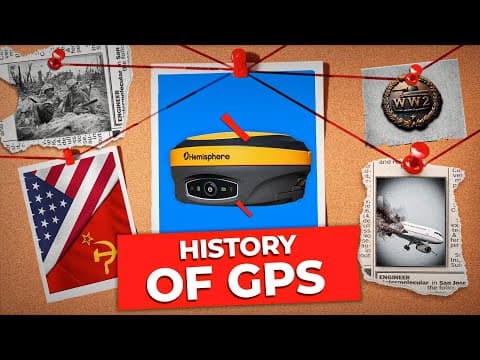
[0:00]In today's video I want to talk about a technology that was built to fight the Cold War, that was used to win the Gulf War, that is related to how a civilian airline got shot down in Russia and what that has to do with these two pieces of technology next to me.
[0:13]So let's get into the video and find out what this all means. So some of you might have already guessed what I'm talking about, but for those of you who haven't, I want to talk about GPS today and kind of how it relates to survey.
[0:21]And to do that, I want to do a bit of a history lesson first so we understand how we got to the point where we did where GPS is so ubiquitous in our day-to-day lives.
[0:29]And to understand that, we need to understand where GPS came from. So GPS was originally developed as a Cold War technology in the 1980s to help fight the Soviets.
[0:38]It was specifically designed to improve weapon targeting. Now, if you're a military guy, that sounds pretty great, but for us civilians, a billion dollar project is never going to be super, super popular.
[0:47]You know, unless you're fighting the Red Scare, of course. Now, we obviously have to get to some point where this is introduced for civilian technology. So, unfortunately, what happened in the 1980s is we're flying around all these airplanes and we're doing all of these navigation techniques using inertial sensors.
[1:00]We're doing it by hand, radio beacons, all sorts of technologies which are good, but they're not always as reliable as what we would like.
[1:07]And what happens is Korean Airlines, a 747 flight, accidentally strays into Soviet airspace. And upon doing that, the Soviet response instead of saying, hey, this is a civilian airline, is to immediately scramble their interceptor fleet.
[1:19]And as a result of this, this airline is shot down and it kills 269 civilians. This is obviously an enormous tragedy and it puts a shadow over US and Soviet relations for a long time.
[1:30]But in response to this tragedy, we did develop something good out of it and that is civilian access to GPS technology. And in direct response to the shoot down of an airline, Ronald Reagan in 1983 signed into law civilian access to this new technology, this GPS technology, which had previously only been accessible to the military.
[1:48]With the introduction of this technology to the civilian world, we gained access to a positional service that would give us our position to within 100 meters.
[1:57]Now, that probably doesn't sound great to all of us who are using this in the surveying world. We're looking for millimeter accuracy, but this is the key moment that kick starts this RTK revolution that we now see in surveying.
[2:08]So GPS technology has been around since the 1960s and 70s, but it wasn't really until the 1990s that we saw the true power of what GPS could achieve.
[2:17]In the pretty impressive invasion of Iraq, the US Army marched through the deserts of Iraq, surprising Iraqi forces, and a key part of why they were able to do that was GPS navigation.
[2:29]Using these military GPS satellites, they were able to pull off something that the Iraqi army had once thought impossible. Now, if we're doing surveying, we probably don't care about how we invaded a foreign country.
[2:40]Those ramifications probably outside our scope of practice. What really matters is in the 1990s, we start to really see the power of positional surveying using GPS signals.
[2:50]We see things like statics where Trimble has some of their first static receivers coming out in the late 80s, early 90s.
[2:57]We're starting to see real time positioning used in things like dredging, marine navigation, real civilian applications that are beginning to change the way that we survey in the field.
[3:05]In 2000, we get another key moment in the timeline of GPS technology that really sets the stage for what we see in today's world with RTK.
[3:13]And that is when President Clinton in 2000 ended what was called selective availability on GPS satellites. And that is what allowed us to do navigation, it allowed us to do precise static work, but not really precise real time work.
[3:25]And with the ending of this selective availability technology, we go from a GPS signal that will give us approximately 100 meters of accuracy down to a couple of millimeters of accuracy if we use some real time kinematic techniques.
[3:37]And this moment is why we can now use something like this Hemisphere S631 to do real time sub centimeter positioning.
[3:46]And if you like what you're listening to today, please hit that subscribe button down below. It really helps us out and it helps us keep making these kind of videos. So if you want to see more videos like this or you want to see different kinds of videos, leave a comment down below so that we can work on what you want to see.
[3:59]So as I mentioned, this ending of selective availability in 2000, fundamentally change the way we can survey. We can finally move away from optical instruments. Now the spirit level is really old.
[4:08]It's not quite as old as something like a total station where we're using an EDM, but it really allows us to get into this real time positioning with RTK.
[4:15]So to understand why we've seen such giant leaps in technology from fifth to sixth to seventh generation RTK. And I'm going to head over to the whiteboard and explain how the evolution in GPS technology and the evolution in the satellites has allowed us to completely change the way we survey.
[4:29]So the important thing to understand with GPS and why you probably see a huge performance difference from something like an S320 to a Hemisphere S631, you need to understand the generations of GPS technology.
[4:40]Because there's three distinct kind of errors of GPS technology from Block 1, which was when it was first introduced, to Block 3, which is what we now have in the sky.
[4:49]With Block 1, we have our first satellite launched in 1978, and we eventually see an expansion to a 24 satellite constellation.
[4:58]Now, the key thing for us civilians is this selective availability. It's made accessible to everybody, so it's something that we can all use in a civilian application.
[5:06]There's a bunch of cool military stuff, but I don't have access to any of that, so if somebody wants to leak classified documents, I'd always be really interested in learning about it. But, after Block 1, we move on to Block 2 in 1989.
[5:16]So with the introduction of these civilian signals, we start to see the real application and how this can change our world.
[5:22]So we get with Block 2, we have a whole bunch of derivatives. There's Block 2A, Block 2R, Block 2F, Block 2M.
[5:28]There's like a million letter codes that all introduce a bunch of minor things and a whole bunch of military codes, but what we importantly see is we see the introduction of L1, L2 and L5 signals over the years.
[5:39]So we kind of start with L1 and L2 signals and we move all the way to L5 signals by the end of the lifespan.
[5:45]This is where we start to see the real world, the widespread application of RTK technologies, these satellites come online.
[5:51]So your S320s, your GRX2s, receivers like that, your Sokkia GSR2700s, those are going to be using primarily Block 2 satellites when they were introduced.
[6:01]So we have access to pretty good L1 signals, pretty good L2 signals.
[6:05]It's going to get the job done, but as soon as we get in things like trees or near buildings, we're going to see a degradation in performance.
[6:11]And the reason the S631 can so greatly outperform these older receivers and I'll link to some videos down below if you want to see just how different the performance can be is the introduction of these Block 3 satellites in 2018.
[6:24]So, as more and more of these satellites get launched and they fill up more and more of our GPS constellation, these receivers are only going to get better and better with time.
[6:32]And the big difference between Block 3 and Block 2 satellites is we don't actually see a ton of new signals necessarily, but we see much better and cleaner signals in terms of performance.
[6:43]So our L5 signal, it's upgraded. It's going to punch through trees better. It's going to perform near buildings better. It's going to have better anti-noise, better anti-scrambling capability, all sorts of things that are going to make your life easier.
[6:53]And then we also see huge upgrades to the L1 and L2 signals for civilian use.
[6:59]So they're made cleaner, they're made more powerful, and all of these upgrades mean that this receiver is something that you can finally take under trees.
[7:05]So no longer is this is RTK a technology for the guys that are doing open construction sites, topos, subdivisions where there's no tree cover, no buildings.
[7:14]With the introduction of these Block 3 satellites, you can finally start using GPS in those difficult environments and put the total station away and start, you know, actually surveying in a different way and changing the way you work with these new receivers.