[0:05]So, this video is going to be a review of a musculoskeletal assessment. Remember, this involves assessing muscles, bones, and joints both structure and function. A couple key points before we start. If your patient can't stand, you can perform active range of motion in the bed to the best of your ability. If they can't perform active range of motion, you can use passive movements to help them through those range of motion exercises. There's three main areas we need to assess: the spine, the upper extremities and the lower extremities, and for each one, you'll inspect, palpate and perform range of motion. So to start assessing the spine, have the patient stand in front of you with their back towards you. You want to inspect and palpate for the spinous processes which should run vertically and in alignment. You also want to look for any abnormal lateral curvature, which could indicate scoliosis. Then you want to look at the patient from the side to assess for kyphosis or lordosis, which is just exaggerated curvatures. Next you want to do range of motion. So, to check range of motion of the cervical spine, have the patient put their chin up and down. Turn their head left and right, and then put each ear to the shoulder on that side. To test thoracic range of motion, have the patient lean side to side and twist left and right. You can demonstrate these motions if it helps. For lumbar, have the patient lean back slightly, just make sure that you are there to support them. All of this should be done smoothly and without pain. Next we're going to move on to the extremities. So, for each joint you assess, starting at the shoulders, you want to inspect for the muscle size and shape. Is there any atrophy? What's the skin color and condition? Any redness, swelling or masses, deformities? Then range of motion for the shoulders involves abduction, adduction, forward motion, backward motion, rotation, and shrugging. You also want to palpate the joint during range of motion. Is there any heat, any crepitus with movement, and of course, ask if there's any pain. Now, you're going to repeat the same inspection and palpation for the elbows, taking them through flexion, extension, supination, and pronation. Then the wrists, flexion, extension, supination and pronation, and of course, the hands through flexion and extension. All the while inspecting and palpating the joints for any abnormalities and asking for any pain. Before you move on to the lower extremities, you want to check the strength of the uppers. We have the patient push against you, pull you towards them, lift their arms up and put their arms down, all against resistance. Check your outline to see the grading scale for strength. It goes from zero to five. For this patient, she's got full strength, full range of motion, so we'd say five out of five. On the lower extremities, you're going to inspect and palpate each joint just like you did on the uppers, looking for heat, deformity, pain, and swelling. Start at the hips and work your way down. The hips should flex and extend, abduct and adduct, and rotate internally and externally. Now, if your patient has trouble with balance, you can do these motions in the bed or just assist them with stability. And of course, check both sides. Then you're going to check the knees for flexion and extension. Make sure that you're feeling for crepitus while they're moving through that range of motion. Then you're checking the ankles. They should be able to dorsiflex, plantarflex, supinate, pronate, and rotate. And finally, they should be able to flex and extend their toes as well. Now, we also will do strength for the legs. We'll, these are often done best sitting or sitting on the edge of a bed. So, have them push against your hands, pull against your hands, lift and lower their legs. Again, all against resistance. So, if they can perform all of these things, then they are five out of five. Again, remember, if your patient can stand, balance and and stand on one leg, they're probably five out of five. So, you also can assess gate during this assessment if you'd like, just make sure that they have any assistive devices they need when they're walking. Now, we tested reflexes in the neurological assessment, but you could also include them here in musculoskeletal if you wanted. All right, well, that's it for this assessment. Make sure you check out all the resources attached to this lesson and the rest of the health assessment lessons. Now go out and be your best selves today, and as always, happy nursing. Thanks for watching another nursing.com lesson. Click the link below in the description to watch thousands more lessons over on nursing.com. Also, be sure to hit the subscribe and the little bell to make sure you're reminded when new lessons come out. And if you want to just keep watching more lessons, go ahead and click this video over here to continue learning. Like we always say here at nursing.com, happy nursing.
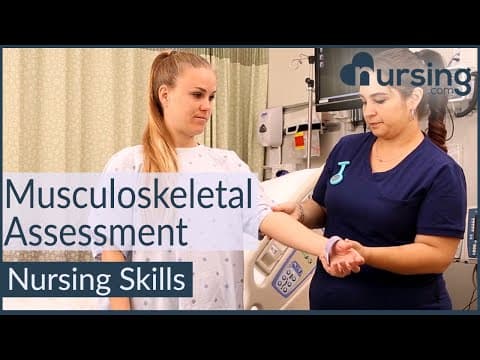
Health Assessment: Musculoskeletal System- Nursing Skills
NURSINGcom w/Jon Haws, RN
5m 7s864 words~5 min read
YouTube auto captions
Transcript source
YouTube auto captions
This transcript was extracted from YouTube's auto-generated caption track. The transcript below is server-rendered so it can be read, searched, cited, and shared without opening the original YouTube player.
Pull quotes
[0:05]Remember, this involves assessing muscles, bones, and joints both structure and function.
[0:05]If your patient can't stand, you can perform active range of motion in the bed to the best of your ability.
[0:05]If they can't perform active range of motion, you can use passive movements to help them through those range of motion exercises.
[0:05]There's three main areas we need to assess: the spine, the upper extremities and the lower extremities, and for each one, you'll inspect, palpate and perform range of motion.
Use this transcript
Related transcript hubs
Watch on YouTube
Share
MORE TRANSCRIPTS


