[0:12]I'm Lisa Meffert. I'm an assistant professor in the Department of Ecology and Evolutionary Biology at Rice University. And today we're going to work out pedigrees.
[0:20]We're going to work out how you can use this little puzzling technique to figure out the genotypes of individuals based upon the phenotypes that you see.
[0:29]Remember that the genotype is that combination of alleles or genetic particles that you receive from your your parents, your mother and your father, and they come together and determine what your phenotype will be, that is the the visible or the observable trait, um, that is expressed.
[0:44]So, there are certain features that we need to work through.
[0:47]First, we want to know, um, are the genes on the autosomes.
[0:51]The autosomes are those chromosomes that don't determine sex.
[0:55]The sex chromosomes are those chromosomes that determine sex. Um, then we want to know the pattern of expression.
[1:00]Is it dominant or recessive?
[1:03]That is, is an allele dominant or recessive. If if an allele is dominant, then it mask the expression of the recessive trait.
[1:09]Remember that you can be homozygote dominant or heterozygote, heterozygous for the dominant allele, and then that will show that trait.
[1:17]You need to be homozygous recessive in order to express the phenotype of the recessive allele.
[1:23]So, the neat thing that you'll find out about these pedigrees is that the dominant allele has to be expressed in every generation, and we'll go through that in a minute.
[1:30]The recessive allele you'll find has a pattern of skipping generations.
[1:34]So, remember how the recessive allele can get masked in underneath the dominant allele in heterozygous individuals, and that's why you can see that you don't see the, um, recessive trait, uh, in every generation because it can be masked by the dominant allele.
[1:47]Then we have sex linkage.
[1:50]Is the, uh, gene located on the Y chromosome.
[1:54]Remember that at least in humans that males are determined by having one X chromosome and one Y chromosome.
[1:59]So if you find that a trait is only expressed in males, then you can really suspect that it the gene is located on the Y chromosome.
[2:07]Is it X-linked? Is it is the gene located on the X chromosome, and usually we talk about X-linked recessive alleles.
[2:15]And what you'll find the the kind of common pattern you'll find is that sons will inherit a disease trait, let's say from normal parents.
[2:22]And we'll go through that in a lot of detail, um, at the end.
[2:26]Now we need to go through the basic symbols of a pedigree diagram.
[2:30]Females are represented by circles by convention and the way you can remember that is that females are kind of soft and round.
[2:36]So alternatively males are going to be represented by squares.
[2:39]Then what we do in these pedigrees is we just put a a line in between the male and the female to show that they've mated.
[2:44]Then the offspring are depicted below, so just think you have one generation up here, father and mother, and then the next generation below them, we have here one son and one daughter.
[2:55]Remember again, females are round.
[2:58]When we fill in the symbol with a black, um, color, that means that the individual expresses the trait that we're interested in, okay?
[3:06]So in this case, you have a father and a mother that don't express the trait, and then the son that does.
[3:10]So, remember how, um, in recessive traits they can skip generations.
[3:16]So in this case, we didn't see, um, the trait in the mother or the father, but in the next generation, we did see the trait.
[3:22]So that gives you a hint that it's probably a recessive trait.
[3:25]Again, we'll work out the little, we'll do the puzzling in a minute. So for the first case, let's work work with Marfan's syndrome.
[3:31]Um, this is a disease state where people have hyperelastic joints.
[3:37]And the first thing you do in this pedigree is, remember we want to determine first, is it autosomal or sex linked?
[3:43]Is it on the X or the Y chromosome? And that is determined by saying, well, is there some kind of restriction of this trait to males or females.
[3:50]We look at this pedigree here and we see, no, there's a female here, female here, female here expressing the trait, and then males also express the trait.
[3:58]Remember again, if it's a dark or colored in symbol, the person's expressing the trait.
[4:02]So, we say there's no particular bias for, um, males or females to have the trait, so we suspect it's autosomal.
[4:10]Then we note that it's expressed in every generation.
[4:13]It doesn't skip generations. Therefore, we suspect it's a dominant trait.
[4:18]So this trait, Marfan syndrome, is determined by a dominant allele on an autosome that is a chromosome that doesn't determine sex.
[4:26]So now what we need to do in this little puzzling is work out the genotypes of all the individuals.
[4:31]Of course, now we see the phenotypes as to whether or not they have a dark coloration or a different kind of color, but we need to now work out the genotypes that determine those phenotypes.
[4:39]So, it we've already determined that, um, Marfan syndrome is determined by a allele that is dominant to the recessive normal allele.
[4:47]So, just for convention, let's just use a big M for the symbol for the dominant allele for Marfan syndrome.
[4:55]Then, by convention, we use a small lowercase M for the normal allele in this case, the recessive allele, the recessive normal allele.
[5:03]So, first we can fill in the genotypes for all the individuals who do not show the trait.
[5:07]So, anyone who is not doesn't have a dark black colored in phenotype must be recessive for the normal allele.
[5:14]Little M, little M, so we fill in all the genotypes for these individuals for all the individuals who do not have dark colored in, um, symbol.
[5:24]Now, we can go to the individuals who do express this trait.
[5:28]We know that they must have at least one big M. Now, remember they could have two big M, and that would still determine, um, that would still give them the Marfan syndrome, but we know they have to have at least one big M, so let's fill in a big M for every individual that expresses the trait.
[5:44]Now, we have to figure out, well, now these individuals who express the trait, are they homozygous for the big M, or are they heterozygous for the, um, big M?
[5:53]That means they have a big M and a little M. They have the the, um, the disease trait, and they also have the recessive allele.
[5:59]So, the way we work this out is that, okay, let's look at individuals number one and two.
[6:04]And we're trying to figure out if they're homozygous or heterozygous.
[6:10]Well, if these individuals were homozygous for the big allele, then you know they must pass on a big M to each one of her offspring.
[6:23]That is, she has nothing else to give but big M.
[6:26]Therefore, all of her offspring receive a big M, and they should all show the syndrome.
[6:30]But we see that's not true. In both of these meetings here, we have, uh, affected and unaffected offspring.
[6:38]Therefore, we know that these individuals here must be heterozygous.
[6:47]They have the effect, they have, um, the big M and the little M, in order to produce both affected and unaffected offspring.
[6:54]So now we've filled in all the all the genotypes of the individuals in this pedigree.
[7:34]So let's move on to a little more complex situation.
[7:38]In this case, we're going to be looking at albinism.
[7:41]Albinism is a trait where individuals don't have pigmentation.
[7:47]You'll find that they have, um, very white, blonde hair, light skin, and these kind of red eyes because they just lack the pigment.
[7:53]Now, remember we want to work out whether or not the, um, the allele for albinism is dominant or recessive, and also whether it's on an autosome, that is a non-sex chromosome or a sex chromosome.
[8:06]So, we look here and we find out that, um, is there some kind of bias for males or females to show the trait?
[8:14]No, there's not any kind of bias. A female can show the trait, again, these females have dark colored in symbols, so they show the trait, and these sons, these males show the trait.
[8:23]Therefore, we know that this is probably an autosomal trait.
[8:27]Now, remember how we said that if you're have a dominant allele, you're going to see it in every generation.
[8:32]You'll see the trait in every generation because it must be expressed in every generation.
[8:36]It's the recessive alleles that can kind of hide underneath the heterozygote and sort of and that causes the skip in the phenotype from one generation to the next.
[8:45]And we'll see here that, look here, you've got individuals in this family here who express the trait, but they're born of normal parents.
[8:52]Therefore, you can say this is probably a recessive trait.
[8:57]So, both we call these individuals here who actually carry the recessive allele but are expressing a normal phenotype because they're heterozygote.
[9:05]We call these carriers. They're carrying the recessive allele, but it's hidden underneath the dominant allele for being normal with regard to your pigmentation.
[9:15]So, we're just going to arbitrarily assign a big A for the dominant normal allele.
[9:21]In this case, a little A for the recessive allele that must be homozygous in order to confirm this albinism trait.
[9:27]We know that all individuals who, um, express this trait now must be homozygous for the small A allele.
[9:34]So now we can fill in their genotypes as little A little A.
[9:37]That that part's really easy. And then we also already discussed this part. Note how these two normal individuals must somehow get together to produce some affected and some unaffected individuals.
[9:47]Therefore, they must be heterozygous.
[9:52]They're carrying the they're carrying the recessive allele. So, remember that this affected son here got an autosome with, um, a small A allele and got an autosome from the father's sperm with also the small A allele.
[10:05]Simple enough.
[10:30]So, now we've worked out the, uh, that all the individuals of this phenotype, if they are normal, they have at least one big A allele.
[10:37]Uh, we've already worked out, we have carriers up here.
[10:43]All individuals who are, um, uh, solid or black colored in circles or squares, they have two little A alleles because we remember albinism is recessive.
[10:52]You have to be homozygous for the, um, uh, recessive allele in order to show this trait, the reduction in pigmentation.
[11:00]So now we have all these offspring here, we know have at least one big A allele because they're normal, but we need to know are they carriers or are they homozygous, um, what are their genotypes?
[11:10]So we have the father here, we know has at least one big A allele, but is he homozygous for the big A allele, the normal allele, or is he heterozygous?
[11:18]So that's why I've put a little question mark here. We know he has at least one big A, but we're not quite sure if he's got another big A, or if he's got, um, a big A and a little A, who must give a little A allele to each one of her offspring.
[11:32]But then we have a father here, who we don't know, if by chance, he just gave his big A allele to all of his offspring, even though he's actually a carrier.
[11:41]Now, on average, if we had a really big family, we would be able to figure out whether or not this could be statistically probable that we have a carrier here, who just by chance, happened to give the normal A to all of his offspring and just never produced affected offspring by accidentally giving his recessive allele along with the mother's recessive allele for the egg, and producing an affected individual.
[12:04]So we're going to leave these as little question marks, because we just don't really know.
[12:10]Um, we look over here at the uh, at this other family here in the lower left hand corner.
[12:17]And again, we want to say, we've already determined that the affected individuals are homozygous for the little A allele, but we need to know, um, we know that the each got a little A allele from their father, who was showing the the disease, but again, we don't know.
[12:30]Does the mother a carrier? Does she have a big A allele and a little A allele, or does she have two big A alleles?
[12:37]Well, she has affected offspring. So, we know that she must have given a little A allele to each one of her offspring, to all of her offspring.
[12:46]So, in order to have, um, affected and unaffected individuals in this kind of mating, a normal female with a, an affected male, um, again, remember that the father has to give a little A allele in each of his sperm to each of his offspring, and then in order for this mother to also produce affected offspring, she must have eggs with the small A allele.
[13:07]And so, sure enough, we have to now say that she is a heterozygote.
[13:11]Okay, so that's how you work out an autosomal recessive trait.
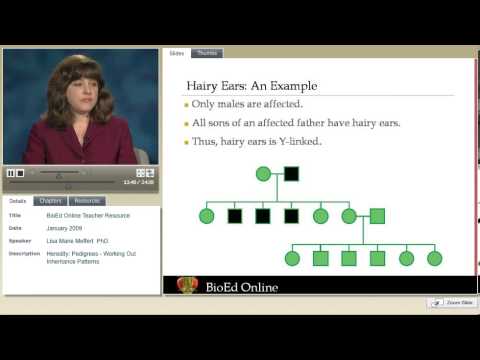
[13:16]Now, we have an unfortunate trait here called hairy ears.
[13:20]Now, um, my brother has a hairy ears, and that's I'm happy to know that it's a Y-linked trait.
[13:26]It's on the Y chromosome, so I don't have to worry about getting hairy ears.
[13:30]But actually, if you'll notice that in human chromosomes, there are very few genes, uh, on the Y chromosome.
[13:36]So, how are we going to work out this pattern? Well, remember the first thing that we do is see, is there some kind of bias for males or females to show the trait?
[13:43]In this case, we show that all of the sons, here's the father with the hairy ears and mating with the normal female, produces, um, daughters and sons, but note that each one of his sons has the hairy allele.
[13:56]That is, every time he produced a son, he had to give a a Y chromosome, and that Y chromosome had the allele for hairy ears.
[14:07]So, we've determined now that there's something about sex linkage with the hairy eared hairy eared gene, and it's on the Y chromosome.
[14:16]So, now we're working with the sex chromosomes. These are not the autosomes, these are sex chromosomes. And so, let's now put down the sex chromosome genotypes for each one of these individuals.
[14:24]Well, remember, if you're female, you're round, that means you must have two X chromosomes.
[14:29]So I'm writing in two X chromosomes for each of the females.
[14:32]And we know then, just because of sex determination in humans, remember, as a side, not everything in biology is determined by X-Y chromosomes.
[14:41]But this is the human case. And so, um, in this case, every one of the males, every one of the squares, has to have an X and a Y.
[14:48]So we just fill those in.
[14:52]Now, we're going to put a little tag on the sex chromosome to show what allele you have on that particular sex chromosome.
[14:58]So we're sort of doing two traits at the same time. We're saying whether or not you're a male or a female, and we're saying whether or not in this case you show the phenotype of hairy ears or not.
[15:06]So, we're now going to fill in, um, the uh, the gene, the the symbol for the gene on the Y chromosome.
[15:13]If you have a Y chromosome and you're hairy eared, um, then we're going to put this little H on each of the Y chromosomes.
[15:22]And then we see that these are normal males, and they must have then, they do have a Y chromosome, but they came from a father who was normal.
[15:30]So that father must have given normal Y chromosomes to each one of his sons.
[15:36]And it's a good way to, what you would want to do is double check if everything here is good.
[15:40]You would double check to say, um, going up to the first set of parents.
[15:43]Okay, we have an X chromosome coming from the mom, um, to produce this female, we have, because that's all she has is X chromosomes, and to produce this daughter in the next generation, you must get an X from the father, because that's how you produce a female.
[16:00]Then we have, she's mating to a normal male.
[16:04]So that means that he is has an X and a Y, he doesn't have hairy ears, so that he has a normal Y chromosome.
[16:11]So these are the all kinds of offspring that you can produce from, in this case, the the last generation from a normal female with a normal male.
[16:18]Okay. So that was a Y-linked gene, and in a sense, it's sort of dominant because you always see it associated with maleness, there's nothing to cover it up, because if you're a female, you can't show this gene because you don't have the Y chromosome.
[16:32]So now we're going to look at, um, in this case, a sex-linked gene that is recessive.
[16:39]Okay. Now, remember we want to look at, first, is there some kind of particular bias for males or females to show the trait?
[16:48]And in this case, we see that there is, um, the the males seem to have a preponderance of this trait.
[16:56]Now, remember, in a sex-linked or an X-linked trait, females can't show the trait, but it's going to be relatively rare, and we'll explain that in a minute.
[17:05]So we see that there's some kind of bias for, um, particular sexes to show the trait, but note that it skips a generation.
[17:14]So there's something recessive about it, okay?
[17:17]So, here we have an affected father meeting with a normal female, and they produced a normal daughter, who meets with a normal male, which produces, here we have some normal males, or two affected males and one normal.
[17:32]And I do apologize, I didn't explain the disease.
[17:35]So hemophilia is when you are missing a blood clotting factor.
[17:39]There are a lot of blood clotting factors, so things that help you bruise and, um, produce scars and scabs to keep you from bleeding, and in this case, you see that this poor child here has lost the blood clotting factor, so is very prone to bruising.
[17:51]And this can be a very dangerous disease because people can bleed to death, even internally, okay?
[17:59]So, how can we say that, okay, there's something about sex in this, um, in this gene, and there's something about recessiveness in this gene.
[18:08]But can we be sure that it's not a Y-linked trait?
[18:11]Something that other kind of case that we had with the hairy ears. It's not a Y-linked trait because note that you have a normal father here producing normal and affected sons.
[18:20]Remember that if it's a Y-linked trait, then affected fathers have all affected sons.
[18:26]So, now we can say suspect that this is on this, um, gene is on the X chromosome.
[18:32]So now we're going to assign sex chromosomes to all the individuals.
[18:36]Remember again, females around, they both eat, they have two X chromosomes.
[18:39]This is easy. So, fill in two X chromosomes for each of the females.
[18:44]And then we know, if you're a male, if you're a square, you have one X and one Y chromosome.
[18:49]So we fill in all the, um, sex chromosomes for the males.
[18:53]Okay, so now we've determined the sex chromosomes for all individuals.
[18:57]That's pretty easy. All the males are X Y, and all the females are X X.
[19:02]So now we're going to fill in the codes for whether or not the X chromosome has this allele for hemophilia.
[19:09]Um, we're going to use an H for the recessive hemophilia allele.
[19:12]Now you'll say, now wait a minute, if it's recessive, isn't it supposed to be lower case?
[19:16]Well, there's another convention that if you're talking about a disease trait, and we did this with the uh, the normal and the hairy ears, is that you assign the code for the disease trait, in this case using an H for hemophilia, and then use a plus for wild type.
[19:30]And wild type comes from a tradition of looking at what is the most prevalent phenotype or or allele in the population, and that's called the wild type allele.
[19:40]So, most most often people have the wild type normal allele, because they don't show this disease trait, okay?
[19:47]So, for all those individuals who are affected, these, um, individuals here who are affected, they must have, and it turns out, these are just all sons here.
[19:57]They must have a Y chromosome, but then they must also have an X chromosome, and this is what they got from their mother's egg, and then we put a little H on the X chromosome for having the hemophilia allele.
[20:09]We can also fill in this intermediate daughter here, because we know that she came from these two parents.
[20:18]So, she must have, she got a normal, um, X allele from her mother, we can assume, but she must have gotten this X chromosome from her father in order to become female.
[20:26]So we know that she's a carrier.
[20:29]So we can put a little X, a little H, excuse me, on one of her X chromosomes.
[20:34]That's the X chromosome that she received from her father's sperm.
[20:37]So now we can look at, let's look at this, um, next generation here.
[20:40]So we have the two parents up here, so looking at the offspring in this second generation, we know that, um, all the females also must have received this X chromosome from their father in order to be female.
[20:53]So we can now fill in the little H to symbolize X chromosome that they got from their father's sperm.
[20:59]So we know that they are carriers. But also double check and say, but they can still be normal.
[21:03]Remember, this is a recessive allele, so that got a normal chromosome from their mother, um, and they got the disease chromosome from their father, but they can still have normal blood clotting factors, because the hemophilia allele is recessive.
[21:38]So now we're going to work out the genotype of this female in the very first generation.
[21:43]Well, we know she's normal, so she must have at least one of these wild type normal alleles.
[21:48]Um, but we can't be entirely sure if she's homozygous for the normal allele, or she's a carrier herself.
[21:57]But at least we can do, what we can do is fill out, fill in a wild type allele for each of these daughters, which is normal, knowing that they must have received the wild type allele from their mother because they are definitely carrying the hemophilia allele from their father's sperm.
[22:15]So then we get into this trick here, well, is this female, let's say up at the top, and these two females down at the bottom, are they carriers, are they homozygous for the normal allele?
[22:26]Well, we can't really tell. I mean, again, we talked about this previously where there's some kind of chance, and if this female at the very be top, um, was heterozygous, a carrier, by chance, she could give normal alleles to all her offspring, and then the the, um, sex chromosome that's carrying the hemophilia allele that's being covered, it just by chance doesn't get passed on to the next generation.
[22:49]Um, and that occurs down here too. So we know that this female is carrying the recessive allele, but she we know that she got at least one, um, wild type allele from her mother, but we don't know if she got, um, we we still can't determine whether or not this mother at the very top is heterozygous or homozygous, um, for the normal allele.
[23:14]So that's why we put little question marks down here, well, the answer is you really don't know.
[23:20]So we can't really say whether or not these these females are carriers or they're homozygous for the normal allele.
[23:26]We do know that, um, we did skip generations, so it's recessive, um, allele.
[23:31]We know that it's X-linked, and we've, but we still haven't been able to completely solve the puzzle for whether or not these females are carriers or they're homozygous for the, um, normal allele.
[23:42]What we can say is that in disease states, those chromosomes that have the diseases tend to be in low frequency in a population because they have some kind of debilitating effect on the individuals who carry who actually express the trait.
[23:55]So, hemophiliacs, the real more severe kinds of hemophiliacs, often can't even make it to adulthood to reproduce.
[24:04]So, we will find that a frequency of that kind of allele will be rare in the population, so we can just say, on average, our statistical guess is that these, that this female up here is homozygous for the normal allele.
[24:16]Thank you very much.