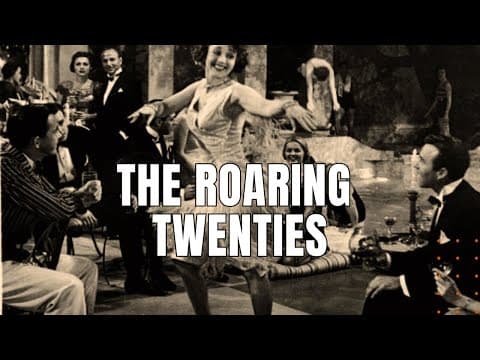
[0:01]Today in the Daily Dose, the roaring 20s.
[0:07]After the armistice of November 11th, 1918, that brought a close to the war to end all wars. A year later, more than 2 million US soldiers had returned victorious to their native soil. duly honored by a parade through New York City, which had now become the beating heart of world finance and banking. Thanks in large part to America's ability to lend money and manufacture weapons for her beleaguered war allies in Europe. The nation was about to enter a period of extreme prosperity, liberalization, and social unrest. Yet as the new decade dawned, at noon on September 16th, 1920, a horse drawn wagon exploded in front of the JP Morgan Bank on Wall Street, killing 38 while leaving another 143 seriously wounded. The two events, from the triumphant return of doughboys to the Communist red scare fears suspected behind the Wall Street bombing, both stood as fitting polarized book ends of the roaring 20s to come. But before prosperity came a brief hangover from the First World War, when the sudden loss of wartime production put the brakes on the American economy, leaving some 1 million returning soldiers unemployed as they relied heavily on bread lines for their daily sustenance. Many Americans found themselves in a world of financial hurt, leading incoming President Warren G Harding to promise that he would put things right for America and return the country to normalcy. Historians would later frame Harding as one of the worst presidents in the nation's history, yet during his term in office, he benefited greatly from an age of rapid innovation and technological advancement. Leading the charge was men like Henry Ford, whose first mass produced Model T drove off his Piquette Avenue assembly plant in Detroit in 1908, revolutionizing interchangeable parts production methods, while delivering the first affordable automobile to road hungry middle class Americans. Colloquially known as the Tin Lizzie, when the Model T first hit the streets, American roads, or what at the time passed for roads, saw fewer than 200,000 cars across the entirety of the United States, limited exclusively to wealthy Americans who could afford such a high priced luxury. While Henry Ford's first Model T's office assembly line were initially rather expensive, 825 or roughly 27,000 in today's currency. By 1925, the cost per automobile had plummeted to 260 each. Along with the introduction of the first moving assembly line, between 1908 and 1927, Henry Ford produced more than 15 million Model T Fords, making the Model T the longest production run of any car in history, until the Volkswagen Beetle hit the streets in 1949, eventually selling 21 and a half million units. His innovations turned Detroit into a boom town, while making Ford one of America's earliest billionaires. As the economy began to boom in the early 1920s, new roads emerged to accommodate the millions of new cars applying city and suburban streets, swelled by new housing and business construction. Although one business, the alcohol industry, failed to join the boom due to the start of prohibition in America. By way of backstory, when the Mayflower made landfall at Plymouth Rock, her hold carried a sizable cargo of beer, setting off a culture in America that gravitated around the consumption of alcohol. George Washington supplied his beleaguered troops at Valley Forge with a half cup of daily rum, while young Abraham Lincoln made a tidy living selling barrels of whiskey from his grocery store in New Salem, Illinois. But as distillers moved from 2% beer to high octane whiskeys and rum, by the 1830s, the average American over 15 years of age drank the equivalent of 88 bottles of whiskey each and every year, more than three times the consumption of today's legal age adults. Husbands came home drunk and penniless from a night on the town, leaving families destitute and frequently abused. In response, temperance leagues such as the anti-saloon League cropped up in cities across America, leading to the 18th amendment to the US Constitution. Known as the Valstad Act, the law came into effect on January 17th, 1920, prohibiting the sale, manufacture, or transportation of alcoholic beverages. Enforcement initially fell upon the Internal Revenue Service, until a rise in gang related bootleggers such as Al Capone, combined with illegal drinking establishments known as speak easies, which in turn moved enforcement to the Justice Department and the Bureau of prohibition. While prohibition witnessed the true birth of organized crime in America, it also pointed to a nation's steadfast resistance to being told how to behave by others. While high priced illegal alcohol could be afforded by middle and upper class Americans, the nation's working class was forced to abstain from alcohol or resort to making their own moonshine whiskeys or bathtub gins. And as the roaring 20s reached its zenith years, even moderates within the temperance movement began to understand that the high costs of prohibition's enforcement grew increasingly untenable. As the demand for black market booze intensified, competition amongst bootleggers witnessed the deaths of some 600 mobsters in Chicago alone. At the same time, after women won the right to vote in 1920, speak easies combined with an overt desire by young women to break with the conservative female mores of the Victorian era, inspiring a new uninhibited lifestyle that shocked the more conservative elements of American society, leading author Dorothy Parker to write that the flapper was not what grandma used to be. Coined from the hit movie by the same name, flappers defined the spirit of the 1920s, who had at first tasted independence during the war years, inspiring a strong desire to part ways with Victorian definitions of a woman's role through marriage and motherhood. They were women who embraced the spirit of pleasure, independence, exploration, and freedom. Flappers bobbed their hair, listened to jazz and flaunted their disdain for what was then considered acceptable behavior. They were also seen by conservatives as openly brash for wearing excessive makeup and dresses of near nakedness, at the same time adopting typically male behaviors such as smoking and drinking alcohol, driving automobiles, treating sex in a casual manner and otherwise flouting social and sexual norms. The rise of the automobile was an important factor in Flapper culture, as cars allowed women to come and go as they pleased, traveling freely to speak easies and other entertainment venues, while using the large vehicles of the day for their most popular activity, petting parties, the original Tinder or hinge of the roaring 20s. According to one study from the late 1920s, 92% of college students participated in petting parties, which went by other names, such as snuggle parties, snuggle popping and necking, adding more relevance to the question, Great grandma, what did you do when you were young? With the American economy now firmly in overdrive, on August 2nd, 1923, President Harding died suddenly from a heart attack, while his successor, Calvin Coolidge, known as Silent Cal, continued the decade of Republican dominance in American politics, maintaining Harding's pro business fair economic policies when he said that one of the greatest favors that can be bestowed upon the American people is economy in government. Since the chief business of the American people is business. African Americans, on the other hand, were largely excluded from the same institutional prosperity as whites. And while racism and segregation were rampant throughout the United States, such exclusionary tactics were at their worst in the Jim Crow South. Named after a black menstrual show character, Jim Crow laws were a collection of mostly Southern state and local statutes that legalized racial segregation, which was implemented shortly after the end of the Civil War and lasted until the civil rights protests and federal legislation of the 1960s. The laws were intended to marginalize African Americans by suppressing their right to vote, limiting their access to good paying jobs and excluding their access to higher education. Those who attempted to shirk the laws often faced arrest, finds, jail time, violence and even death. Even in places where black prosperity had taken root in America, such as Tulsa, Oklahoma and Rosewood, Florida, a marked rise in social tension regarding race and undesirable immigrants witnessed the second rise of the Ku Klux Clan, which led to racist massacres in Tulsa in 1921, followed by Rosewood in 1923. Racial tensions and the Jim Crow laws of the segregated South prompted many African Americans to flee for northern cities, during what became known as the Great Migration. Traveling by trains, boats, buses and cars, even the occasional horse drawn cart, by the mid 1920s, black populations in major northern and Midwestern cities rose precipitously, including a 66% rise in New York City, 148% in Chicago, 500 in Philadelphia and a whopping 611% in Detroit. Many found work from factories to foundries, and while conditions were frequently backbreaking and dangerous, opportunities were plentiful and financially rewarding. The Great Migration also led to the Harlem Renaissance, when 300,000 new black residents became home to many black notables, including poets Claude McKay, Jean Tuner and Countee Cullen, writers Jesse Redman Faucet and Langston Hughes, actor Paul Robeson, sociologist Charles Spurgeon Johnson and civil rights activist James Weldon Johnson. Yet it was the music of the Harlem Renaissance that gave the period its indelible mark on American music, including jazz greats such as Louis Armstrong, Duke Ellington, Fats Waller, Josephine Baker and Cab Calloway. By the middle of the decade, a flood of new inventions revolutionized everyday life in America, including such modern conveniences as vacuum cleaners, electric refrigerators, ovens and washing machines, which in turn gave Americans more leisure time from their otherwise work driven lives. The rising number of radios in American households led to the ascendancy of mass market advertising, while the birth of installment credit loans allowed average Americans to purchase upwards of 80% of all high ticket items purchased on credit. A practice that would later contribute to the economic problems pandemic by the end of the decade. Responding to a French entrepreneurs offer of a 25,000 prize to the first aviator to make a non-stop flight across the Atlantic. On May 20th, 1927, 25 year old Charles Lindberg's Spirit of St Louis struggled to lift off from the muddy grass runway at Roosevelt Field in Long Island. So overloaded with fuel that the plane barely cleared the telephone wires at the end of the runway. On May 21st, halfway across the pond, Lindberg entered a fog bank as he struggled to stay awake. Holding his eyelids open with his fingers, he later confessed that he hallucinated about ghosts passing through his cockpit. After 24 hours of flying, he spotted fishing boats and called down to them, which way to Ireland? When he landed at Leburche Aerodrome in Paris, Charles Lindberg became an international celebrity, strengthening the notion that one man with the right amount of daring and ingenuity could have an enormous impact on the world. President Coolidge dispatched a warship to bring the hero home, and upon his arrival in New York City, Lucky Lindy was given a ticker tape parade before being presented with the Congressional Medal of Honor. During the roaring 20s, overconfidence in the US economy and the stock market in general, saw the Dow Jones Industrial average shoot up to an all time high on September 3rd, 1929, topping out at 381 points. To further set the stage for disaster, ordinary citizens with little financial acumen borrowed money from their stock brokers by putting down as little as 10% of the share price, which artificially drove up stock values almost 20% annually from 1922 until the Great Crash of 1929. The perfect storm worsened in August of 1929, just weeks before disaster, when the Federal Reserve Bank of New York raised interest rates from 5% to 6%, which cooled investor enthusiasm and reversed the economic expansionary trends of the 1920s. At the same time, exposing a glaring and quite uneven distribution of wealth amongst Americans. Other contributing factors included a massive global economic shift during World War I from the once dominant financial centers of Europe to the newly minted American superpower, the later almost single-handedly financing allied debts during the war. The coming disaster was made worse by high American trade tariffs imposed by Congress, such as the Ford NeMacumber tariff of 1922, creating an unsustainable global trade imbalance between Europe and the United States. While a grossly overheated agricultural sector in the US led to falling food prices that left farmers unable to pay their debts. Still considered the worst economic disaster in the industrial age, the great stock market crash of 1929, began on Thursday, October 24th, when skittish investors began selling off 12.9 million shares of corporate equities. On October 28th, known as Black Monday, the Dow plunged 13%, followed by an additional 12% drop on Black Tuesday. The crash wiped out fortunes both large and small in one disastrous collapse, which soon rippled out across the nation, undermining American's faith in their fragile banking system, which at the time was made up of thousands of small town banks that lacked the size and reputation to convince Americans that their money was safe. Ordinary citizens rushed to withdraw their money from American banks, soon discovering that the banks had lost it all on Wall Street stock speculations.
[17:05]As confidence in the American economy continued to erode, by 1931, over 2,000 banks had failed. Mass corporate bankruptcies were to follow, since businessmen could no longer procure the necessary credit that had once fueled their cash flow needs during the boom years of the 20s. The crash marked an abrupt end to the roaring 20s, sending America and the world into a worst hard time known as the Great Depression, not to be fully broken until the outbreak of World War II. And there you have it, the roaring 20s, today in the Daily Dose. If you enjoyed this short educational video, consider giving the filmmakers a YouTube Super Thanks from as little as a dollar, so that you too can feed the filmmakers who feed your brain.


