[0:07]Hello everyone. In this video, I want to tell you about such metal as manganese. In the periodic table of chemical elements, manganese is located in the seventh group, in the period of so-called transition metals. In nature, manganese is present in the composition of minerals pyrolusite, a manganese dioxide and brownite. Metallic manganese that is derived from these minerals does not particularly look like a metal. All because of the layer of manganese dioxide covering the metal pieces. Pure manganese is quite fragile and breaks easily with little effort. When heating a piece of manganese, at first it gets actively oxidized in the air, as evidenced by the iridescent layer of oxide film. True, over time, the oxide layer becomes sufficiently thick and dense to protect the metal from further oxidation. This process is called passivation. By the way, in these shots, you can see how well the metal expands when heated. The metal manganese reacts well with acid, A G with sulfuric acid, it forms hydrogen and manganese sulfate, which has a light pink color. In its solid state, manganese sulfate is a white powder with a pinkish shade. When there is a shortage of manganese compounds in a human body, it is prescribed as a medicine. With this substance, you can conduct quite an interesting experiment, obtaining from it well-known substance, potassium permanganate. To do this, let's take a weak solution of manganese sulfate and mix it with hydrochloric acid. After that, we will add a very powerful oxidant, sodium bismuthate. It is the only substance that can take away from the manganese a whole five electrons, oxidizing it to oxidation state of +7. After adding bismuthate to the solution, you can see a change of the color as the solution becomes purple. It's a clear indication that the solution contains permanganate ions. The only thing that makes it less enjoyable reaction as the floating flakes. There are remains of bismuthate and the basic bismuth sulfate that were formed during the reaction. However, the solution can be eliminated of its color simply by adding hydrogen peroxide, which gives five electrons to the manganese and restores it back to its divalent state. Just on its own, the potassium permanganate is a very strong oxidizer, and because of that, its weak solution is still being used in medicine for disinfection against bacteria and fungi. It is inexpensive and at the same time effective. However, because of some individuals who use it for other purposes, such as producing drugs, it was banned in many pharmacies of the C.I.S. countries. Also in Western countries, it is still sufficiently being used. For example, for healing burns and water disinfection. This substance is included in the list of essential medicines. With this compound, you can conduct an interesting experiment, called a chemical traffic light. To do this, we'll make a weak solution of potassium permanganate and then we'll add an alkaline sugar solution to it. In the alkaline environment, potassium permanganate oxidizes the sugar, thus recovering itself first to the green potassium manganate and then to the yellow manganese dioxide. Also, the well-known reaction of obtaining fire without matches is never without a potassium permanganate, which is the only a case of mixing it with glycerin and then waiting for five minutes. After a time, the mixture ignites on its own and can even ignite a thermite because of the high combustion temperature. In this reaction, the potassium permanganate is an oxidizer and glycerin is a reduction agent, the donor of electrons. The reaction takes place in several stage, but the end result can be written down with one or two equation. Also, if you mix the potassium permanganate as in concentrated sulfuric acid, you can obtain a hazardous substance, the manganese oxide seven. Therefore, I highly recommend you to avoid repeating this experiment. Manganese oxide seven is a green oily substance, which can also ignite any combustible material after a simple contact with it. For example, with alcohol, the reaction takes place extremely rapidly, in which manganese oxide seven is reduced to manganese dioxide. By itself, the manganese dioxide is an excellent catalyst, meaning it is able to reduce the activation energy needed for the occurrence of a reaction. For example, under normal conditions, hydrogen peroxide is stable and decomposes extremely slowly, almost not noticeable. However, by adding manganese dioxide, a rapid decomposition begins of hydrogen peroxide into oxygen and water. During this reaction, the mixture gets very hot, almost bubbly. This property of manganese dioxide is used in organic synthesis for a more effective oxidation of organic compounds. Also, a variety of alkaline batteries are made on the basis of manganese dioxide, where this substance plays the role of the oxidant or cathode. Now, the manganese metal is mainly used in metallurgy. It is added to the steel to increase the tensile strength. And also to remove the unwanted impurities of oxygen and sulfur from it. This metal also play a key role in the production of stainless steel and railway rails. Now you know a little bit more about one of the other metals. If you would like to support the continuous production of science videos like this one, please support the channel on Patreon, link in the video description. Please like this video and subscribe to my channel to see many more new and interesting.
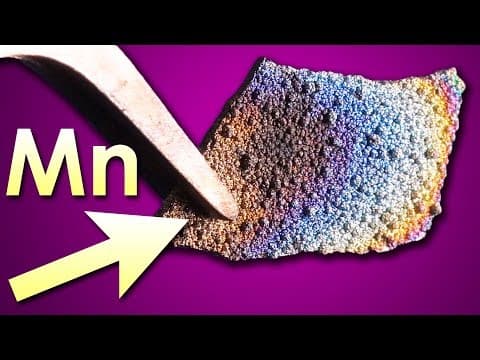
Manganese - A METAL, Which HEALS INJURIES!
Thoisoi2 - Chemical Experiments!
6m 26s896 words~5 min read
YouTube auto captions
Transcript source
YouTube auto captions
This transcript was extracted from YouTube's auto-generated caption track. The transcript below is server-rendered so it can be read, searched, cited, and shared without opening the original YouTube player.
Pull quotes
[0:07]In the periodic table of chemical elements, manganese is located in the seventh group, in the period of so-called transition metals.
[0:07]In nature, manganese is present in the composition of minerals pyrolusite, a manganese dioxide and brownite.
[0:07]Metallic manganese that is derived from these minerals does not particularly look like a metal.
[0:07]When heating a piece of manganese, at first it gets actively oxidized in the air, as evidenced by the iridescent layer of oxide film.
Use this transcript
Related transcript hubs
Watch on YouTube
Share
MORE TRANSCRIPTS


