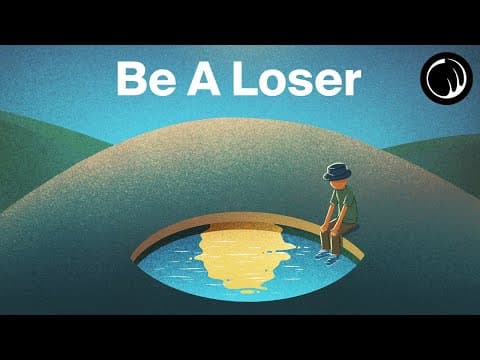
[0:00]This video is sponsored by the self care app, Fabulous. The first 100 people to click the link in the description will receive 25% off their subscription. We want to experience so much in life. We can often ignore and neglect the quality of what we actually experience. We are so often drawn to lifestyles full of busy schedules, active social lives, frequent travels, and elaborate goals and achievements. We end up in lives focused on all of these things, but very little on ourselves. The busy life is promoted to us by culture, in movies, in shows, the news, best-selling books, on social media, and so on. For much of the modern world, the ideal of this life is transfused into the blood. But is this way of life even good for you? Since often times, people who live very simple, modest, quiet lives are viewed as unexceptional, unsuccessful, losers, and so on. It can perhaps be hard to see a quiet, simple life of relative obscurity as something appealing, noteworthy, intentional, and difficult. But in truth, for at least some portion of us, this sort of life is in fact a redeeming endeavor, indicative of immense discipline and wisdom. "If a man does not keep pace with his companions, perhaps it is because he hears a different drummer. Let him step to the music he hears, however measured or far away," wrote 19th-century American transcendentalist writer and philosopher, Henry David Thoreau. Thoreau was a figure who focused much of his life and philosophy on the value of simplicity, self-reliance, authenticity, and separating from the influences and conventions of modern life. He not only wrote about these concepts, but he lived them. After avoiding the expected standard career paths and befriending the founding father of the transcendentalist philosophy movement, Ralph Waldo Emerson, for years, Thoreau lived by himself in a cabin in the woods on a plot of Emerson's land. Here, he led a simple, quiet, secluded life, focusing only on what he believed he truly needed and valued. He worked only one day a week, reduced his material possessions to a minimum, separated from the social and cultural world, immersed into nature, and focused on his passion of writing. During this time, he wrote his masterwork, Walden. In one passage of this book, he reflects on his time and reasons for living alone in the woods, writing, "I went to the woods because I wished to live deliberately, to front only the essential facts of life, and see if I could not learn what it had to teach, and not, when I came to die, discover that I had not lived. I wanted to live deep and suck out all the marrow of life." We all want to live a good life and be successful, but how often do we stop and evaluate what a good, successful life might be for us? How often do we consider not how it would look from the outside, but how it would feel from the inside, the only place it is actually experienced? Plainly, being successful merely means having adequately accomplished a predetermined goal or task. And so, arguably, being successful in life depends solely on having mindfully determined an overarching goal for how you want to live and then living adequately that way. Thus, those who live a quiet, modest, simple life are just as successful as someone who lives a busy and culturally significant one. So long as in both cases, both ways of life are intentionally pursued, both are equally successful when obtained. Only in the case in which someone is living unintentionally and without deliberation is one unsuccessful. Thus, even on the highest of thrones, the remotest of destinations, and the most private of rooms, we might just as likely find examples of failure as we might in a small cabin in the woods. Of course, some of us might find ourselves in conditions and circumstances we did not choose that cannot easily be broken free from. Conditions that come with financial, mental, or health constraints and responsibilities that require ways of life that we may not prefer. And of course, many of us do prefer busy, frantic, material lives. But for the number of us for whom this is not the case, if we choose to give up our time to people and things we don't value that take us from people and things we do, where a different, accessible orientation of our life would not require this, then perhaps we have ventured the wrong direction and would benefit from some amount of simplification or at the very least, a reasonable renovation of our lives. Inevitably, we all must give up some portion of our time to people, things, and tasks that we do not want to. But the essential question we must ask ourselves when we can is how much, why, and for what. We all know that time is the only commodity that cannot be earned or bought back when it is gone. And in a fundamental sense, it is the only thing we truly have. And yet, we often exchange it haphazardly for reasons we don't think much about. We would never let anyone take our money or our car or any of our stuff, but yet, we often freely let people and things and experiences take our time every day, month, year, and decade. And here is where we might call upon Thoreau, Emerson, and other great thinkers alike to realize the value of our deliberateness and focus on our time, our perception, and the internal experience of our lives, and not on things, other people's opinions, and that which we cannot control outside of our self. "In short," Thoreau wrote, "I am convinced, both by faith and experience, that to maintain one's self on this Earth is not a hardship, but a pastime, if we will live simply and wisely." Perhaps we don't always need to take that new job with those greater responsibilities, accept that invitation to that concert or that party. Go to that place we've seen everyone go. Keep as many relationships with as many people as we can, try to keep up with everyone we know and see online, or buy that new version of that new thing. Perhaps, rather, for some of us, we would be better served by focusing on how to draw down the items on the to-do list, the events on the calendar, the people we engage with, and instead, keep a relatively concise schedule with just a few important things and a few important people. In truth, an exciting life is a life in which we are excited to be alive, not necessarily one in which we are always frantically doing things. There is nothing impressive about living a life you do not like if you do not have to. And there is great virtue and heroism in simply staying sane, kind, spending meaningful time with the few close loved ones, and maintaining authenticity in one's work and life. Of course, none of this is to make light of the difficulty of doing such a thing and living such a way. Swimming against the current of social conventions, of personal and cultural expectations, of what you're currently doing, is like trying to get back to the shoreline while the force of the ocean's current pulls you further and further out to sea. And moreover, the ambiguity of what we actually want and what is actually good for us is always present. The temptation of the alleviation of responsibility by just letting the current take us and living how others live, defining success and excitement how others define it, spurs in every post on social media and intimates in every encounter in which we are asked, what do you do? But in the words of Thoreau, "Rather than love, than money, than fame, give me truth." To find truths and values, Thoreau looked to nature, independence, and the life of simplicity. But arguably, where we look is perhaps far less important than why we look where we do. It is in Thoreau's deliberateness that we should draw inspiration from, not necessarily his lifestyle. A successful life is not one filled with important meetings, active social lives, high wealth, or fame, but nor is it one reduced to its most basic form, filled primarily with free time and leisure. A successful life is simply a conscious one, one made of authenticity, self-reliance, and continual adaptation toward who we are and how we want to live. In the end, the only shame of being unsuccessful in life is being unsuccessful in living how you want to, the best you can.
[8:24]This video was sponsored by Fabulous. An essential part of simplifying and leading an intentional life is defining the basic things that we find important and then constructing habits and routines around those things so they stick. Somewhat ironically though, sometimes it's the simple, most important things that can be the hardest to do this for. Eating and sleeping well, exercising or meditating, staying hydrated, focused, and calm, all are about as basic and important as you can get. But yet, a great many of us struggle doing these things and understandably so, the modern world often demands more of us than there is to give. The self-care app, Fabulous, is like a digital coach that helps make the process of developing and sticking to an intentional life easier and more rewarding. By using science-backed principles and a range of functions and features, Fabulous helps you break down long-term goals into small tasks that build into consistent daily routines. You could pick from more than 100 habits or create your own, and then use Fabulous's notifications, tracking function, and other features to take a more self-guided approach. Or immerse into Fabulous's dedicated programs, behavioral change programs, and journeys for additional help in discovering and forming the best habits and methods suited to your long-term goals. Whether you're struggling with stress and would benefit from a habit of meditation or daily walks, want to sleep or eat better, or simply want to be more focused and consistent on your work. Fabulous provides a personalized and rewarding experience that can help turn just about any goal into a part of your regular daily routine. Start building your ideal daily routine today by clicking the link in the description below. The first 100 people to use the link will get 25% off their subscription. And of course, as always, thank you so much for watching in general, and see you next video.