[0:00]Hi everyone, welcome to Miss Adams Teachers English Language and Literature A-level. In this video, we are going to be taking a look at the extract from D.H. Lawrence's travel log, Sea and Sardinia. It's taken from the Voices in speech and writing anthology by Edexcel. We're going to take you through the content, some really exciting contextual factors, because D.H. Lawrence was a fascinating man. We'll do the usual going through genre audience and purpose, before we look at some key moments, thinking about how he sounds, for his voice, underpinning that with some analysis of literary and linguistic concepts. So let's get started.
[0:40]Okay, so let's have a bit of a chat about D.H. Lawrence, or David Herbert Lawrence. Uh, so he was around from 1885 to 1930, so very, very, very famous, very influential writer of the 20th century. Um, known for quite a lot of controversy. Now, this particular piece that we're looking at, Sea and Sardinia, an extract from his travel log, and it's uh whilst he was traveling from Sicily, where he did have a little home, uh to Sardinia. Um, and this period of time in his life, uh he was sort of exiled, I suppose, uh although, you know, it was, it was a sort of voluntary exile, but it was because of the kind of massive persecution that he was facing, um, back at home. And he called this exile a Savage Pilgrimage, which is a really interesting, um, phrase to use. I mean, there's a real jux to position between those terms, I suppose it's an oxymoron. A pilgrimage is obviously a, uh, a journey of worship, but savage has a kind of violent connotation, or certainly a kind of primal connotation. So perhaps it's less about the violence and more about exploring who you are and where you're from and almost like the roots of you, sort of fits with the D.H. Lawrence kind of style. So, um, as I said before, he was a very controversial writer of the 20th century. Um, I mean, quite shockingly, I mean, many of his books were banned. I mean, he wasn't just a novelist, he he wrote plays and poetries, uh, poetry as well. Now, his most famous novel Lady Chatterley's Lover was written a number of years after this. His wife Frieda actually kind of gave him the sort of power to write this incredibly, um, open novel about sexuality. Uh, and it was certainly banned and, you know, even after his death, uh it was still causing controversy, like Penguin Publishing, um, got sued, I think, for some, you know, published something obscene, I can't remember what the act was called obscene publications act or something like that in the 50s, uh for having published it. But even before then, yes, his work was quite, um, out there, I suppose, it pushed some boundaries, it was about relationships, uh, it it was about sex, it was about, you know, difficulties, you know, like, um, Sons and Lovers, for example, um, is is a, is a very interesting book that kind of looks at the sort of, it's very autobiographical, um, and looks at the sort of complex relationship of a mother who an overbearing mother who doesn't want to, there's a little kind of incestuous sort of feel to it all. Uh, but he was also controversial, because, uh he eloped with, uh, who ended up being his wife Frieda. Now she's a German woman, and she was married with children, and they ran off together, they didn't get married until 1914 after they'd run off. So that was pretty scandalous. Um, but when they went over to Germany, he got exiled from there, because they thought he was a British spy, and then guess what, when he came back to England, they accused him of being a spy for Germany.
[3:56:06]Um, so he was booted, um, from the UK as well.
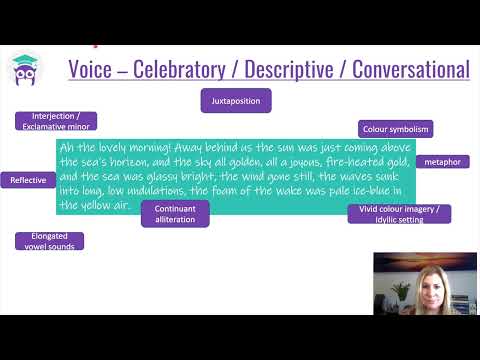
[4:35:04]Um, so, you know, he he was considered a a modernist writer. He looked at the idea of um, alienation, uh he looked at the idea of industry and the kind of damage of industry, and like I said before, um he also explored the idea of life and sexuality. So really, really interesting guy. Okay, so obviously, this is a travel log. It's a piece of travel writing, but you would not be wrong in thinking that it feels a lot like an autobiography. It's less full of facts and stats about the place that someone's going and it's more of a kind of cathartic expression of his own experiences whilst in this place. So in terms of our audience, for that reason, you can say that he's writing for himself. It's a reflection, it is cathartic, it's a place to express his his his feelings, uh, very intense feelings that he has. Um, obviously there is a public audience. I know that his following wasn't massive then. Um, but he did obviously still have fans, he is writing for publication, there is a crafting, uh, to this. You've got fans of D.H. Lawrence, people interested in travel writing and, uh, you know, particularly in Italy. Now, I've also said is it for, is is it for his critics, is it for his persecutors? Is it a sort of educating them about the kind of reality of his world and of his life? Um, I've said before, I I sort of almost makes me think of Deprofundus of Oscar Wilde. You know, yes, writing to the outside world and also writing to himself and writing to his critics to say, look, I am more than what you think I am. Something for you to ponder upon. Okay, so the voice in this, uh, text is, is, is very, very varied. It is very metaphorical, it's so expressive and there's a real movement in this little extract we're looking at. The first section actually is very mundane, it feels very trivial, it's certainly very anecdotal. And he's actually, this this is slightly more conventional of the travel log form, because he's giving us, uh, details about the conditions, particularly the weather. So we start off, obviously in first person, um, with a reflection on the the night that he has just had in terms of his sleep. I slept not so badly through the stifled rolling night. So you've got a little bit of litotes here here, uh, with I slept not so badly, so it's a kind of underwhelming sleep, isn't it? It's it's not great, it's not horrendous, so litotes gets that lovely balance. Um, and we do have a little bit of sibilance, uh, running through here as well. Um, but I think what's more interesting is the use of these adjectives, stifled rolling night. So stifled as an adjective obviously connotes that sort of idea of heat, it's claustrophobic, it's oppressive, and the rolling night, a metaphor, because it's actually the sea that is rolling, not the night itself. Um, suggests that there is a kind of a roughness, uh, to the weather and therefore a roughness to his night sleep. Um, and you get this sort of almost sense of little disbelief here through uh with our little hyphen and our adverbial, in fact, later on slept soundly. So that almost suggests that he's surprised that he managed to sleep. Then we get this growing sense of anticipation, um, part of that is because of the uh frontal coordinate conjunction there, quite conversational. The day was growing bright when I peered through the porthole, the sea was much smoother. So we've got some comparisons here, the sea was much smoother. So we've got comparative adjective, smoother, uh, intensified by the this little adverb here much. So we've got this uh, comparison with the time before, so we know that it has been a difficult night, and now hooray, it's a lot better. Um, declarative sentence, it was a brilliant clear morning. So again, this sort of little sense of pace here, he's excited to get up on board, so he makes haste, washes himself curtly in the saucer that dribbled into a pail in a corner, there was not space even for one chair, this saucer was by my bunk-head, and I went on deck. This little, um, coordinate clause that's been marked as a as a as a main clause, so I suppose you could call it a minor. It marks a transition, so we're about to get this shift in tone. something much more celebratory, and you can see that straight off through the interjection and the minor exclamative. Ah the lovely morning, like it's sort of hit him in the face. There's an immediacy about this and it's like he's talking to us, Ah the lovely morning. Away behind us the sun was just coming above the sea's horizon, and the sky all golden, all a joyous fire-heated gold. So let's just start there for a second. Okay, so we've got the, you know, it's the beginning of the day. We've got the sense of expanse because of the horizon. Uh this massive jux to position between space and lack of space in the previous paragraph. And we've got this color symbolism hitting in. The golden fire-heated gold, a little bit of repetition there as well. Obviously that color symbolism is all about value and worth and beauty. And then the kind of excitement of it is is is emphasized through the metaphor of it being fire-heated gold. Obviously emphasizes the heat as well as making the sun feel really sort of fluid in this moment. And the sea was glassy bright. So this adjective here glassy suggests that it's like a mirror, there's a sense of reflection. The wind gone still, sense of peace. The waves sunk into long, low undulations. Check out how he is playing with pace. He slows it right down after this sort of excitement, it becomes slow and relaxed. This is because one, we've got continuant alliteration with our L's, but we also have elongated vowel sounds, long, low undulations. It's all very low, um, slow, sorry, and drawn out. And then we continue this vivid color imagery creating a very, very kind of idyllic beautiful setting. So we've got the yellow air, so reminding us of the golden and the pale ice blue of the sea. And he does sound inspired by the world around him. He's he's living a little later than the romantic poets, but you can see the inspiration. You can see how he kind of emanates that kind of romantic style with the capital R. Um, still being very celebratory here. The lovely dawn, the lovely pure, wide morning in the mid-sea. So you've got obviously repetition of the adjective lovely, which speaks for itself. And in the earlier bit, I didn't I don't think I included it actually, we've already had the adjective wide being used, um, which again is about the idea of expansiveness. So we're being reminded, yes, it's beautiful, but it's also big. But we have the addition of this adjective pure, which suggests that it's innocent, that it's untainted, there's no corruption here, um, which makes you think, well, what is the corrupting force? And if you think about his kind of situation back in England, um, it's it's man, it's humanity, isn't it? So nature isn't corrupted by like the industry of the world. Uh, further personification uh further repetition, sorry, again, reminding us of the value through the adjective golden, and then we've got this lovely personification of the morning, that the morning is delighted. That the morning has a sense of joy in what it sees. With the sea like sequins shaking, beautiful sibilance, beautiful simile, and if you just imagine it in your head, so imagine sequins in the glitter and then the way that if they were shaking, think about how the light would kind of catch them and bounce off. So very beautiful, very vivid. And then we've got a little bit more repetition, and the sky far, far, far, far above, space, expanse, once more. Unfathomably clear. This impact of the adverb unfathomably. It's like he can't get his head around it, he can't get his head around the beauty and the space. Which leads him to express his joy once more, uh through more exclamative minors. How glad to be on a ship. What a golden hour for the heart of man. Big old chunky monkey metaphor, but it's very universal. He's saying anyone out here would have this experience. It's not just personal to him. Um, and again, check out repetition of golden once more. Okay, skipping ahead a little bit because not doing every single line. He's quite pensive here, um, he's certainly very poetic. So I mentioned the whole idea about prose poetry, you can really see it here. You've got another interjection. Ah, followed by a conditional phrase, if one could sail forever. So this is he starts to sound a little bit wistful, you know, the the the dream is being able to stay in this world of freedom. If one could sail forever, slight hyperbole, on a small, quiet, lonely ship. You've got a triad of adjectives again is about isolation, but it's a pleasing isolation. Peace comes with that isolation. Lonely is not a negative adjective here, it's a positive one. From land to land and isle to isle, so you've got really rhythmic phrasing, this is an element of that prose poetry coming along. And saunter through the spaces of this lovely world, always through the spaces of this lovely world. So this verb is what we're looking at here. When I say impact of the verb, sauntering suggests a slow movement, a kind of meandering, it's it's aimless, it's a wonder, it's slow, it's relaxed. So it's exactly what he's looking for. And what's interesting is the way then, when he says we're going to saunter through the spaces, again, expanse. Always through the spaces of this lovely world. This repetition of the whole, you know, phrase, always through the spaces of this lovely world. Obviously, uh, just giving us this little addition of the adverb here. It's about pace, by creating these long structures that repeat themselves, he is creating that meandering pace that sauntering, like we are sauntering through his sentences, it's blinking marvelous writing. Okay, continuing to be quite wistful, very emotive, very metaphorical, not to be clogged to the land any more. Notice how a lot of his constructions are minor, or, you know, fragmented, I should say. Um, it it feels very conversational and quite spontaneous. So we've got anaphoric structure, not to be clogged, not to be any more, and then we've got these metaphors, um, that are all to do with feeling trapped and burdened. So the idea of clogged to the land, that means sort of bound down, you know, locked to it. And then we have the analogy of being like a donkey, this simile, not to be any more like a donkey with a log on its leg. Again, this idea about being bound down, weighted, tied to the Earth, the Earth which is personified as being weary. He sees the Earth as tired, has having lost its light and its life. And this Earth, continuing the personification, has no answer now. It can it can give him nothing. So the fact that this pilgrimage, this savage pilgrimage, or an exile was voluntary, demonstrates to us, and it's echoed here, that he just doesn't feel that connection with land. It's it's being on land. And again, it's the world of industry, isn't it, in the Industrial Revolution and the busyness of cities. He connects to nature, which you get in this wonderful minor sentence, but to be off. You know, there's so much hope in that little sentence.
[19:09]And then our last little bit, which is just absolutely wonderful. So very, again, wistful, hopeful, very spiritual in nature, certainly metaphorical in tone. Everyone gets very excited at this point, because he seems to be longing for men in his life. To find three masculine, world-lost souls, and world-lost saunter, and saunter on along with them, across the dithering space, as long as life lasts. Now, yes, okay, you can get caught up in the sort of suggestions of D.H. Lawrence, um, having a homosexual relationship, earlier on, about four years before, I think it was 1917, supposedly, possibly with a farmer, we don't 100% know for certain. And yes, there are homoerotic undertones and overtones in some of his works. Yes, maybe he was bisexual. But when he's talking here about finding three masculine world-lost souls, I don't think it's about that. I think it's about this. It's about connection and understanding, because the repetition here about world lost. That's how he feels. He is world lost, you know, he's been exiled, he's been persecuted, and he's now searching for this kind of freedom. Um, he wants to be able to saunter, we've already discussed that verb, but clearly repeated once more, with people that understand him and understand his connection to nature. As long as life lasts, you know, big exclamative. I don't think that we need to be sitting there going, oh, poor Frieda. Because obviously, Frieda's on the boat with him, um, at this moment. Now, this section I think is absolutely marvelous in terms of metaphor. Why come to anchor? There is nothing to anchor for. So what we've got here is is an example of hypophora, where you pose a question and then you answer it. Okay, so you've got interrogative, declarative, but this in itself is hypophora, answering your own question. But anchoring, yes, you can take that literally. Why should I go back? Why should I anchor my boat? But it's more than that, it's almost synecdochy for for settling, you know, for for tying yourself. And again, we come back to this idea about the the Earth having no answers. He says there is nothing to anchor for. He sees no purpose in going back to that old world. And this is extended in this metaphor, this personification, land has no answer to the soul anymore. Note the way that everything is coming back to the soul, it's that kind of central self, it's so spiritual, it's almost metaphysical, um, in tone. He says that the land has gone inert. So, land has no strength, land has no power. The only thing that has power is nature, how very D.H. Lawrence. Then we get this marvelous sort of bit of commanding, you know, lots of imperatives. Give me a little ship, kind gods, and three world-lost comrades. Again, this repetition of the adjective world lost. Hear me, and let me wander aimless across this vivid outer world, the world empty of man, where space flies happily. Isolation, once more. He doesn't want, uh, other than than his three world lost comrades. When he says empty of man, he means big populations. He wants to have that sense of isolation and then you've got the lovely bit of metaphor and personification in the way that it's happy as it flies, where space flies happily. Again, it's freedom. This text is all about escaping the kind of rigid control and persecution of of of the kind of traditional world, uh, for D.H. Lawrence, you know, living in England, being judged in the way that he was. It's about taking solace in nature and exploring the notion of freedom, and I love it. And that's it for me. Um, sorry, I get overly enthusiastic about this piece. I've not gone through every line. If you've got any questions about bits that I haven't done, just come back to me, or check out my friend's page, Alise Faller, um, who has done a line by line, um, analysis of the text. Hope your revision is going well. Exams coming up soon. So I hope you're all, uh, working hard, but like I said, give me a shout if you need anything at all, I'm here. Happy revising.