[0:00]There was a time when people said that I was making things up. That Yazidis had nothing to do with India. That all the similarities that I showed in my old video, the peacock, the fire rituals, the tilak, were just coincidences. Some even called it fluff, speculation, stretching things too far. But what if I told you that in 2025 something has changed? At the Yazidis holiest temple, Lalish, a powerful cultural revival began. A spiritual resurgence. And among some of these Yazidi leaders and diaspora leaders, a name quietly began to circulate. Kartikstan. Not Kurdistan, not Yazidistan, but Kartikstan. A name inspired by Lord Kartike, the son of Shiva. The same Kartike who rides a peacock, who is worshipped in Tamil Nadu, Sri Lanka and among ancient tribal cultures across India. Today they are visiting Murugan temple in India, lighting lamps, meeting saints and reconnecting with what they say as their ancestral roots. They have even appealed to India to raise its voice at the United Nations to stand for Yazidis. Not as outsiders, but as distant cousins of the same ancient fire. This isn't about forgotten history anymore. This is about living memory coming full circle. And a name Kartike that somehow survived genocide, exile and time. They say that when a civilization forgets its past, it loses its future. But what happens when the past refuses to be forgotten? In the remote valley of Northern Iraq, lies the sacred Yazidi temple of Lalish. It's not a grand marble structure, it doesn't feature in UNESCO's list. But for the Yazidis, a community that has faced repeated genocides, Lalish is more than a temple. It's the heart of their identity. And inside its stone walls, there are rituals and symbols that seem oddly familiar, especially to Indians. Visitors to Lalish have often remarked on the flame that has always kept burning, on the oil lamps lit during prayers, on the reverence for fire, the use of tilak-like marks on the foreheads and bowing their heads towards the flame, not away from it. These aren't coincidences. They mirror ancient Indian spiritual traditions, especially those found in Shaivism and Murugan worship in South India. There's one account that left many people stunned. When Indian spiritual leader Shri Shri Ravi Shankar visited Lalish, he noticed something unexpected. As he walked through the temple, he reportedly came across a painting, a modest one, not ancient, but clearly integrated into the temple space. It showed a woman in a saree, holding a lamp, praying to a figure seated on a peacock. Curious Shri Shri Ravi Shankar asked that who is this woman? Why is she here? And the answer he received was quiet, but powerful. They said that she is one of us. She prays to the one we remember, Kartike. Now pause and think about that. Kartike, also known as Murugan, the son of Shiva, is not a deity worshipped in the Middle East. Peacocks do not roam the hills of Iraq. But for the Yazidis, the central divine figure is Melek Taus, the peacock angel. A radiant being born from light, riding a peacock and seen as guardian of truth and fire. In the Yazidi faith, Melek Taus refuses to bow to any force that wasn't divine truth. And for that, he was exiled, just like Kartike, who chose war, fire and righteousness over comfort and submission. Now let's break that down. South India, peacock worship, fire rituals, a deity born of Shiva. It all begins to form a pattern. Long before stone temples were built in India, the hills and forest of Tamilakam were home to ancient tribes who worshipped Murugan. These weren't mainstream Vedic priests. These were warrior clans, tribal chieftains and poet philosophers who saw Sevel or Velm, the red one with the spear as their guardian God. One such clan was the Adiyaman dynasty, who ruled from Tagadur, today's Dharampuri. For them, Murugan wasn't just a deity. He was an identity. The very embodiment of courage, clarity and spiritual light. Now compare this to the Yazidis. They believe in Melek Taus, a being of light who leads an army of angels. He is their protector, their source of moral strength and the keeper of divine knowledge. Just like Murugan, Melek Taus never bowed to deception. He chose exile over compromise. He stands for righteousness in the world that often forgets it. Their rituals are just as tellings. The Yazidis light lamp before prayer, apply oil or sacred ash to their forehead, face the sun while praying, bow to fire as sacred, believe in cycles of rebirth and purification. These aren't superficial similarities. These are civilizational echoes. And in recent years, Yazidi pilgrimage has actually visited Murugan temple in Tamil Nadu. Not out of curiosity, but out of reverence in cities like Coimbatore and even in small shrines nestled in the hills, Yazidis have lit lamps, bowed their heads and stood shoulder to shoulder with Hindu priest. As if someone is returning to their place, a land that was long forgotten, but somehow familiar. It was after these cultural and spiritual reconnections that some Yazidi voices online began to use a powerful term. Kartikstan. As a symbolic idea. A prospered identity of their cultural reverence. A proposed identity of their cultural revival. A name that represents both their suffering and their survival. A name that doesn't point to colonial borders or recent history, but to something deeper, something older. Because for a people who have survived genocide, exile and erasure, it is the memory that defines them. And the memory of Kartike, the peacock, the fire, the light has refused to die. The Yazidis have cried out for help many time. And most of the world has looked away. When ISIS attacked them in 2014, burned homes, addicting girls, executing families, it was declared a genocide. But after the headlines faded, so did the support. The UN passed resolutions, governments gave statements. But what Yazidis truly needed was someone to stand with them. Not as charity, but as kin. And while global powers stayed quiet, something unusual happened. India listened. Leaders like Mirza Ismail came to India, not just to raise awareness, but to rekindle an ancient connection. He met spiritual leaders, saints and scholars. He explained how the Yazidis, despite centuries of persecution, still preserved the same sacred fire, the same forehead markings, the same reverence of the divine peacock. Symbols that India has known for thousands of years. Because India doesn't need to imagine who the Yazidi are. It already knows. Somewhere deep down, it remembers too. Indian spiritual organizations began helping Yazidi refugees. It was a message to the world. But more importantly, it was a message to India. Because if a small persecuted community half a world away still remembers Kartike, then maybe it's time that we remember them too. Civilizations fall, temples collapse, languages fade. But some memories refuse to die. For us a God, for them a Guardian, and for both a light that never went out. From the ashes of genocide, from the quiet hills of Lalish, the Yazidis are telling the world something profound. They are saying that they still remember him. They still remember where they came from. They aren't asking for pity, they aren't asking for rescue. They're asking to be seen by the one land that once shared their fire. India, if you have come this far, maybe you feel it too. That this isn't just their story. This is our story. Split by time, separated by land. But never broken. So if this story moved you, if Kartikstan now feels like more than a name, watch our first video on Yazidis. Where we first uncovered these forgotten roots. And subscribe to this channel. Because this is just the beginning of civilization that refused to die. Of memories that couldn't be erased. And of voices that are finally being heard. This is it from my side. This is Harry signing off. Let's stand with our Yazidi brothers and keep the flame alive. Stay curious.
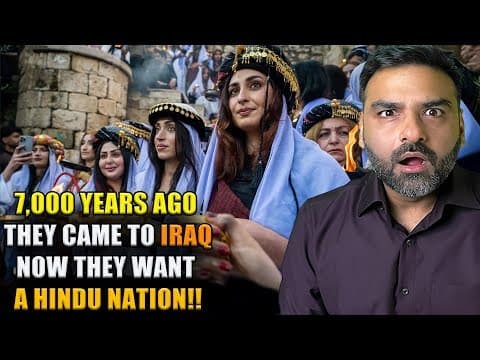
Why Yazidis Are Claiming Hindu Roots in Iraq
Harry Sahota
10m 35s1,347 words~7 min read
YouTube auto captions
Transcript source
YouTube auto captions
This transcript was extracted from YouTube's auto-generated caption track. The transcript below is server-rendered so it can be read, searched, cited, and shared without opening the original YouTube player.
Pull quotes
[0:00]That all the similarities that I showed in my old video, the peacock, the fire rituals, the tilak, were just coincidences.
[0:00]And among some of these Yazidi leaders and diaspora leaders, a name quietly began to circulate.
[0:00]The same Kartike who rides a peacock, who is worshipped in Tamil Nadu, Sri Lanka and among ancient tribal cultures across India.
[0:00]Today they are visiting Murugan temple in India, lighting lamps, meeting saints and reconnecting with what they say as their ancestral roots.
Use this transcript
Related transcript hubs
Watch on YouTube
Share
MORE TRANSCRIPTS


