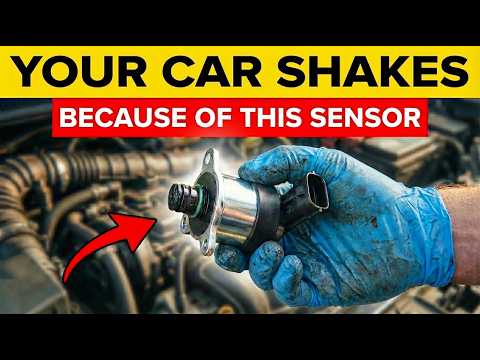
[0:00]Here is the truth nobody is telling you. Nine times out of ten, when a car shakes or vibrates, it is not a mechanical problem, it is a sensor problem. A dirty, failing, or miscommunicating sensor that is feeding your engine the wrong information, and your engine is reacting exactly the way you would expect, by running rough, misfiring, and shaking. In this video, I am going to walk you through 10 sensors that are most likely causing your car to shake. We are going from the least likely to the most likely, so stay until the end. Because sensor number 10, that one is responsible for more shaking, more wasted fuel, and more engine damage than almost any other part on your car. And the fix costs less than $10. Let's get into it. The first sensor on our list is the throttle position sensor, or TPS. Think of your throttle as the door between fresh air and your engine. Every time you press the gas pedal, that door opens a little more. The throttle position sensor is the device that tells your engine's computer exactly how far that door is open, so the computer knows how much fuel to inject. When the TPS gets dirty or starts to fail, it sends inconsistent readings. Your computer thinks the throttle is at 30%, when it is actually at 50%. So it injects the wrong amount of fuel. The mixture is off, the combustion is uneven, and you feel it as a hesitation or light vibration, especially when you first press the gas pedal after a stop. The vibration from a TPS problem is usually subtle. It feels more like a stumble or a hesitation than a full shake. You will notice it most during gentle acceleration, not at highway speeds. To check your TPS, the easiest method is to use an OBD2 scanner. That is the small device you plug into the port under your dashboard. Look for code P0121 or P0122. Those codes are your TPS telling you it is struggling. If no codes appear, but you still feel that hesitation, you can try cleaning the sensor with electronic contact cleaner spray. It is available at any auto part store for about $5. Remove the sensor carefully, spray the contacts, let it dry completely, and reinstall. Now, the TPS is a common culprit for hesitation. But if your car shakes hard, especially at idle, the sensor responsible is probably not the TPS. Keep watching because things are about to get more serious. Sensor number two is the crankshaft position sensor, also called the CKP sensor. Your crankshaft is the main rotating shaft inside your engine. Every time a cylinder fires, it pushes a piston down, and that piston rotates the crankshaft. The crankshaft position sensor monitors the exact speed and position of that crankshaft thousands of times per minute. Your engine's computer uses this information to time the spark perfectly. Fire the spark a fraction of a second too early or too late, and you get incomplete combustion. Incomplete combustion means uneven power strokes. Uneven power strokes mean your engine is not running smoothly, and you feel that as a vibration. A failing CKP sensor can cause anything from a subtle vibration at idle to a full misfire that shakes the entire car. In severe cases, the car will not start at all, because the computer has no idea where the crankshaft is in its rotation. The telltale sign of a CKP problem is a vibration that comes and goes randomly, often getting worse when the engine is warm. You might also notice the engine stalling unexpectedly, or taking longer than usual to start. Common fault codes are P0335 and P0336. If you see either of those, your CKP sensor needs attention. Cleaning the CKP sensor is straightforward. It is usually located near the bottom of the engine block, close to the crankshaft pulley. Remove it, clean the tip with electrical contact cleaner,
[3:58]check for any physical damage, and reinstall. Make sure the gap between the sensor tip and the reluctor ring is correct for your vehicle. Your owner's manual will have that specification, but here is what you need to know. The CKP sensor is important. But the sensor coming up next can cause an almost identical problem, and most people never think to check it. Sensor number three is the camshaft position sensor, or CMP sensor. If the crankshaft is the bottom half of your engine's timing system, the camshaft is the top half. The camshaft controls when the intake and exhaust valves open and close. The camshaft position sensor tells your computer the exact position of the camshaft, so it can coordinate valve timing with the spark and fuel injection. When the CMP sensor starts failing, your engine loses the ability to synchronize those three things precisely. The result is incomplete combustion in one or more cylinders, and that translates directly into rough running and vibration. One of the most common symptoms is a vibration that appears only at certain engine speeds. Your car might idle fine, but shake noticeably at 40 or 50 miles per hour, or it might shake at idle, but smooth out once you get moving. That inconsistency is a classic CMP sensor signature. Look for diagnostic codes P0340 through P0344. Those all relate to camshaft position sensor circuit problems. The CMP sensor is typically located near the top of the engine, close to the camshaft. Cleaning it follows the same process as the CKP sensor. Remove, clean with contact cleaner, inspect for damage, reinstall. Now I want to ask you something. Has any of this already matched what you are experiencing with your car? If it has, drop a comment below and tell me what your symptoms are. You would be surprised how many people have been chasing the same problem for months, and the answer is right here in this list. Speaking of which, the next sensor on our list controls something your engine desperately needs every single second it is running. And when it goes wrong, it goes wrong in a very specific way. Sensor number four is the manifold absolute pressure sensor, commonly called the map sensor. Your engine's intake manifold is the pathway that channels air into each cylinder. The map sensor measures the air pressure inside that manifold. Your computer uses this pressure reading to calculate how much air is entering the engine at any given moment, and from that, it determines how much fuel to inject. Here is a simple way to think about it. Imagine you are baking bread. You need a precise ratio of flour to water. Too much water and the dough is a mess. Too little and the bread falls apart. Your engine is the same. The map sensor is what measures the flour. If that measurement is wrong, the recipe fails. A dirty or failing map sensor typically causes a lean condition, meaning too little fuel for the amount of air entering the engine. Lean combustion is hotter, less stable, and more prone to misfiring. You will feel this as a rough idle, and sometimes a vibration under load, like when you accelerate up a hill. Fault codes to watch for are P0106 through P0109. You might also see general misfire codes like P0301 through P0308, which indicate which specific cylinder is misfiring. The map sensor is often located on or near the intake manifold. It is usually held in place by one or two screws, and connected by a small vacuum hose. When cleaning it, pay special attention to that vacuum hose. A cracked or disconnected hose will cause the exact same symptoms as a failing sensor, and it is something you can fix for free. We are now at sensor number four, and you have probably noticed a pattern. Every one of these sensors affects fuel delivery or ignition timing, and when fuel or timing is off, vibration is the result. Keep that in mind, because the sensors coming up hit those same systems, but with much greater force. Sensor number five is one you have probably heard of. The oxygen sensor, also called the O2 sensor. Your car likely has two, three, or even four of them, positioned in the exhaust system before and after the catalytic converter. Their job is to measure how much oxygen is left in the exhaust gases after combustion. Too much oxygen means the engine ran lean. Too little means it ran rich. Your computer uses this feedback to continuously adjust the fuel mixture hundreds of times per minute. When an oxygen sensor fails or gets contaminated by oil or coolant, it sends incorrect feedback to the computer. The computer then over corrects the fuel mixture. You end up with a fuel delivery that is constantly swinging between too lean and too rich, instead of staying in the ideal range. Engineers call this a hunting condition, and it feels exactly like what it sounds. Your engine seems to be hunting for the right power level, causing a rhythmic roughness or vibration. O2 sensor problems are usually more noticeable during light throttle conditions, like cruising at steady speed. You might also notice a drop in fuel economy, because the computer is burning extra fuel trying to compensate. The most common fault codes are P0130 through P0161. A failed oxygen sensor will almost always trigger the check engine light. Oxygen sensors are designed to last around 60,000 to 90,000 miles in most vehicles. If your car has high mileage and you have never replaced them, they could be contributing to your vibration problem even without a fault code. If this video is already giving you answers that your mechanic missed, hit that like button right now. It genuinely helps more people with this exact problem find this video. Now, let us move to sensor number six. This one has a twist that surprises most people, because it does not seem related to vibration at all, until you understand how it works. Sensor number six is the coolant temperature sensor, or CTS. Here is where things get interesting. Most people think the coolant temperature sensor only affects the temperature gauge on your dashboard. It does much more than that. Your engine's computer uses coolant temperature data to adjust almost every aspect of engine management. When the engine is cold, the computer runs what is called an enriched mixture, meaning it adds extra fuel to help the engine warm up and run smoothly in cold conditions. As the engine warms up, the computer gradually leans out the mixture to the normal operating ratio. When the CTS fails or sends incorrect readings, the computer does not know the engine has warmed up. So it keeps running that cold start enriched mixture indefinitely. Too much fuel, incomplete combustion, carbon deposits forming inside the cylinders, and a rough, vibrating idle that never goes away. The opposite can also happen. A sensor that reads hotter than the engine actually is, will cause the computer to run too lean too soon, causing the same rough running and vibration, but also risking engine damage from lean combustion at low temperatures. Watch for fault codes P0115 through P0118. You might also notice that your car runs rough for the first few minutes after starting, then gradually smooths out. That is a classic sign that the CTS is reading incorrectly during warm-up. The CTS is typically located near the thermostat housing, screwed directly into the engine block or cylinder head, where it can contact the coolant. It is a relatively inexpensive sensor, usually between $15 and $40, and replacing it is a straightforward job on most vehicles. You are now more than halfway through this list. The sensors we have covered so far are all legitimate causes of vibration. But from here on, the probability goes up significantly. The next sensor controls something that directly determines whether each cylinder fires cleanly or not. Sensor number seven is the idle air control valve, or IAC. On modern vehicles with electronic throttle control, this function is handled by the throttle body itself, but the principle is the same. When your car is idling, your foot is off the gas pedal. The throttle is essentially closed. So how does the engine continue to run? It runs on a small, precisely controlled amount of air that bypasses the closed throttle plate. The idle air control valve is what regulates that bypass air. The computer uses the IAC to maintain a steady idle speed regardless of engine load. When you turn on the air conditioning, the computer compensates by opening the IAC slightly to add more air and prevent the engine from stalling. When the engine is cold and needs a higher idle to warm up, the IAC opens further. When the IAC gets dirty, and it gets dirty frequently, because it handles air that contains oil vapor and carbon particles. It cannot maintain a steady flow of bypass air. The idle speed fluctuates. Sometimes the engine gets too little air and starts to stumble. Sometimes it gets too much, and the idle surges. This constant fluctuation produces a very distinct symptom, an idle that hunts up and down, combined with a vibration that you feel most strongly, when the car is stopped at a red light. This is one of the most satisfying sensors to clean, because the results are usually immediate and dramatic. Remove the IAC, which is typically mounted on the throttle body, and clean it thoroughly with throttle body cleaner spray. Clean the passage it sits in as well. Carbon buildup in that passage is often the real culprit. Fault codes P0505 and P0506 relate specifically to idle control system problems. If your mechanic never explained this to you, you are not alone. Subscribe right now because this channel exists specifically to give you the mechanical knowledge that most shops assume you do not need to know. We have three sensors left, and from here the damage potential goes up sharply. Do not skip ahead. Sensor number eight is the fuel pressure sensor, also called the fuel rail pressure sensor on direct injection engines. Your fuel system maintains a very precise pressure inside the fuel rail, the metal tube that feeds fuel to your injectors. Too little pressure, and the injectors cannot deliver enough fuel, causing a lean misfire. Too much pressure, and the injectors over deliver, flooding the cylinders and causing a rich misfire. Either way, the result is the same, incomplete combustion, and vibration. The fuel pressure sensor continuously monitors this pressure and reports it to the computer, which then adjusts the fuel pump speed to maintain the correct pressure. When this sensor fails or gives inaccurate readings, the computer cannot regulate fuel pressure correctly. The vibration caused by fuel pressure problems tends to be more pronounced under load, meaning when you accelerate, especially from a stop, or when merging onto a highway. You might also notice the engine feeling sluggish or hesitant, like it is not getting enough power even when you press the pedal all the way down. On modern turbo charged engines, this sensor is especially critical because turbo engines operate at much higher fuel pressures than naturally aspirated engines. A small error in the pressure reading can have a much larger effect on performance. Fault codes P0190 through P0193 are associated with fuel rail pressure issues. Before replacing the sensor, have the actual fuel pressure tested with a mechanical gauge. If the pressure is correct, but the sensor is reading it wrong, you have a sensor problem. If the pressure itself is low, you might have a fuel pump or fuel pressure regulator issue instead. Now we are entering the final two sensors. These are the ones that cause the most vibration, the most damage, and the most unnecessary repair bills. If you know someone whose car is shaking right now, share this video with them. You could save them a lot of money and a lot of frustration. Sensor number nine is the knock sensor, and this one has a reputation for causing some of the most damaging vibrations of anything on this list. Engine knock, also called detonation or pinging, is what happens when the fuel air mixture in a cylinder ignites before the spark plug fires. Instead of a controlled, even burn that pushes the piston smoothly downward, you get an explosive, uncontrolled ignition that hammers the piston from the wrong direction at the wrong time. That hammering is what you sometimes feel as a metallic rattling or pinging sound from the engine. And if it happens repeatedly, it destroys pistons, connecting rods, and bearings. The knock sensor is a small piezoelectric device mounted directly on the engine block. It listens for the specific vibration frequency of engine knock, and when it detects it, it signals the computer to retard the ignition timing slightly, which stops the knock from occurring. When the knock sensor fails or gets damaged, it can do one of two things. If it stops working entirely, your engine has no protection against knock. The computer keeps advancing timing for maximum power, knock occurs, and you feel that distinctive metallic vibration, along with a shaking that gets worse under load. If the sensor fails in a way that makes the computer think knock is always happening, the computer retards timing too aggressively, and your engine loses power and runs roughly. Both failure modes cause vibration. One of them also causes internal engine damage that accumulates silently over time. Fault codes P0324 through P0327 are your knock sensor codes. If you see those, do not ignore them. The knock sensor is usually located on the side of the engine block, sometimes buried under the intake manifold. On some engines, replacing it requires significant disassembly. This is one case where a professional diagnosis might be worth the investment before diving in. So we have reached the end of the list. You have learned nine sensors, each capable of causing your car to shake. But everything we have covered so far has been building toward this last one, because sensor number 10 is the one that causes the most vibration, affects the most vehicles, and is the most overlooked sensor in automotive maintenance, and it can be cleaned at home today for under $10. Sensor number 10 is the mass air flow sensor, the MAF sensor. This is it. This is the sensor that is most likely causing your car to shake right now. Here is why. The MAF sensor is positioned directly in the path of all the air entering your engine. It measures the exact mass of air flowing in at every moment. Your computer uses this measurement as the primary input for fuel injection calculations. Every single time your engine fires, the fuel injector opens for a duration calculated based on what the MAF sensor is reporting. When the MAF sensor is dirty, and it gets dirty slowly over time from microscopic oil particles and dust that bypass the air filter, it under reports how much air is actually entering the engine. The computer thinks less air is coming in than actually is. So it injects less fuel than the engine actually needs. This creates a lean condition in every cylinder simultaneously. The result is not a single misfiring cylinder like with some of the earlier sensors. It is a global engine-wide misfire condition. Every cylinder is running lean. The combustion is weak, uneven, and incomplete. And you feel this as a persistent whole body vibration, that is present at idle, gets worse under load, and often comes with a noticeable loss of power and fuel economy. Here is the part that makes this sensor so dangerous. A dirty MAF sensor almost never triggers the check engine light. The computer can compensate for a slightly dirty MAF by increasing fuel trim, meaning it adds a little extra fuel on top of what the sensor suggests. This compensation keeps the engine running well enough to avoid throwing a fault code, but it is a bandaid. The underlying lean condition is still stressing your engine, and the compensation itself wastes fuel. Many vehicles with dirty MAF sensors will show long-term fuel trim values above +10%. If your OBD2 scanner shows that, your MAF sensor is almost certainly dirty. Now here is the good news. Cleaning a MAF sensor is one of the easiest maintenance tasks you can do. You will need a can of MAF sensor cleaner spray. Not throttle body cleaner, not brake cleaner, it must say MAF sensor cleaner on the can. This is important because MAF sensors contain extremely delicate hot wire or hot film elements that can be permanently damaged by the wrong chemicals or by touching them. Locate the MAF sensor in the air intake tube between the air filter box and the throttle body. It is held in place by two screws and a wiring harness connector. Remove the connector and the screws. Take the sensor out carefully. Spray the cleaner directly onto the sensing elements, which are the fine wire or film inside the sensor housing. Do not touch them. Do not wipe them. Just spray and let them air dry completely for at least 15 minutes before reinstalling. That is it. That simple process can eliminate the rough idle, reduce the vibration, restore lost power, and improve your fuel economy, all for the price of a can of spray. If your car has more than 60,000 miles on it and you have never cleaned the MAF sensor, there is an extremely high probability that it is contributing to any vibration you are feeling right now. So let us bring this together. You now know the 10 sensors most likely causing your car to shake. Starting from the throttle position sensor and working through the crankshaft, camshaft, map, oxygen, coolant temperature, idle air control, fuel pressure, and knock sensors, all the way to the one that matters most, the mass airflow sensor. Most of these can be cleaned at home with basic tools and a can of spray cleaner. None of them require a mechanic to diagnose if you have a simple OBD2 scanner. And understanding them puts you in control of your vehicle, instead of at the mercy of a repair bill you cannot question. Here is what I want you to do right now. If your car is shaking, start with the MAF sensor. Clean it today. Give it a week and see if the vibration improves. If it does, leave a comment below and tell me. Those comments help other people with the same problem know that this works. If the vibration is still there after cleaning the MAF, work your way back through this list. Check the knock sensor codes. Check your fuel trim values. Check the idle air control valve. The answer is in this video. If this information helped you, please subscribe. This channel is built for car owners who want real answers without the runaround. And share this video with someone you know whose car is shaking. You never know. You might save them a thousand dollars.


