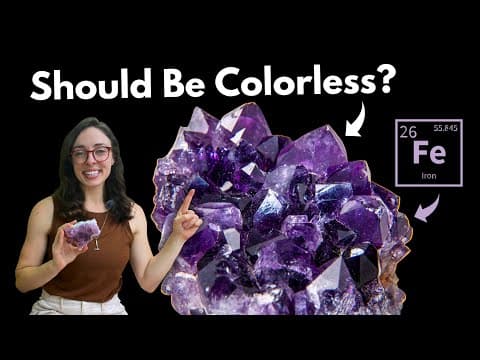
[0:00]What gives rocks and minerals their beautiful colors? Minerals like quartz, amethyst, citrine, obsidian, shirt, even beautifully banded agate are all made of silicon dioxide, or what we call silica.
[0:16]So why are they all different colors? Actually, silica in its purest form should be colorless like glass, hence why glass, surprise, surprise, is made of silica. So why are these natural silica minerals not colorless? Well, it's due to tiny trace amounts of impurities present in the mineral. Most often, transition metals like iron. And I promised in a video an embarrassingly long time ago that I would make a follow-up video to explain what it is about metals that allows them to create such stunning colors. And I'm finally doing it. So let's get into it. It essentially all comes down to electrons. Transition metals like iron, chromium, titanium, copper, manganese, and cobalt, have these special electron orbitals that we call D orbitals, and that's where the magic happens. When light hits a mineral, its atoms interact with that light. And in minerals that contain transition metals, light can excite the electrons in the D orbitals of those metal ions. And for an electron to jump from a lower to higher energy level, it absorbs a specific wavelength of light. And the color that we see that the mineral appears to us is actually the opposite or the complement color to this wavelength that it absorbs. In other words, all of the wavelengths of light that are either reflected or transmitted by the mineral instead of absorbed are what we see. So for example, Amethyst, which is essentially purple quartz, contains iron that absorbs greenish, yellowish light wavelengths. So we see it as purple. The wavelengths of light that aren't absorbed, the ones that are reflected or transmitted. And like Amethyst, citrine also contains iron, but since its iron is in a slightly different arrangement and different oxidation state or electronic state. It absorbs blue and violetish wavelengths, causing it to appear orangey yellowish. So different metals and even different oxidation states of the same metal can cause different colors in minerals. And it's all because they have different energy gaps between their D orbitals. In other words, there are electrons at the lower energy state require different amounts of energies or wavelengths of light to excite them to the higher energy state. The most common color causing transition metals include iron. In fact, I think my friends that I go to the field with probably get annoyed with me because every time there's a question of why a rock is a certain color, whether it be green or bluish, purplish, yellowish, or pretty much any shade of red. My answer is always the same. It's because of iron. Iron is most often what you see at earth's surface. Iron is probably the reason for the color, but there are some exceptions we'll go through some of those later in the video. And other common color causing metals include manganese, which can cause pink or purple, chromium, which typically causes greens, copper, which is typically associated with blues and greens, and titanium and cobalt, which typically cause shades of blue. And it's not always just one metal causing the color in a given mineral or rock. Sometimes it's multiple metals and impurities that are causing a combination of effects that lead to the color or blended colors in a mineral or rock. But why can't non-metals cause fun colors? Don't atoms like silicon and oxygen have electrons that can get excited, too? Well, the D orbitals are key. Not all elements have D orbitals of electrons, which affects that energy gap we were talking about earlier. So here's the breakdown. Silicon and oxygen bonding involves S and P orbitals of electrons, but not D orbitals. And the energy gaps or the difference in energy between filled and empty orbitals, are very large in the silicon oxygen bonding molecular environment, too large to be excited by visible wavelengths of light. Instead, they absorb in the ultraviolet or UV wavelength. So since no visible light is absorbed, no visible color is produced. But transition metals like iron, manganese, chromium, cobalt, all the things we just talked about, have partially filled D orbitals. And in a mineral structure, these metal ions often become surrounded by other atoms like oxygen, creating crystal fields. And this splits the D orbitals into slightly different energy levels. And these energy gaps are just the right size to correspond to visible wavelengths of light. So in short, when it comes to creating colors in minerals, size matters. Size of the energy gap between electronic states, that is. And fun fact, transition metals don't just create beautiful colors in minerals. They can also make liquids really cool colors. This is something I got to interact with a lot in grad school when I worked with a lot of dissolved molybdenum and iron compounds, which was super cool. I had bright orange liquid containers all over my lab. And another fun fact is if you think about everything we've mentioned thus far in the video, how light has to interact with the mineral to excite the electrons, which creates the color. This means that if I were to put this Amethyst into a dark room with no light penetrating, it would technically not be purple anymore. But now we're getting into kind of the philosophical realm of if a tree falls in the forest, so let's move on back to the regular old science. All right, so metal impurities cause colors in minerals, but it turns out that this isn't the case for all minerals. Sometimes color is caused by structural defects or even radiation damage. For example, color centers, which are structural defects in a crystal lattice where an electron or ion is missing or out of place, can also cause color. Smoky quartz, for example, gets its brownish, smoky color from radiation induced color centers. So sometimes it's chemical impurities, sometimes it's structural, sometimes it's radiation damage, sometimes it's a combination of all of those or some of those. But let's finally get to the part of the video that I know you all have been waiting for. The information that will allow you to be that annoying friend on the hike that stops at every rock to tell everyone why it's that color. Let's run through some of the most common minerals at Earth's surface and why they look the way they do. First, we'll start with the classic quartz. Quartz is colorless when pure, but varieties like amethyst and citrine get their color from iron, like we talked about earlier. Feldspars like potassium feldspar can be pink to whitish depending on its structural disorder and trace amounts of iron. Actually, it's a common misconception that potassium feldspar, K spar, or K feldspar, gets its pinkish color from potassium. I actually was also under this impression until I started to do the research for this video. I was taught that potassium was the reason Kspar was pinkish, but apparently, that is a common misconception, it's actually structural disorder in the aluminum silicate structure, and sometimes trace amounts of iron. Next, we have Olivine, which is one of my favorites. It's green. My mom, who's also a geologist, always had the same whenever we went out into the field that all that's green is Olivine. And that is oftentimes true, sometimes not, but a lot of the times all that's green is Olivine. And I Olivine is my favorite mineral. I actually have it right here in this ring, as well as in all of these samples here. And Olivine is green due to iron, and you can actually see the beautiful variations in deeper, darker, versus lighter greens in different crystals of the Olivine and these samples here. And that's just due to a combination of iron content. So the amount of iron in each crystal, as well as the slight variations in oxidation state or electronic state of the iron in each crystal. But green isn't always due to iron. In fact, my second favorite mineral, Malachite here is green due to copper. Now this isn't as common as the silicate minerals here. It's actually a carbonate mineral, but it is green due to copper and it's it's one of my favorites. But next we have garnets, which can also be green, but garnet can actually also be red, pink, orange, pretty much anything under the sun. It's funny because we often call this kind of deep reddish color garnet, because there's a lot of garnet that is deep red, but there's so many varieties that have different colors. And it's because garnet has actually a really complex kind of composition and structure that allows for the presence of a lot of different metals, including iron, chromium, manganese, etc., that lead to lots of different colors. And finally, pretty much anything we find in the field that's red or kind of a rusty red color is typically due to iron. Specifically oxidized iron, hence rust, rust is just oxidized iron. So anything that looks rusty in the field is also probably rust in some form or oxidized iron in some form. And sometimes it can make just the most beautiful shades of red. Actually, one of my favorite samples is this petrified wood sample. The petrified wood is silica in composition, but it's got these beautiful colored bands in it, and that red color is due to iron. But knowing what causes these minerals to be these amazing colors isn't just fun for rock collectors. It's also pretty useful when we're trying to interpret the conditions in which a rock or mineral formed. Like I mentioned, oftentimes red indicates an oxidizing environment, an oxygen rich environment that oxidizes the iron in the mineral. Whereas greens and purples sometimes can indicate more reducing or less oxygen rich environments, sometimes even oxygen poor or anoxic environments. But anyway, I hope you enjoyed learning about colorful minerals in this video and finally hearing the answer to the question that was asked in so many videos ago, and I'll pop up the videos that inspired this question and this follow-up video, uh, up here on the screen somewhere. But with that, guys, thank you so much for watching, and I'll see you in the next one. Bye.


