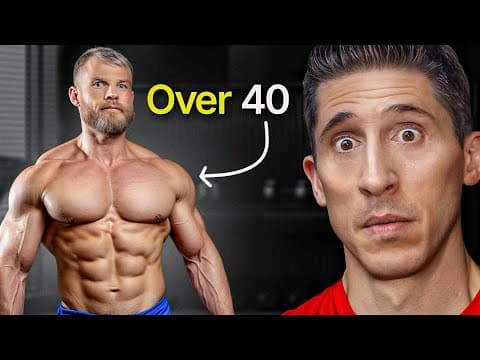
[0:00]I'm going to take some people off today, Jesse. Oh boy, here we go. Today we have a question that kind of kicked this all off. You probably already know where we're going with this. Jesse, read the question, please. So this is from Bob Stryker, 1979. Hey Jeff, I'm 46 years old and have been working out regularly for the last 10 years, but I'm feeling lost. I've made some good progress for sure, but I saw a Joe Rogan interview with David Goggins, but I couldn't help but get discouraged when I saw how good they looked and what great shape they're in, and they're both over the age of 50. They had to be taking something, right? I feel like there's no way you can build muscle like that and be that lean over the age of 40 naturally. I posed the same question to my MD and he agreed with me that it's not possible. I know you're in your early 40s and in great shape, so what do you think? Oh boy. All right, so there's a lot here. Um, I'm going to give Bob Bob Stryker. Bob Stryker. I'm going to give Bob an actual plan here today. If you're out there, if you're over 40, you're going to get a full like a training concept and a nutrition concept that's going to work for you. I guarantee you're going to be happy. What about those of us that are not 40? You need to watch this because you need to learn where you're ultimately heading here. And a lot of what I share is going to apply right to you too. They're universal principles. Okay. But can I start by being ticked off myself? Sure. I just said I was going to do it to other people. I am myself. Nothing pisses me off more than when MDs make those kind of blanket statements because they're highly discouraging. And a lot of times, this is coming from someone, by the way, who has a father who's an MD, okay? But he also knows that there's some limits as to what he knows about. It's an all-encompassing practice, but he doesn't necessarily know about how to build muscle the best. Okay. He's not the best guy you go to. You're sick, you want to get better, that's who you go to. But you want to kind of optimize your health. He's not the right guy for that. And he'd be the first one to admit it. I don't know if this guy should be giving out that advice because he just discouraged him right there. He's looking for agreement. You're not going to get agreement from me that that exists. By the way, there are some very good doctors out there that know exactly about these types of things, but he's not one of them. Okay. Now, the next thing is the comparison to Joe and David Goggins. Yeah. Okay. Now we'll get into them specifically, but the point is, we are setting ourselves up for failure by comparing ourselves to who we see. Yes. Okay. Now, back in the day, we didn't have social media, we didn't have our phones. We looked at ourselves. Right? We trained in our basements. We had mirrors, right? You had a mirror, Jesse. Yeah, yeah, well when we started training when I was a kid, uh, we had that full length mirror right next to the dumbbell rack. Right. Because, you know, you'd catch a glimpse, the first time you ever saw a tricep. Oh dude, don't even get. Right. The little wrinkle of a tricep. You're like, wow, making progress. And you'd feel good about it and you you'd strain together enough victories to feel motivated to keep going. Yeah. Nowadays what people do is they don't look at themselves for the gauge of how they're progressing. Instead, they look to the other people. Yes, it's very discouraging. Very discouraging. From experience. And the problem is they're not just looking at Joe and David Goggins. They're looking at regular people who are have a job and they're in the same position as them. There, they look fantastic because, of course, they're going to put those fantastic photos under the best lighting on Instagram and they get discouraged by that. So it's when regular people start to look really good, that becomes especially defeating. So I think that's one of the big issues and I want to make sure people steer away from that. When I what I was a kid, I had bodybuilding magazines and of course, those guys were immense and everything else, but I kind of did look at them as pros, right? They were the pros and I was naive to what they were actually taking in terms of drugs. And I figured if I could just look 25% of that, I'd be happy. So yeah, I still compare myself to myself and not them. And I would encourage people to continue to do that if they want to have more of a positive mindset. As far as Joe Rogan, Joe's actually someone I believe has been openly honest about being on TRT. Yeah, I'm pretty sure. But the thing that people will chase that with is this gentleman here would probably go, ah, I knew it. That's why we can't we shouldn't even bother training because I'm not taking that so therefore I can't. First thing is, you might want to get looked at, you know, just responsibly to make sure that testosterone is not an issue for you because it could explain why he's struggling with his results. But the point is is like, you can't then say, oh, well, that's the reason Joe looks the way he does. Completely discounting the fact that he's on a rigorous training program. He does Jujitsu outside of just training in the gym. His health and putting in the the donations of time towards improving his health is one of his highest priorities. Like he doesn't just fuck around with that. It's actually what he does and he prioritizes that. So therefore, that's what I think when you put the big picture together is what accounts for him looking the way he does. Okay, whether or not the TRT is a factor of that, of course, it can enhance things, but it's not the main reason or the only reason why. Then you think a guy like David Goggins on the other end there, he's someone who's claimed to be 100% natural, and I believe him. And he looks phenomenal too, and he's 50 years old also. So, you know, by the way, he, uh, he gave me some extra years on that question. Did he? Yeah, he made me younger than I actually am. I'm going to be close to David Goggins' age this year. He said early 40s. Yeah. Early 40s. Thank you very much. So now, how do we still acco how can we look like that? Well, it is possible. It is. See, I'm here to tell all those out there who think it's not possible that 100% it is. And the way to get there is to have a specific approach to training and nutrition. Let's start with training. Okay. The first thing for me, if you're looking to build muscle and you're over 40, but again, you're aspiring as a even your age now. The first thing I would do is I would try to aim for three to four workouts in a week, strength training workouts. Okay. Lifting weights. And if you could do four, I would do four. If you can only do three, I do three. If I was doing three, I'd be doing total body workouts. If I'm doing four, I do a Monday and a Tuesday with a day off, and then a Thursday and a Friday, and I'd split it up with upper lower, upper lower. Okay. Okay. All upper body stuff, lower body, upper body, lower body. Got it. The next thing is I want you to train both for strength and for hypertrophy. Do you know some people don't know the difference. Really? Yeah, you do now, but in the beginning, you actually didn't know what hypertrophy was, right? No, I that was a term that had gone right over my head. And it's so like it's it's part of what I do so I kind of take it for granted. Hypertrophy is when you are trying to build muscle as your main focus. Building strength is trying to become a stronger individual, being able to move more weight in space or move your body around against resistance more easily. As athletes, we're going to need all of that, right? All of the above. So we should be training for that simultaneously. The fact is that as we get older, both of those things are very important. You're going to need your strength because with each passing decade, you're going to actually lose the ability to produce force. And that can set you up for some disasters down the road. Like if you fall. Now, maintaining muscle mass is also important because sarcopenia starts to set in, you start to lose muscle mass, you become more frail, you become more susceptible to disease, you can't fend off diseases as easily. Now, what I would do is I would try to separate those two workouts where one of my focuses in those workouts was to train more for strength, by doing lower repetitions with heavier weights. Aiming for say five repetitions or so, right? Training in that rate, taking longer rest periods between those sets. Those are the workouts that I like to do. And not training to failure there. That's not the point. The point is building strength. In order to build strength, you really need to be especially on exercises like squats and deadlifts, like you're not training to all out failure. No. Never have. That's so bad. But if you're looking to build muscle, then what I would do in the second upper body workout, let's say that week, and same thing with lower body, is I would focus on slowing down those repetitions, even if you had to lower the weight. You've already covered the element of the heavier weights and the benefits that comes from those. Go to slightly lower weights, move those weights a hell of a lot slower. Four seconds up, four seconds down. Okay? Taking momentum out. I say, at some point, momentum really isn't a muscle. Yeah. Okay. Make the muscle you're trying to build do the work. You'll be astonished at what happens through the entire middle range of motion there where you're just moving that weight through space at the sole discretion of the muscle you're trying to train. In other words, it's responsible for moving the weight. You're not swinging the weight anywhere. Yeah, it makes it difficult. It makes the exercise a lot harder but a little bit more rewarding. And what that does is it creates more of a stimulus, even with a lighter weight. The lighter weight helps to save and spare those joints a little bit, okay? And at the same time, the speed of movement will protect those vulnerable joints and ligaments if you're already somewhat injured.
[8:19]That's what you mean with your shoulder, right? 100%. my shoulders are trashed. But by going slow and incorporating the style of training in, I've been able to extend, I probably should have had this thing operated on years ago. I've been able to extend the life of this and again, knock on wood, I don't even have any issues with it right now. That's good. All right? So I'm able to do that because of this approach. So I'm I mean I'm I'm I'm encouraging you to do that. And can we please train through a full fucking range of motion? I'm serious. Like I I am serious. I know this science-based approach is to train exclusively in the stretch position. That's not the approach you want to do as you're getting older, because there's a lot of value to strengthening throughout a full range of motion, at least to be able to be functionally productive human being. So you're telling me that if I want to be the most optimal version of myself over the age of 40, I shouldn't be doing the partial reps. No, and you shouldn't be doing it your age either. In other words, you want to build resilience and longevity into your training, train through a full range of motion. There's more than just the one-dimensional aspect of building muscle that's important. Now, conditioning, because we didn't even mention conditioning, but that's part of the training for me. Conditioning is something that I will admit was not part of my training approach for a long time. So you're saying you don't need you cardio is not necessary to be lean. No, it no, no, no. The nutrition dictates levels of leanness. Now, how can cardio help? Well, as you start to get older, what will happen is metabolically, you'll become less efficient. In other words, you're going to start to see that you don't burn as many calories as you used to. And a lot of that has to do with the declining levels of muscle mass that we talked about before that you're trying to stave off. That's that sarcopenia. Right. And again, like, I don't say that you should be looking to add five pounds of muscle each year in your 40s and 50s and 60s. That ain't possible. But think about this, if you are maintaining, then you are gaining. Right, because you're losing the process. Right? So if you can even maintain what you've got, you're gaining. Right? So understand that. So when you're doing this, if you are experiencing some of that muscle loss and therefore a decreased metabolic rate, then by nature of wanting to keep the body fat away, you might need to increase your cardio output anyway. Okay. Right? Your calories out or that sort of exertion must go up in order to burn more of the calories that you're not burning just through the act of metabolism. Right. There's also another added benefit to doing some cardio especially as you get older. What's that? For your heart. Well, that's I here I am focusing solely on the aesthetic part of what that equation was from the guy's question, but by all means, keeping a strong heart is incredibly important, again for the overall quality of life. Yeah. So not just hypertrophy, not just strength, but also your overall uh conditioning levels. Now, I will say when it comes to nutrition, it's the main driver of body fat levels. Okay? If you want to be lean, you can accomplish it all through nutrition. Matter of fact, this is a picture of me from 2019, in a year when I really was doing almost zero conditioning, and I was pretty shredded. Yeah. Okay. That is solely a fact of being locked in on my nutrition, right? But I will tell you this. It is the most challenging thing for people to conquer is maintaining low levels of body fat as they age. Number one, because of this metabolic slowdown we talked about, but number two, I call it the 23 and one concept, the 23 and one. That means there's 24 hours in a day. We might all be able to find the consistency and the dedication to make ourselves in our way to the gym for that one hour. But you got 23 other hours outside that gym that you need to be good in. If you want to maintain proper nutrition because there's all the temptations of not having good nutrition. Donuts. 23 hours. Yes. 23 hours of that. You got to have a plan. You got to have a plan, you got to be able to stick to it. And what happens as we get older, you're starting to experience this now, Jesse, as an adult. Yes. What happens as we get older is life's inconveniences and even some of life's pleasures get in the way of having the schedule that you might have scripted for yourself earlier in the day. I can tell you that. You know, when I was in my 20s, going to the gym and working out was a lot easier than when I was in my 30s. Jesus, that's like it. Right. Now, I have more responsibilities now than I did then. Family responsibilities, parties, travel, work, there's a lot of things that come up that will easily become a roadblock for you in your pursuit of good nutrition, making it more challenging. So again, when you have these things start to stand in the way, how resilient are you and how dedicated are you to the plan to be able to stand that good nutrition path? That being said, if I had to give advice, the first thing I would say is, try not to focus too much, even though that we know being in a caloric deficit is what it required to lose that body fat. Try not to focus too much on calories in, calories out. Okay. All right? Because when you just focus on calories in, calories out, you're not necessarily as focused on the quality of those calories, as long as those calories are less than the calories that you're burning in that day. Right. Then you will lose weight. Okay? So let's say you have Duncan Donuts in the morning and lasagna at night. Okay? And that's all you have. And it totals a, you know, 2,000 calories for the day. Okay. And you're burning 2,100 calories, right? Then you are in a deficit. But you haven't really learned proper nutrition. No. And your ability to like to stick with it on that fine line is going to eventually probably go wayward. What I'd rather see you do is focus on learning what quality nutrition really is. Because if you can learn what good foods are that are that are nutritionally dense, but maybe not so calorie dense, right? Then you can get high quality nutrition and you don't have to count calories as much. Because you're not, because those those foods that are often times more nutritionally dense are calorie light. Okay. And you're not going to have to be worried as much. You make one screw up in terms of a fettuccine Alfredo, you might have 1,500 calories just like that. Right. It's a bad choice. But if you learn how to make the smarter choices, you don't have to be doing all the math every single day in terms of dissecting your calories and figuring out where you need to be. Is that why I never see you count calories? Never count calories. Have you ever counted calories? Very early just to educate myself as to what the calorie contents were in different foods, but I stopped doing that a long time ago. Right? And I and what I use is a plate division technique that you can find on many of my videos. I'll actually link one at the end of this video that you can see. But the next thing is, I would advise you not to be carbphobic. And I'm talking about starchy carbohydrates. Don't be completely carbphobic because what you're setting yourself up for there is an exclusionary based diet where you're taking something out completely. Yeah, and that's not fun. Well, it's it's not going to be fun. It's not going to be something that you likely could stick with long term. Yeah. I'm looking for a long-term solution. So I think that there's a way to respect the carbohydrates and you do so through portion size control. And we do that with the plate division technique, too. But you're able to find a way to keep them in so that you aren't craving them all the time. And you're learning to live with them and because they're not completely excluded, you can live with them for the long term. And you can live with them in a healthy way with like healthy sized portions and stuff like that. Because I as Italians, pasta is not going to be obsolete from our diets, but knowing how much to eat in relative, uh, or in relation to all the other food on our plate. Yeah, it's it's a portion of the plate. It's not the whole bottom of the plate with the meat balls on top, right? So, your mom might want it that way. So, last thing I'll say is you talked about Joe Rogan. I watched a recent interview he did with Antonio Brown. You know, I love Antonio Brown, right? He's been in here, we've trained. I love him. I love him. The one thing about Antonio Brown that he said there was Joe was talking about how it's very difficult to be a NFL wide receiver and and perhaps one of the greatest to ever play the game when it comes to AB. That being said, AB was quick to say to him at that point, but, you know, it's not just about talent. It's the ability to have the discipline to put in the work over and over and over and over again to maximize that talent. To realize that talent. I would argue that of all the guys in the NFL, they kind of all are rather similar in terms of their level of talent to rise all the way to the top of that, that sport. But the guys who put in all the work, the Tom Brady's, the AB's, those are the guys that stand out as some of the greatest of all time. And what I'm advising you to do is to find a way to love the process here so that you could start to be more willing to put in the work. And do it consistently. And with that, you'll find the discipline. You'll find the discipline. The discipline is what's going to keep you on track. But to our question asker over there and to first of all, yes, it's very possible to be in great shape. And yes, it's possible to look like a lot of the guys that you see out there, but I would advise you first and foremost to focus on what you look like and make yourself a better version of you. And that could be done through what I just outlined for you here, very easily, but if and only if the consistency and the discipline is there to keep you on track. And to those of you out there who say, oh, damn it, I was waiting to see if Jeff would just relieve me of ever having to do any hard work again because I thought there's no way that you could look like that if you're over 40 years old. Not true. I just ruined Christmas for you. You need to put in the work and it's possible if you do. Now go do it. All right, guys, if you're looking for plans on how to do this step-by-step, I have them over at Athleanx.com. We got meal plans, we got supplements. All the tools you'll need, the fact is, you got to get your ass motivated enough to go over there and do it. Now's your chance. All right, guys, see you back here soon. Make sure you click subscribe, turn on notifications so you never miss a video when we're putting out. See you soon.