[0:09]So, let's look a bit more detail at the sawmill itself. What would we do if we were going to do a life cycle assessment? So, life cycle assessments are always about defining to begin with a system boundary, which sounds more complicated than it really is. It's just trying to decide what it is that you're analyzing and what it is that you're not analyzing. So, the system boundary if we're looking at a sawmill could very well be the fence that surrounds a sawmill, in which case we do have a physical system boundary here but quite often system boundaries are imaginary. And what we do here is we look at what's going into the system and what's coming out of the system and that helps us with our LCA analysis. So, the sorts of things we'd be wanting to measure would be, maybe we got logs coming in. I would hope we got logs coming in, otherwise we're not going to have much of a sawmill operation. We may have electricity going into the system. I'll do it a bit wiggly to show it's electricity, it's energy. Energy will be wiggly, materials will be straight. So maybe we're using some sort of fuel. I don't know, maybe gas is going in for some reason. So we'll call that energy going in. We may be using oil for heaters, this sort of thing. So we have to measure everything that's going in. We may be using some sort of plastic for packaging or wrapping or something like that. So all of these things are being purchased by the sawmill in order to do its operations. And obviously the logs themselves they will have to be transported so we need to know where the logs are coming from, how far they're coming and what they're being transported on. What size the lorry is? So this is an awful lot of information that needs to be collected to do the LCA. And that is all used to produce something called an inventory, an inventory. And that is an absolutely necessary part of the LCA process. So it's collecting all this data together. And you need some sort of proof of it. There's no point in sawmill saying, oh we've only purchased 500 liters of oil this year. You need to see some sort of proof, so you need to see purchase orders, this sort of thing. So it's quite an invasive process going in and doing this analytical work. There's all sorts of processes going on in that sawmill, and as a consequence of those, you may have emissions coming out. Some of those may be direct emissions such as carbon dioxide. You won't be able to measure that but you can work out what that should be because you know how much oil and how much gas is going in and you know what happens when they're combusted. So you can't measure this. You may have steam coming out, water and that may come out because of the logs that went in. Steam has come out of the kiln when you dry the logs. So when you measure something like wood coming out, you would measure the number of tons of logs going in and the number of tons of wood coming out and there will be a difference. And that difference will be because the wood's dryer, but also there'll be a difference because you've got other things coming out as well. There'll be sawdust. Maybe you'll know the weight of that, maybe you won't. There might be chips coming out. Those chips might then be going off to a particle board mill. So these could be treated as waste materials or they might have a value. They might be used, I didn't want to write the word waste, I was going to say bark. So, there we are bark. Um, so all of these things may have a value in which case if they have a value, they're not waste materials, you can't treat them as if they have zero impact. So all the impacts associated with this processing somehow have to be allocated amongst all the outputs from the sawmill. So we have this what's called allocation issue, how are we going to allocate the impacts between these different outputs?
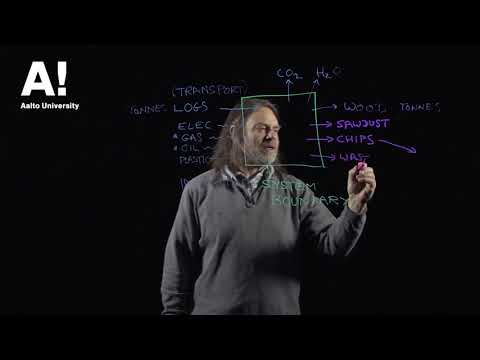
Life Cycle Assessment (12) Operation of a sawmill
Aalto University - Wood Science
4m 18s724 words~4 min read
YouTube auto captions
Transcript source
YouTube auto captions
This transcript was extracted from YouTube's auto-generated caption track. The transcript below is server-rendered so it can be read, searched, cited, and shared without opening the original YouTube player.
Pull quotes
[0:09]So, life cycle assessments are always about defining to begin with a system boundary, which sounds more complicated than it really is.
[0:09]It's just trying to decide what it is that you're analyzing and what it is that you're not analyzing.
[0:09]So, the system boundary if we're looking at a sawmill could very well be the fence that surrounds a sawmill, in which case we do have a physical system boundary here but quite often system boundaries are imaginary.
[0:09]And what we do here is we look at what's going into the system and what's coming out of the system and that helps us with our LCA analysis.
Use this transcript
Related transcript hubs
Watch on YouTube
Share
MORE TRANSCRIPTS


