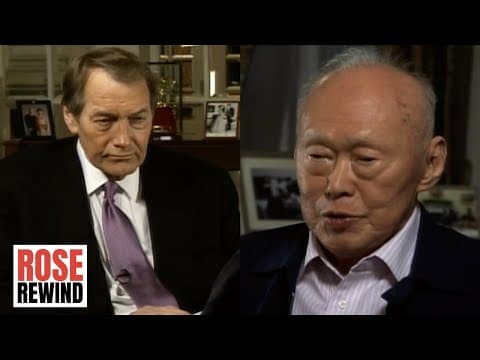
[0:06]From our studios in New York City. This is Charlie Rose. This is the Astana, Singapore's White House, except it is not a residence. It is a place for meetings. I have come here to meet Lee Kuan Yew. He is the founder of modern Singapore and a man much admired for making his city a prosperous country and an economic power. Although some criticize his methods, he has no regrets for the choices he made to build Singapore. I've interviewed him three times. He is 88 now and walks carefully. His beloved wife of 63 years Chu died last year. His son is the prime minister, the sharpness that made Singapore is very much present. I've come here like so many others to talk about the world today, about America and China, about the Middle East and Asia and about Singapore. He understands life's clock, which makes it a time to look back and to look forward. We begin with the future, which has always been his subject. How do you see it this Arab Spring? Well, the analysis that I have read, the one I find most credible is that it differentiates between Arab states that have become nations and Arab states that still remain tribal. The ones that become nations are Morocco, Tunisia, Egypt. Right. There's no Libyan nation, that's multiple tribes.
[1:46]So, when these nations change their leadership, a nation remains and the new leadership emerges.
[1:59]Not tribal, whether it's military dictator or dictatorship of civilian with a military behind it, that's like to be seen. I do not see democracy taking rule because there's no history of counting votes. So what will happen? Well, just back to this to score with the new leader. Well, but do you think that these revolutions can be hijacked? Whether it's Egypt or whether it's hijacked by whom? By people who are on the side of the of the protesters or by people like uh in Egypt's case, whether the uh Muslim Brotherhood will do well in the elections and Right. The Muslim Brotherhood is always a force underground and a free election. If they were to participate, they have never proved that they can carry the majority. But some say they're better organized than anybody else. Yeah, that's all right. They still haven't got the majority because the Egyptian population as a whole does not want a severe Muslim state. What impact if any do you think this will have on the appeal of fundamental Islamic radicalism? It will encourage radicals in other Islamic states, but the people don't think that's the solution to their problems. They don't think fundamentalist Islam is a solution to their problems. How can they solve it? You got to face the problems of the modern world, growth, jobs, and an adjustment to different social values and cultures in a globalized village. Do you think the President has explained our interest, the United States interest in this well? Well, the French have taken the French have taken the lead. They know the area well. Sarcozy has I think very courageously gone ahead regardless of what the US was was willing to do. By recognizing the rebel. Yes. I think he knows that if Gadhafi stays there, he'll have no end of problems with Libya.
[4:27]They can't let Kaddafi stay, can they? Well, they've made him a war criminal. So how can he leave without ending up in the Hague?
[4:40]So somebody has got to see him and to tweak that problem, finesse that problem. Because they cannot let him stay. I agree with that completely. If they let him stay, it'll be a two-state Libya. He with his clan and then the majority of tribes against him and constant warring. Back to the American President, is it a dilemma for us that we choose to do something where Libya's involved, but not where Bahrain is involved, or certainly not if Saudi Arabia has No, no, no, no. Those are understandable and explainable. No, no. I know Bahrain, I know Saudi Arabia, I know Libya. They're two two different categories.
[5:28]Libya is tribal with a dictator on top. Saudi Arabia is feudal with a king on top with massive oil wealth, which is used to keep its people happy. Bahrain is a Sunni a minority ruling over a Shia majority and the Shias confronted the Sunni rulers with the encouragement of Iran to to get a bigger share of power, which will have repercussions on Saudi Arabia because the oil wells to the east are all Shias.
[6:14]So Saudi Arabia intervened in a massive way and put it down. But they are two different types of problems. And I would go along with what uh has been done in Saudi Arabia and Bahrain and what is being done in Libya and in fact, I think in Libya more has to be done to resolve the problem with Gaddafi. Is there humanitarian reason to do this? The way his killed his own people has made him a war criminal. I mean, he's been branded a war criminal. So he has no choice but to fight to the end. That's right. There's no way he can buy his way out or anything else. Well, you can't see. I mean, in the end they have to do a plea bargain or who will take him?
[7:09]What does the world want from the United States in 2011? Still leadership. Leadership? Yes. Because you're the only mover and shaker with the where with all.
[7:41]Yeah, but you have said that China's intent, intent is to be the greatest power in the world. There's no doubt about that, but let me take them more than 10 years. How long would you said they'll do it they'll be the world's greatest economic power in 20 years? But that does not make them a technological power in 20 years. They'll still be behind the US. Yes, they put up a stealth fighter, but they've put a man into space. That's a prodigious effort on their part. Is the face-off between China and the United States going to come primarily in the Pacific? Is that where the struggle will be? No, I don't think they'll be a face-off in the sense of a conflict. I don't mean a military conflict, but I mean a struggle for a struggle for influence. Yes. I think it will be a subdued struggle because the Chinese need the US. Chinese need US markets, need US technology, need so that students go to the US to study US ways and and means of doing business so that they can improve their law.
[8:54]That is going to take them 10, 20, 30 years. So they quarrel with the US and become bitter enemies. All that information and all that technical technological capabilities would be cut off from them. So it would be maintained at the at the level which allows them to still tap the US. You knew Dung Sha Ping well, what would he be doing today? Would he be any different than Hu Jintao? I cannot say, I mean, because Dung Sha Ping was of a different generation. And what he says goes. I mean, the generals will not question him or political leaders will not question him. He's supreme. Hu Jintao is not supreme. So he's got to have a consensus. You know what fascinates me about the Chinese is that I read that Dung Sha Ping pretty much dictated his successors and even chose Hu Jintao. Yes. because Hu Jintao put down the rebellion in Tibet. That was effectively and that impressed Dung Sha Ping. But Jang Zeman did not want Hu Jintao. Well, Jang Zeman had other ideas. He he wanted somebody more like him. How would you define more like him? Well, more more hard-being, uh more savoir faire and able to present China to the world with a friendly face. Which Hu Jintao is hard put to do because his his You know, he's a bit wooden. He keeps his professorial smile. You don't know whether the smile of his Dane or a smile of assent. He's a different character altogether. Who do you like in the Chinese leadership today? I like them all. I have to. You have to. Yeah. But of all the Chinese leaders, the one I like to do business with is Wang Qishan. I thought you'd say that. There is talk that he may stay on even though he's 65. Well, if I were them, I'd keep him on because he's outstanding. You think state capitalism will be the model for the future? The economic model for the future.
[12:03]For China. For many countries that might want to follow China. No, no, no, no. State capitalism is not as effective as private capitalism. But you still are too, 3:00 in the morning. If it's not your company, it's state with the with the leaders I all crisis. No. So you wake up tomorrow morning knowing that your salary is intact. At least your capital and your shares, your stakes involved, and the other stakeholders also make sure that you're on the ball, or they're going to move you. You've got to stay focused. So I believe very strongly that private capitalism easily outdoes state capitalism. Define what Singapore has.
[12:59]More and more private capitalism. We started off we started off with state capitalism because we did not have the entrepreneurs. Our entrepreneurs were traders, and traders have no capital and do not have the foresight or the capability to sink in capital for many years before return comes in. So the state sent out its best officers who were entrepreneurial and started off national shipping line, Neptune Orient Lines, Singapore Airlines. We have privatized them. Singapore has a very good relationship with China. One, there's a long history, Dung Sha Ping came here to see what you were doing and sent a lot of Chinese over here to as you have described to me in other conversations. How about your neighbors? How about Malaysia? Well, they want to make friends with the Chinese too, and they're using and they're using that Chinese to learn to be the frontrunners. How about South Korea? South Koreans are the biggest student population in China. Biggest student population in China. Yeah, because their parents are opening companies there and they've got to understand the Chinese psyche and the language and the network. So the South Koreans are sending their students to China and the Chinese are sending their students to America. And elsewhere. Europe. No. South Korea. How about Indonesia? Indonesians depends on their Indonesian Chinese who go to China on their behalf. Vietnam. Vietnam is a special case. It's a long history of uh non-friendliness and their cherry of the Chinese.
[15:59]How can it tread carefully? You know that these are sensitive issues and they don't want to stir up a hornet's nest. Now, I said in that book, that I think the Malays, that Muslims should be relaxed and eat together with the others. And it created a firestorm. And your son said, the prime minister, differed with you. That's right. So were you right or was your son right?
[16:32]He has to be right because he's the prime minister. But you ask the average person in the street whether what I've said is true. And they would say? You asked them.
[16:50]You were born of well-to-do family or Well, we went poor. You went to Cambridge to law school. Did you then think that you wanted to go into politics? Yes. Because I saw no reason why the British should run the place. I competed with them. I knew them as a society, and I think given the chance, we would do better because we know the people better than they do. So you joined and help be part of an anti-colonial people's party. Yes.
[17:29]And we've done better than the British ever did. Because we mixed up the people and combined the British kept us segregated from the time Stamford Raffles built the place. He marked out areas. Chinese live here, Malays live here, Indians live here, Arabs live here. In the 19th century they were very disparate peoples and they didn't want riots. So they segregated them. But I've got to make one society out of these people. And I've got to get them to understand each other even if they don't like each other. And that's why you think it's fragile. Yes, of course. It's not it's not inside it's not in the DNA yet. It's enforced by sheer living conditions, physical living conditions and everyday intermingling. Same school, same playing field, same shopping centers, same neighbors.
[19:01]This is why you were against what they call Singlish. Yes, I still am. You still are. Yeah. Even though the youth sort of have their own language. No, it's you you want a language which you can communicate to with the world easily. And if you speak your own patois of English, you're disadvantaging yourself.
[19:27]I once went to Jamaica for a Commonwealth conference, and I'll never forget this. They took over an American holiday resort to house us.
[19:44]So all the cooks and so on were blacks and good cooks, but they spoke an acquaint accent. And so I went out to watch the fishermen bring the fish in. So I asked him what kind of fish? He said, damn spratts. I said, what's that? Damn spratts. I figured out, oh, they're spratts. Okay.
[20:20]Well, that was the result of the amalgamation of many African dialects with the slave masters' language. Now, we inherited the English language from the British. We decided in this multiracial society to make it the working language and Chinese, Malay, Indian, whatever, the second language. Are you worried today about the declining birth rate? Nothing can be done about it. Nothing. It's a lifestyle change. The women are educated. They're completely independent. They don't marry until they are in the late mid-30s. It's late childbearing. Here's my impression that you because you have shown results, believe that the Prime Minister became senior minister, became uh Minister mentor. Uh knows best what's and feels strongest about what's good for Singapore. And what worries most about threats against it.
[21:33]Yeah. What is best? I don't see Singapore continue to thrive and to prosper. And if you don't produce yourself, and you have migrants overwhelming the local population, we haven't got that yet. Today the migrants are only 30%, and I think we should never allow them to become near 50%. Then they will change us. We want them to become So what would you do to make sure they don't become 50%? Just make sure the numbers are kept down. So how would you do that? Immigration restrictions. Yes. Is that what it's going to come to? Just taking the high quality people, those with tertiary education. Do you worry a bit though that Singaporeans because of all this prosperity are becoming a bit soft? No, not soft. They're becoming self-centered or taking for granted what they're not hard working, hard driving, and enjoy life, travel, have a good time. They work hard and they play hard. They're not going soft.
[22:50]You have said with respect that they they don't feel the spur in their hide. That's because they don't think it's necessary to strive anymore. So we're already here. We have arrived. Our standard of living won't go down. Just leave it. And so what's your message to them when they say that? This needs more than an autopilot.
[23:13]You run into storms. You run into air pockets, and the pilot and the co-pilot and the spare pilots must be alive and awake and alert. I sent you word.
[23:32]I'm worried because if we if they rather, the new leaders and the population as a whole do not realize the small base on which this is built. And they take liberties with it. We could go down quickly, spiral down, a vicious circle down. Quickly. Yes. Standard of living will go up, confidence will disappear, investments will disappear. So your legacy is that you have presided over, encouraged, led this prosperity. Your developing legacy is you want to make sure that it is sustainable. I want to make sure that this place always commands confidence. Confidence brings in investments and brings in talent. With investments and talents, they will prosper.


