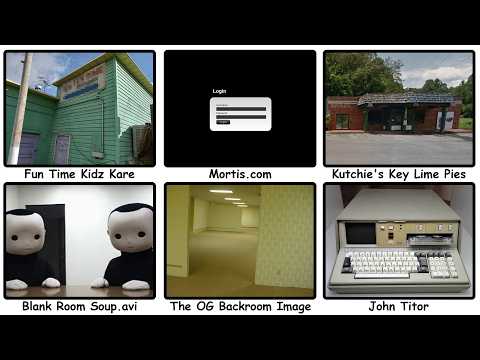
[0:00]Fun Time Kidz Kare. On a normal street in Salt Lake City, you could see a brightly painted building with neon green walls and purple doors. Above the entrance, a sign read, Fun Time Kidz Kare. At first glance, it looked like a typical daycare center, but as locals drove past it day after day, they started to notice something very strange. No one ever saw a single child playing in the fenced yard. The playground equipment sat empty and covered in dust. The windows were entirely blocked out from the inside using faded drawings and thick curtains, preventing anyone from seeing what was going on inside. Naturally, people began to talk. The mystery eventually found its way to the internet, where amateur detectives started digging into the background of the daycare. That is when things got much weirder. When people searched for the business online, they found a website that looked fake and poorly thrown together. The phone numbers listed on the site would often ring endlessly or someone would pick up and immediately hang up. The strangest clue of all came when people searched through public import records for the address. They found a shipping log showing that over 8,000 pounds of cheap plastic jewelry had been delivered to the daycare. People wondered why a small local daycare would need literal tons of plastic rings and necklaces. The internet exploded with wild theories. Some people believed it was a secret front for a criminal cartel to hide their money. Others were convinced it was a spy safe house. The most popular and disturbing theory was that the building was hiding an illegal trafficking ring. The rumors grew so huge that people started visiting the building in person to take photos, peek through the covers and harass whoever was inside. The situation got so out of hand that police and local officials had to step in and clear the air. The truth was finally revealed, and it wasn't a dark conspiracy at all. It turned out the building was purchased years earlier by a man who wanted to give his elderly mother something to do after she retired. They decided to open a real daycare. Because they did not need to make a large profit, they only took in a very small number of kids at a time. This explained why the playground always looked empty and why the business had almost no public presence. As for the thousands of pounds of plastic jewelry, it was simply a side business. The owner imported cheap items in bulk to sell online for extra cash, and he just used the large daycare building as a storage space for the boxes. Mortis.com. Back in the early days of the internet, people stumbled upon a website that felt incredibly unsettling. If you typed Mortis.com into your browser, you were met with a completely black screen. The only thing on the page was the word Mortis, which translates to death in Latin, written in plain white text. If you clicked on the word, a username and password box would pop up. People naturally wanted to know what was hiding behind the login screen, and when people started digging into the website code and the server it was hosted on, they discovered something completely baffling. The server holding the website contained huge amounts of locked files. People immediately started wild theories about what could be hidden inside. Some thought it was a secret government database. Some that it was a repository of illegal material, while others believed it was a hub for international spies. A massive group of amateur internet detectives decided they were going to crack the password and uncover the truth. They used special programs to guess thousands of passwords, but the security was surprisingly strong. So, they decided to investigate the owner of the site instead. Public web records showed the site belonged to a man named Thomas Ling. As the detectives dug into his name, they found that his server was linked to several other strange websites. One site just showed a picture of a chess piece, and another site referenced dark fantasy monsters. Even weirder, they traced the server connections to physical addresses across the country, and they found links to a dentist's office, a high-end security firm, and a lawyer. When internet users looked up the physical addresses for these businesses, many of them turned out to be empty lots or abandoned warehouses. To make things worse, some of the people listed in the business records were dead. The internet was now convinced that Thomas Ling was an alias for a criminal mastermind running a massive illegal network. The stories spread like wildfire, and soon people were claiming the FBI was investigating the site. Eventually, the website suddenly vanished from the internet completely, leaving everyone to assume the government had finally taken it down. However, years later, the real story came out, and it wasn't what people were expecting. Thomas Ling was just a regular guy who worked in IT. The massive amounts of hidden data were not government secrets or criminal files. They were simply the backups of his personal files. As for the other weird websites with chess pieces and monsters, those were just personal projects. Thomas was a fan of fantasy games and books, and he used his own server space to mess around with web design as a hobby. He chose the name Mortis simply because he thought it sounded cool. Also, the FBI never raided his house or shut down his website. When the thousands of internet detectives started trying to hack his server and sharing his personal information online, Thomas noticed the unusual web traffic. He briefly tried to tell people online to leave his server alone, explaining it was just for personal files. When people refused to listen and kept trying to break in, he simply got annoyed and took the site offline himself. Captain Kutchie's Key Lime Pies. For years, comment sections on random news articles, small blogs, and YouTube videos were plagued by a very specific, bizarre type of spam. Starting around the late 2000s, across thousands of different websites, an unknown user was leaving massive walls of text about a restaurant called Captain Kutchie's Key Lime Pie Factory. The comments were incredibly hard to read. Almost every single word was capitalized, and the sentences rambled on about wild topics. One paragraph might have talked about government conspiracies or famous celebrities, while the next would suddenly switch to praising the unbelievable taste of Captain Kutchie's Key Lime Pie. At first, people just brushed it off as normal internet spam, but as the years went by, the comments never stopped. They kept appearing on cooking forums, small local news sites, and even random art pages. Because the messages were so widespread and lasted for over a decade, people realized this was not just a passing joke. Amateur internet detectives gathered to figure out what was happening. The first major clue was the sheer volume of the comments. Many users theorized that it had to be a bot, designed to automatically post spam across the web. However, people noticed that the comments would occasionally reply directly to other users and change topics based on current events. A simple spam bot from that era would not be smart enough to do that. The mystery deepened when people started looking closely at the language. Some believed the rambling stories were actually coded messages. They thought international spies or criminal groups might be using the public comments to communicate, using the phrase Key Lime Pie as a secret code word for something illegal. To get to the bottom of it, people decided to search for the restaurant itself. Surprisingly, they found that Captain Kutchie's was a real place that used to be located in North Carolina. However, public records showed that the restaurant had closed its doors years before the weird comments even began appearing online. This discovery only confused people more. Why would a criminal ring use a closed-down restaurant as their secret code? Or if it was an advertising campaign, why try to sell pies from a place that no longer exists? Some people then suggested it was an elaborate online puzzle game created for entertainment, but usually, those games have clues that lead to an ending. These comments just went on and on without leading anywhere. Eventually, the true story surfaced. The real-life owner of the closed restaurant was a man named Oswald Pelaez, who proudly went by the nickname Captain Kutchie. By digging into his background and his public social media profiles, investigators realized that Oswald himself was the mysterious poster. There was no secret criminal code and no bots. Oswald was simply a very eccentric older man who was battling severe late-stage multiple sclerosis, with a unique personality and a very unusual way of typing. Even though his restaurant had closed down, he was still incredibly proud of the business he had built and the pies he used to bake. So, in his free time, he would browse the internet, read random articles, and manually type out his thoughts. He liked to mix his personal opinions on the world with fond memories of his famous Key Lime Pie. He did this for years, simply because he enjoyed it. Blank Room Soup.avi. If you spent time exploring scary videos online years ago, you might have seen a famous clip titled Blank Room Soup. The video is very low quality and shows a man sitting alone at a small table in a completely white room. He is eating out of a large bowl using a big spoon. As the video plays, you can hear the man crying heavily. Suddenly, the door opens and two people walk into the room. They are wearing large, dirty mascot costumes that look like cartoonish people with giant round heads and blank expressions. One of the mascots slowly walks up behind the crying man and begins patting him on the back to comfort him. The man just keeps crying and eating his soup. The video feels incredibly creepy, and because there was no explanation attached to the video, people started to guess what was happening. The most popular and scary theory was that the man was a kidnapping victim. Some internet users claimed the video was found on the Deep Web. They guessed the man was being forced to eat something terrible, and the people in the costumes were his captors mocking him. People tried to figure out where the room was and who the mascots were. Eventually someone recognized the giant mascot heads. They were characters named RayRay, created by a professional artist and animator. When internet detectives contacted the artist, he told them he had created the costumes for a live stage show, but shortly after the show, the costumes were stolen from his vehicle. A few weeks later, he received an anonymous email containing a link to the strange soup video. This made the mystery even more terrifying. The artist said he did not know the crying man and had no idea who took his costumes. For years, the video was seen as the recording of a real crime. However, some people kept digging, looking for any clue they might have missed. They looked closely at the room and the way the video was filmed. They noticed the camera was set up on a steady stand, and the lighting in the blank room was actually very professional. Slowly, a theory that many believed to be the true story began to emerge. The artist who made the costumes continues to claim they were stolen, but many think he and his friends deliberately created a strange and confusing video. You see, the artist's sister is in a theatrical rock band called Stolen Babies, and he himself was heavily involved in the band's theatrics. The RayRay costumes frequently appeared in their live shows and promotional material. This led people to theorize that the video was a marketing stunt or an art project. They filmed it in an empty room, posted it online, and waited for people to discover it. There is no fully confirmed truth, but this is what many people believe today. Some, however, still think the footage is simply the work of fans or artists who used the stolen costumes to create a surreal video. The original backroom image. In 2019, an anonymous user on 4chan posted an unsettling photograph of an empty room with yellow wallpaper, old carpet, and fluorescent lights. Along with it, they wrote a short story about no-clipping out of reality and ending up in a maze of empty rooms. This post sparked a massive internet phenomenon, known as the backrooms. As the legend grew, a real mystery emerged. No one knew where the photo was actually taken. For years, reverse image searches failed because the original source was buried under millions of reposts. People theorized the image was generated on a computer or a secret room in an abandoned office building. The mystery seemed impossible to solve until a group of internet researchers on a Discord server changed their strategy. Instead of just reverse searching the image, they looked for its digital fingerprint. They found an early archive of the 4chan post from 2011, which revealed the original file name. This pointed to the photo being taken by an early 2000s Sony digital camera. The researchers began searching for this specific file name, and a researcher found a 2019 tweet that had linked to a defunct website for a store called Hobbytown in Wisconsin. Because that website was long gone, the team used the Wayback Machine to look at captures of the site from 2003, and the truth was finally revealed. The photo was taken inside a building that used to be a furniture store. The store was being renovated to become the Hobbytown shop, and during the construction, the owner snapped a series of photos to document the progress of the renovation and uploaded them to the shop's website to show customers the new space. John Titor. This case is unusual as it would normally be dismissed as someone lying, but the facts align so well that this was not the case. In the early 2000s, a user named John Titor appeared on internet message boards with a very weird claim. He said he was a soldier from the year 2036, and claimed he was on a military mission to the year 1975 to pick up a specific vintage computer called the IBM 5100. He explained that he only stopped in the year 2000 to rest and visit his family. When users asked him questions about the future or how his machine worked, he gave highly detailed scientific answers. He even posted photos of his time machine. It was a heavy, ugly metal box, stuffed into the back of a normal car, complete with printed caution labels and confusing instruction manuals. However, the biggest reason people believed him was something else. John said his future timeline needed the old IBM computer to fix a massive software bug. He claimed that specific machine had a hidden hardware feature that allowed it to translate very old computer languages. When computer experts read this, they were shocked. It turned out that the IBM 5100 actually did have that exact secret feature. Only a very small handful of high-level computer engineers knew about it, and because internet searches were still very basic back then, it seemed impossible for a random person to know such an obscure piece of technology history. John also made several dark predictions about the future, and after answering questions for a few months, he announced his mission was over, logged off, and was never heard from again. For years, people debated if he was actually real. However, as time went on, his terrible warnings about wars or destroyed cities didn't come true. But how did he know about the IBM 5100 feature? People began searching for clues. Then, a few years after John vanished, a company called the John Titor Foundation appeared and published a book collecting all of his internet posts. Investigators managed to track down the business records for the foundation, and they discovered the leader of the company was a man named Larry. Then they looked into Larry's family, and they found out that his brother was a highly experienced computer scientist. Suddenly, for many, the entire mystery made perfect sense. The theory was that the two brothers had teamed up to create the ultimate internet character, and that the computer expert brother used his deep knowledge of vintage technology and physics to write highly believable scientific posts. Larry and his family have consistently denied and still deny being behind John Titor, but many people still believe they were involved, even though there is no definitive confirmation. If you want to discuss this video or suggest an idea for the next one, join my Discord.
13m 40s2,839 words~15 min read
YouTube auto captions
Transcript source
YouTube auto captions
This transcript was extracted from YouTube's auto-generated caption track. The transcript below is server-rendered so it can be read, searched, cited, and shared without opening the original YouTube player.
Pull quotes
[0:00]On a normal street in Salt Lake City, you could see a brightly painted building with neon green walls and purple doors.
[0:00]At first glance, it looked like a typical daycare center, but as locals drove past it day after day, they started to notice something very strange.
[0:00]The windows were entirely blocked out from the inside using faded drawings and thick curtains, preventing anyone from seeing what was going on inside.
[0:00]The mystery eventually found its way to the internet, where amateur detectives started digging into the background of the daycare.
Use this transcript
Related transcript hubs
Watch on YouTube
Share
MORE TRANSCRIPTS


