[0:00]In every great restaurant, there's a secret behind the perfect steak. They don't just decorate, they define the dish. From big and bold to delicate and light. These are the steak sauces every chef needs to learn. Okay, first sauce up. Probably one of the most well-known steak sauces out there. We're going for Bernaise. This is an absolute classic. When it's done nicely, it's super delicious, very rich, definitely like a special occasion sort of sauce, especially if you want to look after your heart and your waistline. Okay, to kick things off, start my butter clarifying. Couple of blocks of butter into a pan, and I'm just going to put it on the lowest setting that I can. What's going to happen is the butter is going to separate. The milk solids and that like wishy like sort of weigh liquid is going to go to the bottom and the butter will rise to the top. I like the texture of the slots in the Bernaise. So what we're going to do here is we're going to really finely dice our shallot and then we're going to add it to our vinegar and our white wine and reduce it down and then leave the slots in there. You just get the nice natural flavor of the shallot and it adds a little another level to your sauce. The story goes that this sauce was actually created as a drunken mistake. The traditional hollandaise you can make with just lemon juice. The story says that the chef was drinking too much wine during the service. And instead of grabbing the lemon juice, he grabbed the white wine and the tarragon and the vinegar, um, by mistake, instead of using the lemon juice and served it anyway because he was absolutely rat asked. And then his guests loved it and hence the sauce then stayed on the menu. Okay, so I've got my finally brunoise uh shallot. My To my shallots, I'm going to add my white wine. We're going about two parts white wine to one part vinegar. So I've got a couple of pasty stalks here. So as you can see, my butter is now separated. I've got the lovely yellow uh color of the butter there that's risen up. So I'm going to remove that and I'm going to put my reduction onto the stove and then turn the heat up and reduce that down. And we're going to reduce that by about 80 to 85%. Okay, so now I'm just going to pour off my clarified butter into this pan. The the fat is pouring off the top. And you're left with the white watery milk solids in the bottom of the pan, which you can see there. So as you can see, there's your clarified butter and there's your milk at the bottom. So we're going to discard that and then we'll use this to make our hollandaise. While my reduction is just finishing off, I'm going to separate my eggs. We need the egg yolks for the Hollandaise. I'm actually going to go four eggs cuz these are looking quite pokey-nyah. And still got a little I've got the lovely shallots in there. It's still got a little bit of liquid. Importantly, I'm going to remove my peppercorns, which is a bit of a ball-ache step. There's different I mean you could obviously put crack pepper in there if you wanted. You could put the peppercorns into a little sachet, I just into like a little muslin cloth or something, but to be honest with you I just couldn't be bothered. And also going to remove our stalks. This is our bain-marie, and this is how we're going to cook the Hollandaise. Then with this reduction you can almost add as little as much as you like. You need a good amount I personally, so I'm going to go with two tablespoons. Want to make sure you get a nice bit of that liquid in there. This is the tip to make sure your Hollandaise does not split. Some people will say, oh you should be able to do it without but I don't really see why you wouldn't put it in. And that's a spoonful of boiling water. The boiling water helps to stabilize it and helps it stop from splitting. Over the pan of boiling water and then start to whisk. Now you need to make sure you get all around because obviously the egg is going to start to cook now. So as you can see now we're getting somewhere. This is nice and thick, lovely and sort of light and white in colour and it's now holding its shape. Just sits nicely on the top there. Just going to trickle feed my butter in slowly at the start and obviously once you've got the emulsification made, you can then go a little bit faster. So you can see how this thickens up really quickly. Just going to add our tarragon. So here we have beautiful ribeye on the bone aged for 40 days. Going to carve them off the bone. That's the thing about Bernaise. I always feel like I I will always order Bernaise as a default. I'd always go Bernaise sauce because it's also so good for chefs. Wait you try the others. Hey, we're in for a treat. This is the one of the backbones of the fallow kitchen this, red wine sauce. We go through about seven or eight litres of this sauce a day at fallow. So to start off with this, we're going to take our trimming from our lovely beef. We're going to roast off the trim first just in a nice pan. So keep that ticking over. While that's done, I'm going to roughly cut my shallots. Place that into the pot straight away as well. And I've got some thyme, bay leaf. The reason we're cutting everything down is to extract as much flavor from it's possible. The caramelization on the beef is going to add the roasted flavor into our stock. And you obviously got the shallots. It's going to add some sweetness and then you've got the aromatics here which are going to infuse into the sauce. As you can see here, my shallots are starting to caramelize down, the beef's caramelizing as well. It's one of those things with the sauce, the more love you put into it, the better result you will get. So next I'm going to go in with my garlic and then I'm going to place my hard herbs on top as well. I like to roast off the hard herbs slightly. The smell that comes off it when you're roasting is next level. A bit like anything, a lot of people to forget to season sauces. We're going to leave the heat on high. We're going to add our wine. Now, you can use any wine. It's one of those things wines in sauces. You know, the better quality wine you put in, you are going to get a better product. But the difference between using something really premium and something average, it's not going to make that much difference. So, the red wine has reduced right down. So there's barely anything left in the pan. Turn the heat down slightly and then we're going to go in with our stock. So we've gone in there with about 250 mil of chicken stock. Dark chicken stock and another 600 mils of the reduced beef stock. And we're just going to bring that up to a simmer to emulsify everything together, and then leave it to simmer for a few minutes. My sauce has been reducing slightly and then we're just going to squeeze out all the flavor out of those ingredients there. Ah, flavor! Just going to give it a little taste and adjust the final seasoning. So, a touch of red wine vinegar. And then we are going to emulsify in just a few cubes of butter which is just going to help to give this the sauce a really nice gloss. We're going to do that when the sauce isn't super hot because otherwise it'll just split out. And then our sauce is ready. So what have you been up to then, chef? Our next sauce, red wine sauce. Fantastic. Simple, elegant, full of flavour. In terms of like my death throw steak sauce, it's more towards the lower end of the scale. I want this with Bernaise. That's cuz you're a greedy bastard. Would you ever gnaw the bone in a restaurant? I always find it gets in my teeth a bit. Oh, really? No. Nice. Great work, chef. Thanks, man. Hey, see you for sauce three. The famous chimichurri. Originating from Argentina and Uruguay. This sauce is our only sauce not from France, interestingly enough. Simple to make, but really delivers on flavour. We're going to keep it quite simple and traditional for this recipe. So just going to finally shiffonade our parsley. That's going to go into our bowl ready for mixing. So the name for this uh sauce, it's got a couple of couple of stories. The one I like the most was the one that says it was from a Irish English immigrant named Jimmy McCurry. And it was said that the the locals couldn't pronounce his name, Jimmy McCurry, and then that turned into chimichurri. Believe it if you will, but it's still a good story nonetheless. Other stories, Spanish Basque translation that sort of roughly translates to a mixture of things in no particular order. It probably sounds the most believable. So, red chili next. Julianne that before we finally dice it. So the garlic I'm going to go in with um a lovely microplane here. Two thirds of that. So I'm going to go in with a little bit of salt. Good couple of twists of pepper. And then our vinegar. So it's about two, sorry, three parts oil to one part vinegar. Summer in a bowl. I'm going to hit it with a touch of lemon, just cuz that vinegar is very good quality. So it's a little bit sort on the sweeter side. You want that little freshness from the lemon. Oregano. So it's going to season it with a slight sprinkling of oregano. Hey, Jimmy McCurry. We are on a journey to South America. Wow. It's banging. It's really good. It's very garlicky. That raw garlic intensity, very delicious. It deserves a shoo-in, for sure, deserves a place within the within the other big boys, but this might just be a bit more seasonal. Right, next sauce. We are off to Geneva this time. Geneva. Before we're doing Café de Paris? Stay tuned. You'll figure out more. Café de Paris butter. A sauce that's very famous, everyone knows it. It's what um, you might have heard of as a as a compound butter. So the basis is is softened butter with loads of different flavourings, basically. So we're going to start off with some finely minced shallot. Somebody called Mr. Boobier in Geneva. He had a restaurant called cock door and he actually passed the recipe down to his daughter and he owned the Cafe de Paris. And hence where the sauce got got its name. They changed the whole menu to only serve sirloin steak served with the Café de Paris butter. Finally chopped some anchovy and half a clove of garlic. Just going to roughly slice. And we're going to chop those together just to get them a bit finer. Goes in there with our shallot. Next up, we've got our herbs, so we've got some parsley and some tarragon. Again, you get the theme here. Nice and finely chopped. So this sauce is obviously quite an influential sauce because it's not necessarily every restaurant will be using this sauce. But the the idea of of sort of doing flavored butters as garnishes and sauces for different things, fish, meat is is a very is a is a trend that's been sort of carried on through years and years of cooking and still very prominent in in kitchens to this day. So we got lemon juice and then next we're just going to season this up. There we have a baseline quantities, but obviously it's it's all down to preference on this and you can add as as much or as little of each one as you like. So we've got mustard and then we're going to go in with our paprika and curry powder. Before then adding our softened butter. You may feel like you're adding a lot into this butter, but it's going to be diluted and and it's going to sort of melt over the steak. And almost mix with all the juices and the fat that come off the steak. So you want it to be quite strong in flavour. We're going to season that with a bit of pepper, touch of salt, not too much cuz we've added a few salty ingredients in there. So you might have heard of a cowboy butter, which is the American version, which is pretty much a similar thing but it just doesn't doesn't have the anchovy. There we have it. Café de Paris butter. Oh, wow. You can't get much more flavor in that, let's be honest. Anchovy, mustard, wooster sauce. I can see why this has stood the test of time and I can see why the Americans even took it themselves and bastardized it. Chef, have I got a treat for you next? What's up? Straight from the Papa Kross repertoire de la cuisine. My favorite sauce of all time. Steak poivre, peppercorn sauce. The one you've all been waiting for. I'll see you shortly. The absolute classic peppercorn sauce, or steak au poivre. This one is close to my heart. This actually is the one that my dad taught me to make. Whenever I see other people's, I'm never a big fan of. Everyone always makes it too creamy in my opinion. So, I'm going to show you what I think is the best peppercorn sauce. Steak au poivre will be you where you you do coat your steak in pepper, cook the steak and then make your sauce afterwards. Whereas peppercorn sauce is more than the entirety of the sauce. So, again, as you can imagine, most of these sauces is very similar. Going to start off with some nicely fine brunoise shallot. Doesn't need to be sort of as neat and fine, but for this one, it can be a little bit rougher cuz we're going to cook it down a bit more. We're going to start off a preheated dry pan. Brandy, some butter, some garlic. I like to keep the garlic larger like slices that you can leave in. I think it has quite a nice effect. So you can grind this out your peppermill. Turn the heat down nice and low. And then we're going to go in with the pepper first. We've gone in with a little bit of chunkier pepper um to start with. And then I'm also going to go in open up my peppermill and go in with some sort of fresher ground pepper on a larger setting. So you get so you get some different sort of levels of pepper. If you just use pepper out of here it gets a bit it can be a bit too um a bit too fine wishy washy, but some of those big flex of pepper roasted off gives you that nice intense heat that you want. So you're going to roast it off nicely in a dry pan until you get that until you get that heat of pepper in in your face and up and up your nostrils. A lot of people never toast the pepper hard enough, but you can you can almost feel it in the back of your throat. And similar to the hollandaise, do want a nice low heat. Gently toast the pepper. So this stage now we're going to go in with some butter. And onto the butter, then we're going to add our chopped shallots. So we're going to cook the butter down with the shallots in there, probably for about three to five minutes. Just to nicely soften the shallots. The garlic won't take anywhere near as long to uh to cook. So once my garlic is nicely soft, the shallots have been caramelizing beautifully. This stage, I want to clean the side of the pan to make sure nothing is on the side while we flambé the brandy. So once the once the flame has burnt off, then I'm going to turn the pan down. At this stage I want to be careful not to burn the shallots or the garlic on the side of the pan. That's why we clean it. As long as that alcohol reduces down it's going to have the same effect. The flame is just for a bit of a laugh. So we're going to go in with some double cream next. Keep it on a bit of a lower heat now, once the brandy has reduced down to a nice glaze. Reduced beef stock goes in. We're going for about probably two parts beef stock to one part cream. Because it although you might have a recipe, all ingredients react differently on different temperatures. And more importantly, just learn to taste them. Taste what you're looking for. Taste the taste. Doesn't need more acidity, doesn't need more cream. Going to go in with my green peppercorns. These are just green peppercorns that are in brine. So again, they're going to add a nice little bit of texture when you bite into them. And then I'm just going to season it with a bit of freshly ground black pepper as well. You just getting that different notes of pepper. A bit of lemon juice. So, just a little touch of parsley to finish. Just nice. Just going to keep it a bit rougher this time. Chef, you couldn't have waited for a better one to finish, hey? An absolute classic. Absolute classic. When did your uh dad teach you this recipe? How old were you? Four. I want to say like maybe 10, 10 to 12. What? Is this the best sauce for steak? Smells incredible. It's good. So good. Has to be the ultimate steak sauce. Yeah, I think so. It's got the acidity. It's got the heat. We're talking ultimate steak sauce. Has to be. You're right, you're right. This is a special occasion steak sauce. It's not your chimichurri barbecue sauce. We all agree this is number one, but what takes the second spot? Bernaise. And then your chimmy, your red wine sauce and your Cafe de Paris depends on the mood. Let's know if we missed any sauces. Flavor boys out.
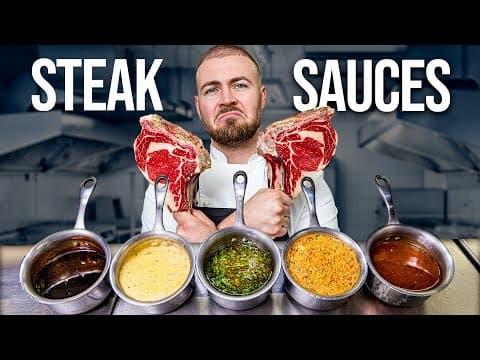
The 5 Steak Sauces Every Chef Needs to Learn
Fallow
15m 0s3,174 words~16 min read
Auto-Generated
Watch on YouTube
Share
MORE TRANSCRIPTS